In India, the quality and safety of products are legally binding and not negotiable. The manufacturers should make sure that their products meet some Indian Standards before they are allowed to enter the Indian market. To have an ISI mark is not only a legal requirement but also enhances credibility in the market, avoids hefty fines, and provides easy access to the Indian market for industrial and electrical products.
Although the regulatory environment might be considered quite overwhelming, the initial step towards a successful market entry is to understand the framework.
Why Does Your Business Need ISI Certification in India?
The ISI Mark Certification in India, run by the Bureau of Indian Standards (BIS), is an assurance that products are in compliance with the safety and quality standards provided by the National Standards Body of India.
- Legal Compliance: The legal obligation of manufacturers is not to sell, import or distribute notified products in India without complying with the mandatory BIS standards.
- Consumer Trust: It is a visual representation that the consumer is being given a safe, reliable and quality assured product.
- Market Dominance: This mark is legally required on several hundred products, such as steel, cement and electrical appliances, to enter the Indian marketplace.
How to apply for an ISI Certificate?
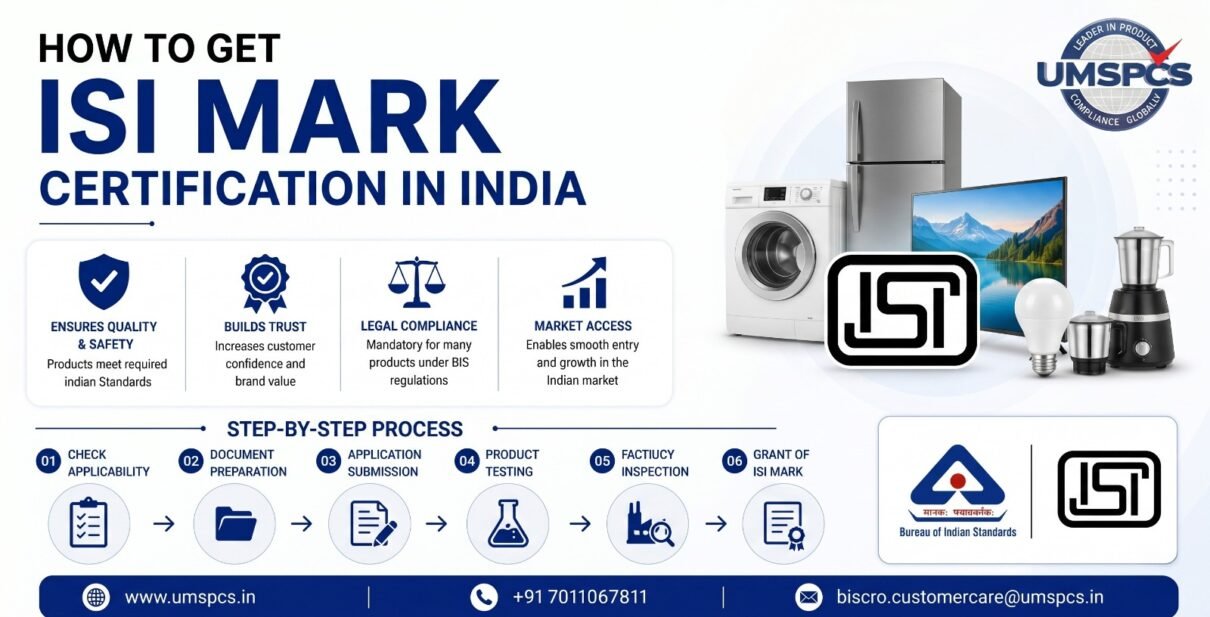
An ISI license is usually issued within 30 – 40 working days in case of standard applications. The following is the way to go in approval:
- Unit Alignment: Determine the Indian Standard (IS) that is applicable and modify your production line to meet it. This includes setting up an in-house laboratory.
- Filing and Documentation: Prepare technical files and have your product tested in a BIS-recognised lab. The application is done through the online BIS portal.
- The BIS Factory Audit: An official will come to your plant to audit production, quality control and testing capabilities. Random samples are independent and tested (sealed).
- Independent Testing: The sealed samples are sent to an accredited lab, which in turn sends a Lab Test Report (LTR) to BIS.
- Handling Deficiencies: In case any of the Non-Conformities (NCs) are detected, the manufacturer is obliged to take corrective measures as soon as possible.
- Final Grant of License: When all the standards are satisfied and the final fees have been paid, then the ISI License is officially granted.
The Documentation Blueprint: What You’ll Need to Prepare
To receive a BIS ISI Mark Certification in India, you would need to prepare a strong technical dossier that would comprise:
- The fundamental data of the production plant and the type of product
- Evidence of address (ownership/lease deed, utility bill, etc.) to the manufacturing unit address
- Registration certificate, Trademark registration certificate (when brand name is used and registered)
- Manufacturing license / statutory approvals (where applicable) (e.g. pollution control, industry-specific approvals, etc.)
- Product drawings/design schematics
- Installed manufacturing capacity
- List and specifications of raw materials used
- Details of manufacturing machinery and equipment
- Plan of factory layout (including production, testing, and storage space)
- Flow of the manufacturing process in detail
- Table of test equipment and calibration in-house
- Information on quality control staff
- Factory organisational chart
Products Under BIS ISI Mark Certification in India
As of now, there are the following products that need to be registered with BIS and require BIS Registration to manufacture, import, and sell the product in the INDIAN market. The following are the main products that we cover:
- Electrical and Electronics: Electric irons, room heaters, LED lamps, switches, circuit breakers (RCCBs) and PVC cables.
- Construction Materials: White Cement, Ordinary Portland Cement (OPC), Portland Pozzolana Cement (PPC), and masonry Cement.
- Automotive Components: Tyres, safety glass and wheel rims.
- Consumer Goods: Milk powder, infant foods, dry batteries and kitchen appliances.
- Industrial Equipment: Steel products, transformers and heavy machinery.
UMSPCS offers end-to-end certification on more than 500+ products, and in each major industry.
Budgeting for Success: Understanding the Cost Structure for ISI Mark Certification in India
The overall cost of certification includes government charges, laboratory costs, and expert advice.
| Particulars | Estimated Cost (INR) |
| Application Fees (BIS) | ₹1,000 |
| Testing Charges (Lab Fees) | ₹15,000 – ₹2,50,000 |
| Factory Inspection Charges | ₹7,000 |
| Annual License Fees | ₹1,000 |
| Marking Fees | Based on production volume |
| Consultancy Charges (UMSPCS) | ₹50,000 |
ISO vs. ISI: Which One Truly Matters for Your Product?
They both are quality benchmarks, but they serve different masters:
- ISO (International Organisation towards Standardisation): It is concerned with the management system. It is an international standard of the way the company is operated and is generally voluntary.
- ISI (Indian Standards Institution): It is concerned with the physical product. It is a legal requirement that is mandatory for many industries in India.
- The Verdict: When your product falls into the mandatory list, ISI is the first choice of legal entry into the market.
Avoiding the Pitfalls: Why Applications Get Rejected
Some common causes of rejection are:
- Poor or incomplete technical documentation
- The product sample failed in an independent laboratory test
- The deficiency of proper in-house testing equipment in the factory audit
- The inability to correct Non-Conformities (NCs) during the specified period
Why choose UMSPCS for ISI mark certification?
UMSPCS has over 600+ successful projects, making it a reputable leader in the BIS Certification as a consultancy. We offer end-to-end support of specialised standards for the ISI mark, which guarantees that your business remains compliant without the technical burden. It is all taken care of by our professionals, so that the process of certification is smooth, fast and successful.
We are your one-stop shop for the BIS ISI Mark Certification in India, which includes:
- End-to-End Handling: This is between a normal identification and the ultimate issuance of a license.
- Audit Readiness: We guarantee that your factory is 100% ready for the visit of the BIS authorities.
- International Experience: Specialised assistance to the local manufacturers as well as BIS Certification for Foreign Manufacturers (FMCS).
Conclusion
Obtaining the ISI Mark is not all about placing a logo on a box; it is a serious commitment to quality that can open the huge potential of the Indian market. Although the regulatory obstacles may be tricky, they play a crucial role in helping to guarantee consumer safety and industrial integrity.
By following the right procedures and engaging a professional consultant such as UMSPCS, you can safely go through the steps to comply in a matter of record time.
Ready to start your certification journey?
Call UMSPCS today at +91 7011067811 to get expert help and a tailor-made quote to have your ISI mark certification.
Read more about: BIS Certification and Standards for Electronics: Guide 2026
FAQs- Get ISI Mark Certification in India
- How long does it actually take to get an ISI Mark certificate for a factory?
Indian manufacturers usually spend 30 – 40 working days on it, as long as documentation and lab tests are correct.
- Are foreign manufacturers compulsory?
Foreign manufacturers can apply through the FMCS scheme, and they appoint an Authorised Indian Representative (AIR), such as UMSPCS, to manage all local regulatory requirements and ensure successful certification in India.
- What is the main reason to reject an application?
Incomplete documentation or product samples that do not pass independent laboratory testing are the most common reasons.
- What is the difference between ISO and ISI?
ISI is a compulsory product-related quality label for selling in India, whereas ISO is a voluntary management standard.
- Do I require a lab in-house?
Yes, the majority of Indian Standards (IS) require manufacturers to possess certain in-house testing equipment to sustain continuous quality control.
- How much total investment should I budget for ISI Certification?
The cost will depend on the product, but will include a 1000 application fee, laboratory testing fees (up to 2.5 Lakh), and consultancy fees.
- Can I sell my product as the application is pending?
No, you are only allowed to use the ISI mark and sell the products that have been notified after the official license is given by BIS.
- Why do I want to hire a consultant such as UMSPCS?
We provide first-time-right documentation and mock audit, sparing you the exorbitant cost of delay and re-testing charges.
❓ Ask a Question
Have any doubts? Fill the form below and our team will respond shortly.