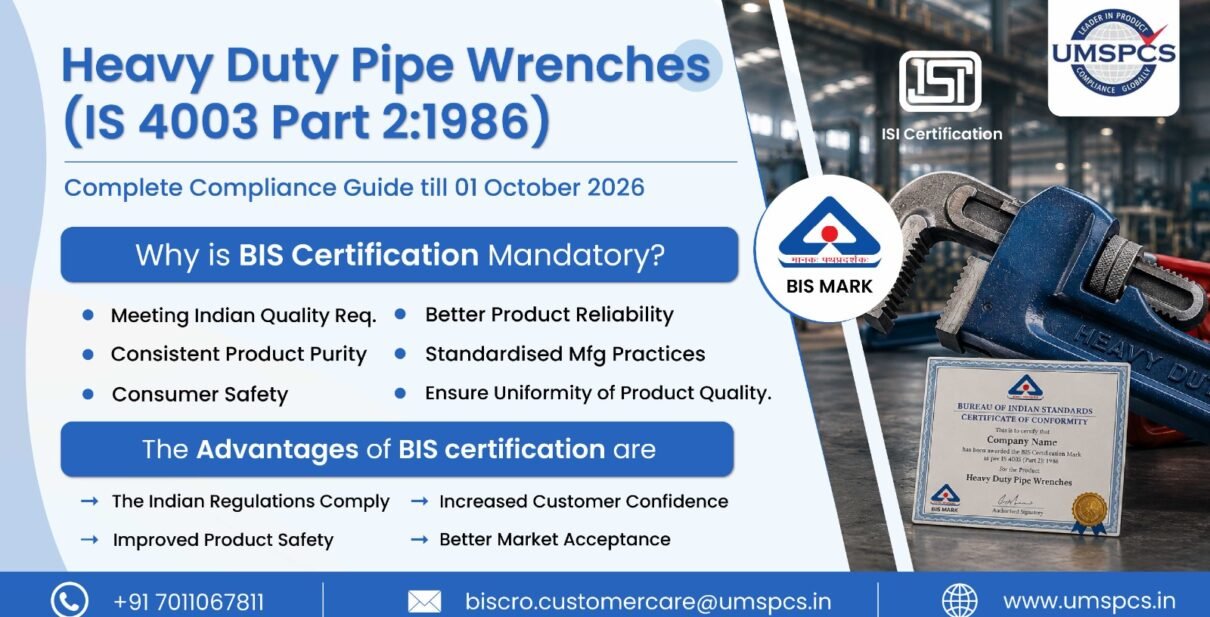
An important regulatory modification is on the horizon if you’re involved in the manufacture, import, or supply of heavy-duty pipe wrenches in India. Heavy-duty pipe wrenches, as per the Hand Tools (Quality Control) Order 2025, notified by the Department for Promotion of Industry and Internal Trade (DPIIT), will be subject to mandatory BIS certification from 01 October 2026 as per the notified timeline of implementation.
After the applicability of the Quality Control Order (QCO), manufacturers / eligible importers for notified products are required to adhere to Indian standards and must secure the BIS license prior to introducing the products into the Indian market. The Standard Mark (ISI Mark) is to be affixed to the products under the order in accordance with the BIS license.
This guide will help you learn about Heavy Duty Pipe Wrenches (IS 4003 Part 2:1986) , their requirements, importance, and what businesses should do for BIS certification. UMSPCS helps Indian & foreign manufacturers in getting BIS Certification for Heavy Duty Pipe Wrenches in a structured manner.
What is BIS Certification for Heavy Duty Pipe Wrenches?
The Bureau of Indian Standards is the national standards body of India for the development of Indian standards and running product certification schemes. Manufacturers who wish to sell or import the products covered by mandatory quality control orders must have a BIS license prior to manufacturing or selling/importing the product to India.
The Heavy Duty Pipe Wrench is covered by Indian Standard IS 4003 (Part 2):1986 for this type of hand tool. The standard sets out the technical and quality requirements to be satisfied when making products for certification.
After the applicable BIS certification requirements are successfully completed, the manufacturer is granted permission to put the ISI Mark on certified product. The ISI mark is an indication that the product is in compliance with the applicable Indian standard and has been certified by the relevant BIS scheme.
What Are Heavy-Duty Pipe Wrenches?
Heavy duty pipe wrenches are hand tools that are designed to turn large-diameter pipes and other large parts that require considerable torque in order to install or maintain them. These are strong tools that are made using high-strength materials, as compared to ordinary pipe wrenches.
These tools are commonly used in industries such as the following:
- Oil and gas
- Water Distribution and Pipeline projects
- Petrochemical plants
- Heavy engineering
- Construction and infrastructure
- Power generation
- Industrial maintenance
- Manufacturing facilities
These are often used in critical industrial processes, and ensuring their consistent quality and performance is vital for safe and reliable usage.
Why is BIS Certification Mandatory?
The Government of India issues Quality Control Orders (QCOs) to enhance the quality of the product, ensure consumer safety, and ensure that notified products meet Indian standards prior to entering the market.
The requirement for mandatory BIS certification of heavy-duty pipe wrenches is to ensure that products falling under IS 4003 (Part 2):1986 conform to the specified technical requirements and guarantee uniformity in quality.
Mandatory certification helps:
- Ensure uniformity of product quality.
- Enhance safety when working with machinery or equipment.
- Minimize distribution of inferior products.
- Promote fair competition between compliant manufacturers.
- Build buyer, contractor, and institutional buyer trust.
- Promote compliance with the specified Indian Standards.
Having a certification also gives manufacturers and importers a commitment to quality and a boost for business expansion in regulated markets.
Who Requires BIS Certification?
In most cases, the responsibility for getting BIS certification would lie with the entity importing the notified product to the Indian market.
It can be, such as:
- Indian manufacturers.
- Heavy-duty pipe wrenches are imported from abroad by manufacturers in India.
- The importers of notified products.
- Regulated products distributed by a brand owner under its own brand name.
- Original Equipment Manufacturers (OEMs), as appropriate.
Before onboarding businesses into the certification process, it is important to ascertain whether the product falls under the applicable Quality Control Order and the relevant Indian Standard, namely IS 4003 (Part 2): 1986, is applicable.
Heavy-Duty Pipe Wrenches vs General Purpose Pipe Wrenches: Understanding the Difference
There are some general misunderstandings among manufacturers that they need to understand the difference between the general-duty pipe wrench and the heavy-duty pipe wrench.
The two tools have similar functionality but have different specifications around where they can be used and are regulated under different Indian standards.
General-purpose pipe wrenches are designed for basic plumbing, repair, and light industrial uses that require moderate gripping strength.
Heavy-duty pipe wrenches, on the other hand, are engineered for heavy-duty industrial applications that demand the use of larger pipes, increased torque, and more demanding operating conditions.
Accordingly:
- IS 4003 (Part 1) is applicable to general-purpose pipe wrenches.
- Heavy-duty pipe wrenches are covered by the following Indian standard: IS 4003 (Part 2): 1986
Applying to the wrong product classification is the first step that can delay and cause more compliance requirements; it is important to get it right the first time.
What If You Don’t Comply After 01 October 2026?
Heavy-duty pipe wrenches subject to IS 4003 (Part 2):1986 will need to meet the requirements of BIS before being manufactured, imported, or sold in India once the relevant implementation date for the standard becomes applicable.
If not done, it could lead to:
- Failure to have legal manufacturing or importing capabilities of the notified product.
- Prohibition on selling non-compliant products in the Indian market.
- Failure in product launch and commercial supply.
- Disruption in business because of the failure to comply with regulations.
- Missed opportunities in government departments, institutional buyers, and a large industrial customer base that prefers compliant products.
In enterprises with long production cycles or international supply chains, it is possible for the delay of certification to have a significant impact on the availability of the market and inventory planning.
Procedure for BIS Certification for Pipe Wrenches
The procedure of receiving BIS Certification for pipe wrenches (IS 4003 Part 2:1978) consists of various clear steps. Here is a simplified procedure given as follows:
For Indian Manufacturers (ISI Mark Licence)
Application Submission
Submit your application for registration at the BIS Portal, available at the Manak Portal, in accordance with all necessary details concerning your business and products. Attach relevant documents.
Testing of Product Samples
BIS will instruct you to submit your product samples to the laboratory approved by BIS. These samples are analyzed based on IS 4003 (Part 2):1978 standards, including jaw strength, dimensions, materials, etc.
Factory Audit
An officer from BIS will pay a visit to your factory in order to analyze your process of manufacturing, quality control system, testing facilities, etc.
Grant of Licence
BIS issues an ISI Mark license in line with a separate CM/L number when your product passes testing and your factory satisfies BIS requirements.
Marking & Selling
You can now stamp or label your pipe wrenches in line with the ISI Mark and sell them lawfully in India.
Surveillance & Renewal
BIS performs periodic factory visits and random market sample testing. Licenses are renewed consistently, which gives constant compliance.
For Importers (Foreign Manufacturer Certification Scheme)
Appointment of Authorised Indian Representative (AIR)
Foreign firms must appoint an AIR in India to continue with BIS on their behalf.
Application Submission
Submissions must be made using the BIS FMCS website, according to the product information, company papers, and factory information.
Testing of Sample Products
Samples of the products are tested in laboratories that have been approved by BIS in India or in labs overseas.
Inspection of Foreign Manufacturing Facility
BIS inspects the foreign manufacturing facility before issuance of the license.
Issuance of Licence
The ISI mark license is issued to import and sell the products in India.
Documents Required During BIS Certification for Pipe Wrenches
When applying for BIS Certification for pipe wrenches, you are required to upload the following documents, which are as follows:
For Indian Manufacturers
- Certificate for Business Registration
- Certificate for GST Registration
- Layout of the factory and proof of address
- Process of manufacturing and the flowchart
- Machinery and testing facilities available in-house
- Drawings and technical specifications in accordance with IS 4003 (Part 2): 1978
- Test report from the laboratory approved by BIS / NABL accredited lab
- In-house quality control plan/testing process
- Letter of authorization
For Importers / Foreign Manufacturers
- Company registration and legal entity documents from the country of origin
- Authorisation letter appointing an Indian Representative (AIR)
- Product technical standards and drawings
- Sample test reports
- Factory details and quality management documents
- Import-export documents and IEC Code
- Brand ownership or trademark proof
Read more about: BIS Certificate for Foreign Manufacture
Common Production Issues Affecting Manufacturers
Delay in certification is often due to unnecessary problems, not the certification process.
Common difficulties are
- Misidentified Indian Standard.
- Mixing up heavy-duty and general-purpose pipe wrenches.
- Partially and/or inconsistently documented technical documentation.
- Product-testing or report delays.
- Lack of adequate quality control documentation for certification.
- Starting the compliance process too late.
These problems can be resolved in a timely fashion, which facilitates a business’s certification process.
Why Early Compliance Gives Manufacturers a Competitive Advantage
For many businesses, the BIS certification is an afterthought, and the process is only undertaken when it becomes a regulatory requirement.
There are ways to help, and early compliance can be beneficial:
- Do not make production interruptions prior to implementation.
- Minimize shipment or import delays.
- Enhance supply chain planning.
- Assure continuity of product supply.
- Increase the confidence of distributors and institutional buyers.
- Improve preparedness to supply products that meet requirements for government and infrastructure projects.
Why Choose UMSPCS?
With specialized experience, understanding BIS regulations, applicable Indian Standards, and certification requirements can be challenging. UMSPCS helps manufacturers and importers through practical regulatory support during the certification process. The expert has 6 years of experience in this industry and has helped manufacturers while providing smooth, effortless certificates. Also, it has completed 600+ successful certificates.
Our services include:
- Product applicability assessment.
- Determine the appropriate Indian Standard.
- Documentation support.
- Coordination for product testing.
- BIS application assistance.
- Support on inspections as appropriate.
- Regulatory query assistance.
- Post-certification compliance guidance.
Our knowledgeable experts are able to work with manufacturers in a variety of industries, making the regulatory compliance process easy and ensuring your business can enter the market successfully.
Conclusion
The mandatory BIS Certification of heavy-duty pipe wrenches in accordance with IS 4003 (Part 2):1986 is yet another step towards enhancing the quality and safety of products in the hand tools sector in India.
As 01 October 2026 is drawing near, manufacturers, importers, and brands should use this period for getting acquainted with the requirements, checking if their products comply with the standards and preparing for conformity.
Not only does preparation involve the need for compliance, but also making sure that the process of manufacturing runs smoothly, building trust with the customer, and providing uninterrupted access to the market.
Need help with BIS Certification?
UMSPCS offers complete assistance for BIS certification, such as product applicability assessment, documentation guidance, testing coordination, application help, and continued assistance.
Talk to our experts today to get your heavy-duty pipe wrench products ready for the next regulations.
Read more also: Hand Tools QCO 2026: BIS Certification for Hand Tools
FAQs
- Is BIS Certification mandatory for Heavy Duty Pipe Wrenches?
Yes. Heavy-duty pipe wrenches, which are in the scope of IS 4003 (Part 2):1986, are in the applicable quality control order and will get BIS certification from 01 October 2026 as per the implementation provisions of the notification.
- What is the Indian Standard Applicable for Heavy-Duty Pipe Wrenches?
The Indian Standard that must be followed is IS 4003 (Part 2):1986, specifying the requirements for heavy-duty pipe wrenches.
- What is the difference between IS 4003 Part 1 and Part 2?
IS 4003 (Part 1) deals with general-purpose pipe wrenches, while IS 4003 (Part 2):1986 deals with heavy-duty pipe wrenches.
- Who has to have BIS certification?
Indian manufacturers, foreign manufacturers, importers, and brand owners may need to certify products placed on the Indian market under the applicable BIS Scheme.
- Is a foreign manufacturer allowed to get BIS certification?
Yes. Foreign manufacturers can apply for certification under the relevant BIS certification system in India for notified products, as per BIS conditions.
❓ Ask a Question
Have any doubts? Fill the form below and our team will respond shortly.