
EPR Registration for E-Waste Management in India
Electronic products are an essential part of modern life, and the way they are handled when they are no longer in use has now become a major environmental and regulatory issue. As manufacturers continue producing, importing, and selling electrical and electronic devices, they are compelled to find out what happens to their products after disposal.
India has fulfilled this obligation through the Extended Producer Responsibility (EPR) approach laid down in the E-Waste (Management) Rules, 2022. The aforesaid approach provides several obligations to stakeholders involved with manufacturing, production, refurbishing, and recycling of e-waste. It also allows for establishing a procedure for the collection, recycling, and disposal of e-waste in accordance with the principles of environmental sustainability.
For any company that is involved with covered electrical and electronic equipment, registration under the EPR scheme in India is a key compliance obligation. Yet registration represents only one element of the process; such businesses also have to properly identify their products, keep the required information, understand their EPR responsibilities, and comply with the relevant reporting and recycling requirements.
It is at this stage that professional regulatory assistance can help to give the process a more structured approach; we provide businesses with support concerning the assessment of EPR applicability, the preparation of documentation, applications on the CPCB portal, responses to regulatory queries, and continuous compliance support, thus helping them to better understand the e-waste compliance framework.
What Does EPR Registration for E-waste Entail?
What is the Need for EPR Registration Concerning E-waste?
- Manufacturers
- Producers
- Recyclers
- Refurbishers
Get Your Free Expert Consultation
EPR for Manufacturers
EPR for Producers
EPR for Importers
EPR for Refurbishers
EPR for Recyclers
EPR Registration Requirements in India
- Valid Business Entity
- PAN and GST Details
- Authorized Person
- Product Details
- Manufacturing Details
- Import Details
- EPR Compliance Information
- Recycling Arrangements
- Regulatory Declarations
EPR Targets for E-Waste Management
EPR Target Table
According to Schedule III:| Sr. No. | Year (Y) | E-Waste Recycling Target (by weight) |
| i. | 2023-2024 | 60% of the quantity of an EEE placed in the market in year Y-X, where ‘X’ is the average life of that product. |
| ii. | 2024-2025 | 60% of the quantity of an EEE placed in the market in year Y-X, where ‘X’ is the average life of that product. |
| iii. | 2025-2026 | 70% of the quantity of an EEE placed in the market in year Y-X, where ‘X’ is the average life of that product. |
| iv. | 2026-2027 | 70% of the quantity of an EEE placed in the market in year Y-X, where ‘X’ is the average life of that product. |
| v. | 2027-2028 | 80% of the quantity of an EEE placed in the market in year Y-X, where ‘X’ is the average life of that product. |
| vi. | 2028-2029 onwards | 80% of the quantity of an EEE placed in the market in year Y-X, where ‘X’ is the average life of that product. |
| Sr. No. | Year | E-Waste Collection Target (Weight) |
| i. | 2023-2024 | 15% of the sales figure of financial year 2021-22. |
| ii. | 2024-2025 | 20% of the sales figure of financial year 2022-23. |
| iii. | 2025-2026 onwards | 20% of the sales figure of the financial year two years back. |
CPCB Clarification on E-Waste EPR Registration
CPCB has issued a clarification regarding registration on the E-Waste EPR Portal for certain importers and consumers. The clarification specifies situations where registration as a Producer may not be required, including certain imports of electrical and electronic equipment (EEE) not covered under Schedule-I and specific imports covered under Schedule-I for purposes such as sale to registered producers, self-use, or captive consumption.
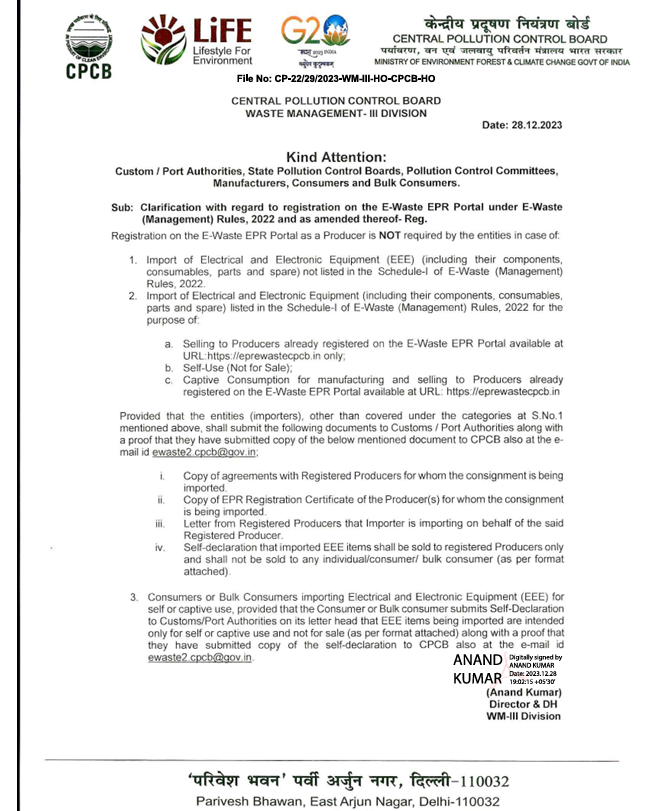
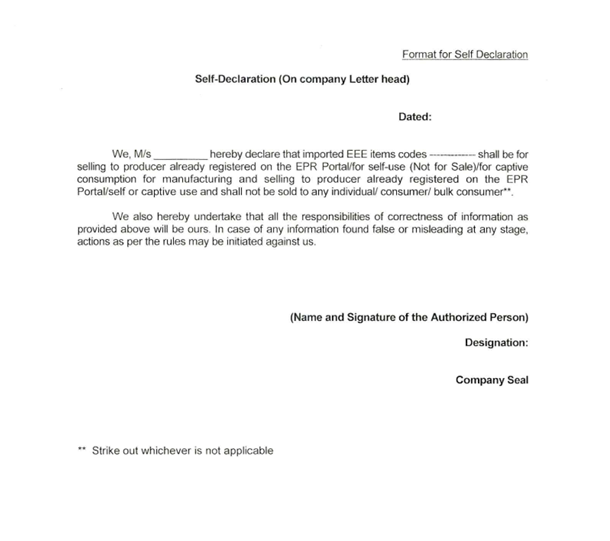
The notice also specifies supporting documents and declarations that may be required in applicable cases. Businesses should review the latest CPCB requirements and determine whether their specific import activity falls within the stated conditions.
ERP Authorization











Documents Required for EPR Registration in India
The documents required will vary according to the type of applicant and the business model; in general, the documents and information needed may include:
- ID and Address Proof of the Authorised Persons
- Documents such as the CIN, the MoA, the Partnership Deed, and the MSME, etc., are required for business registration.
- PAN and GST Details
- Import Export Code
- Details of Manufacturing
- EPR Plan to fulfil the targets
- Details Regarding the Manufacturing
- Details Regarding the Annual Returns
- Data Regarding the Generation of Used Oil
Product Information Required for EPR
An essential aspect of the application is giving accurate product information. Businesses should prepare a product master containing details such as:
- Product name
- Product category
- Brand
- Model number
- Product description
- Country of origin, where applicable
- Manufacturing location
- Import details, where applicable
- Annual production quantity
- Annual import quantity
- Product weight
- Relevant EEE category
- Applicable product components
- Historical sales/placement data, where required
For companies that have a number of products, keeping their product list properly organised can greatly simplify compliance with EPR requirements.
EPR Compliance Obligations in India
EPR registration should not be regarded as a one-off formality. According to the nature of the entity and the relevant provisions, businesses may find that they need to:
- Maintain accurate product and quantity records
- Fulfil applicable EPR obligations
- Use the prescribed recycling/EPR certificate mechanism
- Work with appropriate recycling channels
- Maintain supporting records
- Submit required returns or reports
- Keep registration information updated
- Respond to CPCB queries
- Follow applicable environmental requirements
- Maintain documentation supporting EPR compliance
The exact duties depend on the type of applicant and on the relevant regulatory provisions.
What's the Difference Between an EPR Certificate and an EPR Registration?
The terms EPR Certificate and EPR Registration are frequently used by businesses as if they were the same, whereas they in fact relate to different aspects of the E-Waste EPR framework.
EPR Registration
This relates to the process of registering the relevant entity on the CPCB's E-Waste EPR Portal.
EPR Certificate
The EPR framework includes a method by which EPR certificates or credits can be produced and transferred via the specified system in order to meet the relevant producer responsibilities.
That does not mean that all the EPR obligations in question have been fulfilled simply because EPR registration has been obtained.
Complete Process of EPR Registration in India
Step 1: Develop an EPR Strategy
Key Points:
Step 2: Complete the EPR Application
Key Points:
Step 3: Prepare and Upload Documents
Key Points:
Step 4: Submit the Application to CPCB
Key Points:
Step 5: Address CPCB Queries
Key Points:
Step 6: Obtain EPR Registration
Key Points:
Step 7: Maintain Ongoing EPR Compliance
Key Points:
Timeline for EPR Registration in India
The registration timeline depends on:
- Completeness of documents
- Number of products/categories
- Accuracy of product information
- Portal processing
- CPCB review
- Additional information requested by the authority
With a simple application and full documentation, the process could take several weeks; however, applications that need further clarification might take even longer.
UMSPCS assists businesses in preparing their applications correctly and in answering regulatory queries in order to reduce delays that could have been avoided.
Validity of EPR Registration
Within the CPCB framework in question, the registration for E-Waste EPR is normally given a validity period of five years, provided that the relevant conditions are met and continued compliance is maintained.
Companies should keep an eye on their registration status and compliance duties during the entire period for which they are valid.
What Takes Place After EPR Registration?
Getting registration is merely the start of the compliance process. Once registration has been obtained, the relevant producers may have to:
- Monitor the products that have been introduced in the Indian market.
- Make sure that the quantity and product records are accurate.
- Monitor applicable EPR obligations.
- Carry out the obligations by using the specified mechanism.
- Make sure that the documentation relating to recycling and compliance is kept.
- File the required returns or reports.
- Respond to regulatory requirements.
- Make sure that information about both the company and the product is up to date.
- Keep an eye on any changes to the EPR regulations.
Having a good system for keeping internal records will make it easier to prepare future reports and have them verified by regulators.
Common EPR Registration Challenges
- Incorrect Product Categorization
- Incomplete Documentation
- Incorrect Quantity Data
- Multiple Brands or Models
- Import Compliance
- Post-Registration Compliance
- Regulatory Changes
EPR Registration for Importers and Foreign Manufacturers
Before entering the Indian market, foreign manufacturers and international brands that supply electrical and electronic products into India should evaluate their EPR obligations.
When considering compliance with the EPR regulations, it may be necessary to take into account other Indian product regulations such as BIS certification, the requirements set out by the WPC/MTCTE, Legal Metrology, and any other applicable approvals, depending on the product.
For imported EEE, businesses should assess:
- Product category
- Brand ownership
- Importer structure
- Indian entity involvement
- Import quantity
- Product weight
- EPR obligations
- Recycling/compliance arrangements
- Applicable product certifications
Planning with regard to compliance from an early stage can prevent regulatory problems arising after products have already been introduced into the Indian market.
EPR and Sustainable E-Waste Management
The EPR approach promotes a more structured method of managing electronic waste by linking the product's lifecycle with its management at the end of its life.
Proper EPR implementation can contribute to:
- Responsible recycling
- Resource recovery
- Reduction of improper disposal
- Better tracking of e-waste
- Circular-economy practices
- Improved environmental accountability
- Sustainable product lifecycle management
Manufacturers and producers can therefore make EPR a significant element of their overall environmental compliance strategy.
What Makes UMSPCS the Choice for EPR Registration?
UMSPCS offers structured regulatory assistance to companies that have to manage environmental and product compliance requirements.
Due to our team's experience of more than six years in the field of compliance and having handled over 600 product compliances, we have provided support to businesses in a wide range of product categories and under various regulatory requirements, helping them with the preparation of documentation, regulatory procedures, applications, and all other compliance-related matters.
- Product-Specific Assessment
- Complete Documentation Support
- CPCB Portal Assistance
- Query Management
- End-to-End Compliance Assistance
- Support for Multiple Product Categories
Conclusion
Compliance with the EPR requirements goes beyond just getting a registration number; businesses must properly identify their products, understand their obligations, keep accurate records, and adhere to the relevant CPCB framework throughout the entire product lifecycle.
No matter whether you are a manufacturer, producer, importer, refurbisher, or recycler, UMSPCS can assist you in understanding the relevant requirements and in arranging the registration and compliance process.
We offer professional help with EPR registration in India, including the preparation of the necessary documentation, the assessment of products, filing on the CPCB portal, responding to regulatory inquiries, and providing continuous compliance support.
Connect with UMSPCS now regarding EPR Registration, Environmental Compliance, and Product Regulatory Approvals.
Frequently Asked Questions (FAQs)
Organisations, manufacturers, producers, refurbishers, etc. covered by appropriate E-Waste Management Rules are required to register with CPCB so that they can remain operational.
Yes, importers classified as producers under the right category are supposed to obtain EPR Registration and comply with the obligations imposed by the relevant authority.
EPR will cover the equipment that has been mentioned in the lists of electrical and electronic equipment defined by the E-Waste Management Rules, 2022.
Generally, the EPR registration requires business information, PAN, GST, information concerning the product, and brand name, among others.
The major EPR frameworks in India include:
- EPR for E-Waste Management
- EPR for Plastic Waste Management
- EPR for Battery Waste Management
- EPR for Waste Tyre Management
- EPR for Oil Waste Management
Each category is regulated under its respective rules and compliance framework.
Yes, EPR Registration can be adjusted if the organization has made changes in the information connected to the product, brand, business, etc.
Yes, even after getting registered, the compliance responsibility does not come to an
The concerned parties can accomplish their responsibilities by following prescribed recycling policies and the EPR system by using registered recyclers and records of compliance.
Neglecting compliance obligations may lead to enforcement actions, compensation for damages to the environment, or any other actions that may be required according to the E-Waste Management Rules in force.
Yes, doing business in the online sphere does not mean one is free of their obligations, since the products he is selling or the activities of conducting business are not excluded from requirements under these rules.
Yes, it is possible to register several e-products depending on their categories and brands, provided the necessary information is given in the registration forms provided by the CPCB.