PESO Certificate: Compliance Guide (Requires, Benefits, Major Areas, Process, Penalties & Documents)
What is a PESO Certificate?
Petroleum & Explosives Safety Organisation (PESO) is the regulatory agency for dangerous substances such as petroleum, explosives, and compressed gases in India. PESO is an organisation under the Ministry of Commerce and Industry, which is DPIIT.
PESO has developed into a primary regulatory body that confirms Industrial Safety in India. It was implemented in 1898 as the Department of Explosives.
Key Responsibilities of PESO:
- Regulating the manufacturing and handling of explosives
- Ensuring safe storage and transportation of petroleum products
- Approving pressure vessels and gas cylinders
- Certifying equipment used in hazardous environments
- Granting licenses for fuel stations and gas plants
- Equipment meets Indian safety standards
- Facilities are designed to prevent accidents
- Operations follow strict safety protocols
- Products are suitable for hazardous environments
Get Your Free Expert Consultation
Why PESO Certification is Mandatory
In India, PESO Certification is not just an option, but it's a legal requirement for applicable industries. Harmful materials like petroleum and compressed gases are excessively volatile. Even a small spark or improper management can result in catastrophic complications.
Key Reasons Why PESO Certification is Important:
1. Legal Authorisation:
2. Safety Assurance:
3. Accident Prevention:
4. Market Entry Requirement:
5. Industry Credibility:
Who Requires a PESO Certificate?
Businesses Covered:
- Petroleum storage facilities and fuel stations
- LPG bottling plants
- Explosives manufacturing units
- Fireworks manufacturers
- Gas cylinder manufacturing and testing units
- Pressure vessel manufacturers
- Chemical and hazardous material industries
- Importers and exporters of regulated equipment
Scope of PESO Certification
PESO Certification covers several sectors working with harmful substances.
Major Areas Covered:
- Crude Oil
- Motor Spirit (MS)
- Diesel (HSD)
- Aviation Turbine Fuel (ATF)
- Kerosene (SKO)
- Light Diesel Oil (LDO)
- Furnace Oil (FO)
- Naphtha
- Benzene
- Toluene
- Hexane
- Styrene
- Xylene
- MTO
- Flammable mixtures having liquid hydrocarbon, etc
Industries That Require PESO Certification
- Oil & Gas Industry
- Chemical Industry
- Manufacturing Sector
- Infrastructure Projects
- Fireworks Industry
- Energy Sector
Consequences of Non-Compliance
- Heavy penalties
- Business shutdown
- Legal action
- Product rejection
- Safety hazards
Types of PESO Licenses
Several types of PESO licenses are in demand, which are based on the nature of business activity.
- 1. Manufacturing License: It is required for manufacturing explosives, gas cylinders or harmful equipment.
- 2. Storage License: For storing petroleum, gases, or explosives.
- 3. Transport License: In demand for the transportation of hazardous substances.
- 4. Import/Export License: Compulsory for foreign manufacturers who want to get into the Indian market.
- 5. Site Approval: Required prior to setting up hazardous material facilities.
- 6. Equipment Approval: Required for flameproof or hazardous area equipment.
PESO Certification Process
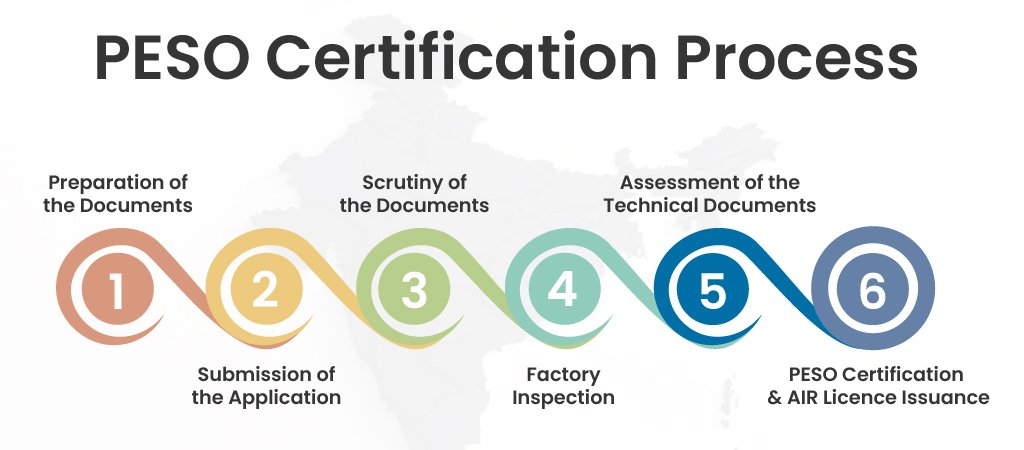
The PESO Certification process consists of various steps to confirm solid compliance.
Step 1: Preparation of the Documents
Step 2: Submission of the Application
Step 3: Scrutiny of the Documents
Step 4: Factory Inspection (If Necessary)
Step 5: Assessment of the Technical Documents
Step 6: PESO Certification & AIR Licence Issuance
Documents Required for PESO Certification
Paperwork is an essential part of a PESO permit.
- Application documents (application form, contract with AIR for min. 5 years, technical competence proof of AIR, etc.).
- Business Licence of manufacturer, plant and AIR.
- Global organisation chart.
- Global organisation chart.
- Test Reports, QAR/QAN.
- Test Reports, QAR/QAN.
- List of production equipment and test instruments.
- ISO Certificate.
- Video of the Production facility.
- Commercial information includes 3 years' sales figures, a list of Indian customers, hazardous area installation information like installation location, the intended use of equipment, etc.
SMPV Rules (Static & Mobile Pressure Vessels)
One of the most essential frameworks under PESO is the Static and Mobile Pressure Vessels Rules.
Such rules are applied to pressure vessels, which are used to store gases and liquids under high pressure.
Key Highlights:
- Design and drawings must be approved by the authorities
- Equipment must meet safety standards
- Regular inspections are mandatory
- Proper installation and maintenance are required
Such rules confirm safe management of pressurised systems in industries.
Validity of PESO Certificate in India
The validity of PESO Certification is based on the type of license, which is as follows:
- Standard licenses: Typically 3 to 5 years
- Pressure vessel approvals: Up to 3 years
- Renewal required before expiry
Common Challenges in PESO Certification
Several businesses struggle with PESO Certification because of its difficulty.
Major Challenges:
- Complex documentation requirements
- Strict safety compliance
- Lack of technical knowledge
- Delays in approvals
- Errors in application
Even minor mistakes can result in rejection or postponements. Also, you can get to know more about EPR Certification for E-Waste Management Service.
How UMSPCS Helps You Get PESO Certificate
Receiving PESO Certification might be difficult without getting expert guidance. That is where UMSPCS comes in.
Our Services Include:
- Requirement Analysis: We find out the exact PESO license that is applicable to your business.
- Documentation Support: Preparing and verifying every required document.
- Application Filing: Submit the application on the PESO Portal.
- Authority Coordination: Managing interaction in accordance with PESO authority.
- Inspection Assistance: Assistance regarding site audits.
- Faster Approvals: Minimising postponements and preventing denials.
Expert Insights
From a regulatory compliance perspective, PESO certification is one of the most critical approvals for industries dealing with hazardous materials.
Depending upon industry experience, businesses should do the following:- Start certification early
- Maintain proper documentation
- Conduct internal safety audits
- Work with experienced consultants
Why Choose UMSPCS?
With extensive experience in regulatory compliance, UMSPCS has successfully delivered compliance and certification services for 600+ products across various industries, making it a trusted partner for businesses in India.
Key Benefits:
- Strong experience in PESO certification
- Updated knowledge of regulations
- End-to-end support
- High success rate
- Transparent process
- Requirement Analysis: We find out the exact PESO license that is applicable to your business.
- Documentation Support: Preparing and verifying every required document.
- Application Filing: Submit the application on the PESO Portal.
- Authority Coordination: Managing interaction in accordance with PESO authority.
- Inspection Assistance: Assistance regarding site audits.
- Faster Approvals: Minimising postponements and preventing denials.
Conclusion
Safety in industries that use hazardous substances cannot be maintained without the contribution made by the Petroleum and Explosives Safety Organisation (PESO).
Not only is it mandatory, but obtaining a PESO Certificate is also a promise of maintaining high standards regarding compliance and efficient functionality.
UMSPCS is an organisation that offers expertise on the subject. As per the guidance received from them, businesses streamline the process of obtaining certifications to avoid delays.
Also, we provide IEC Certification: Import and Export License for your product run global market.
Frequently Asked Questions (FAQs)
PESO certificate is a license provided by the Petroleum and Explosives Safety Organisation that gives permission to the company for the lawful manufacturing, storage, transport, and handling of explosive substances like petroleum, explosives, compressed gases, etc.
No, the certificate is applicable only for those industries that deal with the use of hazardous substances like petroleum, gas cylinders, explosives, etc.
The responsibility of issuing this license lies with the Petroleum and Explosives Safety Organisation in India.
Validity of the PESO certificate is usually between two and three years
This will vary from situation to situation. Depending on the needs, it might take just a few days or even months.
Yes, the foreign manufacturer has to appoint a representative in India, who will apply for the PESO certificate for the exported product.
Typical documents that are required include registration details of the company, specifications of the product, drawings of the product, safety data, certificate of testing, layout and NOCs of local authorities. Depending upon the type of license, it may vary.
Yes, physical inspection is done by PESO in the manufacturing unit, storage unit or installation location.
The SMPV rules deal with the design, manufacture, installation and operation of Pressure Vessels holding compressed fluids.
Yes, the electrical devices that will be used in any hazardous location (i.e., flameproof or explosion-proof devices) have to pass the scrutiny of PESO to make sure that they are suitable for being used in such locations.
The electrical products that are going to be used in hazardous places (for example, flame-proof products) should have a PESO certificate.