The quality of welding joints depends upon the raw material used in their construction. Variations in the composition and performance of welding consumables can lead to quality and reliability issues in end products. This is especially important in industries where structural strength, quality, and the long-term durability of welds are of prime concern. That’s why a control system for the manufacture and distribution of consumables is essential to maintain quality in welding consumables in India.
Flux-Cored (Tubular) Electrodes are used for gas-shielded and self-shielded metal arc welding of carbon and carbon-manganese steel. Manufacturers and importers of these products have to comply with certain Indian quality and certification requirements to do business in India.
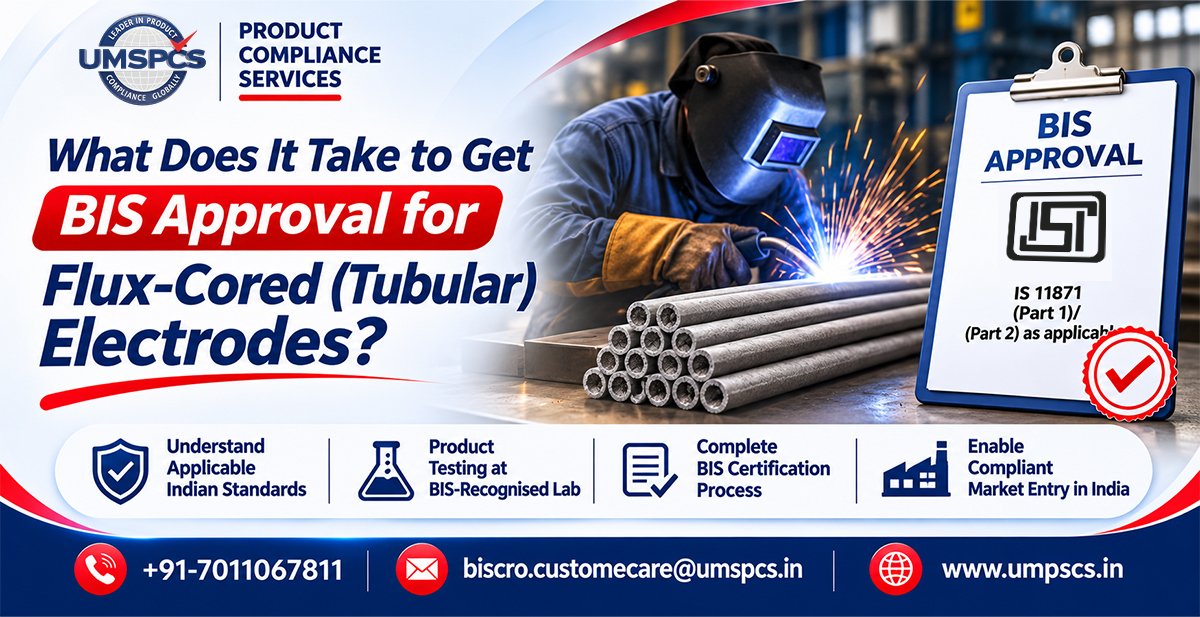
Under the Flux Cored (Tubular) Electrodes (Quality Control) Order, 2021, issued by the Department for Promotion of Industry and Internal Trade (DPIIT), the Government of India made it mandatory to obtain BIS certification for Flux-Cored (Tubular) Electrodes. The applicable standard is IS 15769:2008. The order states that products under it must be marked with the BIS standard mark (ISI mark) and a valid licence.
So, what does it take for manufacturers to obtain this approval? This blog explains the entire certification journey for manufacturers, from understanding the applicable standard to preparing factory documents and undergoing BIS inspection.
Why Is BIS Approval Mandatory for Flux-Cored Electrodes?
There is a mandatory certification requirement stemming from the Flux Cored (Tubular) Electrodes (Quality Control) Order, 2021, issued by the Department for Promotion of Industry and Internal Trade (DPIIT), Ministry of Commerce and Industry.
According to this order:
- Products must comply with IS 15769:2008.
- The BIS Standard Mark (ISI Mark) is mandatory.
- Certification must be obtained under Scheme-I of Schedule-II of the BIS (Conformity Assessment) Regulations, 2018.
- BIS is the sole certification and enforcement authority.
- Products intended exclusively for export are exempted from this Quality Control Order (QCO).
This QCO applies to flux-cored tubular electrodes used in gas-shielded and self-shielded metal arc welding of carbon and carbon-manganese steels.
Of particular importance, this QCO specifies mandatory requirements, and approvals granted by BIS are not optional. Manufacturers and importers cannot consider BIS approval as a post-market formality. Prior certifications by BIS are required for manufacture, import and sale of the regulated product in India.
The Government has demonstrated strict enforcement. In August 2022, BIS officials conducted enforcement against a unit that imports and markets flux-cored welding wire without a valid licence, and seized 193 such units.
Basic Requirements Before Applying for BIS Certification
Prior to applying for the BIS Standard Mark, applicants should ensure that they have the required manufacturing facilities and capabilities to produce the product as per the specified standards, and are able to consistently meet the requirements of the standards through an adequate quality control system.
The following should be in place before an application is made for the BIS Standard Mark.
- Adequate manufacturing facilities
- Testing facilities
- Quality control system
- Adequate personnel
- Clear understanding of the requirements of the BIS application process.
BIS evaluates the applicability of the Standard Mark based on the manufacturing and testing facilities of the applicant.
Complete BIS ISI Certification Process for Flux-cored (tubular) Electrodes.
The BIS certification process complies with Scheme-I of the BIS Conformity Assessment Regulations, 2018. The following provides insight into the process from the perspective of the manufacturer.
Step 1: Understand IS 15769:2008
The first step is to understand IS 15769:2008 related to flux-cored (tubular) electrodes. About this IS standard, Manufacturers are required to:
- Understand the requirements.
- Identify the classifications and sizes of electrodes.
- Confirm the conformity of the product and take necessary actions for product manufacturing.
Step 2: Testing and Documentation
The Manufacturer has to organize the testing of the product against IS 15769:2008 and generate necessary technical documents.
- Testing of the electrode samples is carried out at this stage.
- Manufacturing and factory details are reported.
- Quality control records are prepared.
- Techno-commercial details of the product are captured in these documents.
Step 3: Application to the BIS
The Manufacturer has to make an application to the BIS, available on the BIS website, and submit:
- Techno-commercial details of the product.
- Manufacturing details of the product.
- Factory details.
- Lab and testing details.
- Supporting test reports, where applicable.
- Application fees.
Step 4: Inspection of BIS
An inspection of the Manufacturing Facility is conducted by a BIS official to review:
- Machinery and Equipment.
- Manufacturing processes and infrastructure.
- Quality Control processes and in-house laboratory and testing facilities.
Step 5: Sampling and Testing
A product sample is collected by the BIS and forwarded to a BIS-recognized testing laboratory.
- Product samples are tested against the requirements of IS 15769:2008.
- The laboratory evaluates the technical parameters.
- The test report is submitted to the BIS.
Step 6: Removing Non-Conformities
If any non-conformities are observed during the inspection or testing, the Manufacturer is required to remove the same and provide necessary clarifications/documents to the BIS.
Step 7: Payment of Fees to the BIS
The Manufacturer is required to pay the BIS certification fees comprising license fee, marking fees and other fees.
Step 8: Grant of BIS ISI Licence
Once all the requirements are met and BIS approves the application, an ISI licence is issued.
Manufacturers can:
- Use the ISI mark on the certified flux-cored electrodes.
- Manufacture products within the scope of the approved licence.
- Market and supply the certified products in the Indian market, provided that the products comply with the requirements of the Bureau of Indian Standards (BIS).
Documents Required for BIS Approval in India
The role of documentation in avoiding delays during the certification process is of utmost importance. It is the responsibility of the applicant to provide the required documentation.
The basic documents are:
- Address of the Unit (Lease/ownership deed, utility bills, etc.)
- Basic Data of the Unit and the Product
- Trademark (if brand name is used and registered)
- List of licenses/ approvals (pollution and industry-specific approvals, etc.)
- Product Designs/Drawings
- Product test and calibration equipment
- Manufacturing Process
- Manufacturing/test personnel
- Organization Chart of Factory
ISI Certification Cost of Flux-Cored (Tubular) Electrodes
The cost of ISI certification for Tubular Electrodes is dependent on several factors, i.e., the nature and specifications of the product, level of testing and inspection required, the equipment and facility available in the factory, and adequacy of documentation.
| Particulars | Estimated Cost (INR) |
| BIS Application Fees | ₹1,000 |
| Laboratory Testing | ₹15,000 – ₹2,50,000 |
| Factory Inspection | ₹7,000 |
| Annual Licence Fees | ₹1,000 |
| ISI Marking Fees | As per BIS norms |
| UMSPCS Consultancy Charges | ₹50,000 |
Estimated Timeline and Validity of BIS ISI Certification for Flux-Cored (Tubular) Electrodes
As per Document, Product Testing, Factory Inspection, and BIS Assessment.
- Estimated timeline: 30 – 40 Working days.
- Delays can be due to Testing failures, Incomplete documents, and Factory Improvements.
- For AIF products, the timeline can be up to 180 days.
Validity and Renewal
Under Scheme-I, BIS licenses are granted for up to 2 years and can be renewed for up to 5 years. ISI Mark can be used by manufacturers only if the licenses are renewed before expiry.
Common Challenges Manufacturers Face During Certification
Even with established production facilities, manufacturers can have challenges with BIS approval. Challenges can include,
- Technical non-conformity
- Incorrect product grouping
- Inadequate testing infrastructure
- Documentation gaps
- Overseas coordination
- Surveillance
If challenges are addressed beforehand, unnecessary delays and expenditure can be avoided.
How UMSPCS Helps You Obtain BIS Certification for Flux-Cored (Tubular) Electrodes
Obtaining BIS approval involves the intersection of various departments in the organization and external entities. This is where external assistance can simplify the process.
UMSPCS has a team of 6+ years of compliance professionals and has handled 600+ product compliance requirements across diverse industry sectors. Thus, UMSPCS can assist clients with product compliance requirements in diverse fields in India.
What We Offer for BIS Certification for Flux-Cored (Tubular) Electrodes:
- Standard Identification
- Assistance with Application
- Documentation Assistance
- Factory Readiness
- Lab Coordination
- Inspection Readiness
- Tech Query Assistance
- Post Certification Assistance
Conclusion
BIS approval for Flux-Cored (Tubular) Electrodes is a mandatory approval, not a quality preference. As per the Flux-Cored (Tubular) Electrodes Quality Control Order, 2021, the manufacturers and importers have to ensure that their products comply with IS 15769:2008 and hold the BIS approval before supplying the products in India.
There are several key steps, including product classification and identification, lab tests, factory inspection, and post-certification surveillance. Each of these steps requires a significant amount of planning, know-how, and expert judgement.
Hiring a competent BIS certification consultancy in India will ease your burden of managing this process.
If you are planning to obtain BIS approval for flux-cored electrodes, contact UMSPCS. We will assist with your documentation, lab coordination, and support for the end-to-end BIS certification process.
Read more also: Are Self-Ballasted LED Lamps Compliant with IS 16102 (Part 1)
FAQs
- Is BIS certification necessary for flux-cored (tubular) electrodes in India?
Yes, as per the Quality Control Order (QCO) Flux Cored (Tubular) Electrodes, 2021, the products mentioned in the said QCO should meet the requirements of IS 15769:2008 and bear the BIS standard mark.
- Can manufacturers of flux-cored electrodes sell products without the ISI mark?
No, products manufactured or imported against the aforementioned mandatory QCO should not be manufactured, imported, or sold in the Indian market without the prescribed BIS certification.
- What is the applicable BIS certification scheme?
Certification is done under Schedule II of the BIS (Conformity Assessment) Regulations, 2018, Scheme-I.
- Can flux-cored electrodes manufactured outside India get BIS certification?
Yes, they are eligible to apply under the Foreign Manufacturers Certification Scheme (FMCS), provided they fulfill all other stipulated requirements and appoint an Authorized Indian Representative.
- What is the penalty for selling flux-cored electrodes without BIS approval?
The manufacturer or the importer of such product can be subject to enforcement actions, product seizure, and/or penalties as provided under the BIS Act, 2016.
❓ Ask a Question
Have any doubts? Fill the form below and our team will respond shortly.