The dental industry is changing at an unprecedented pace, from new dental implants and orthodontic appliances to advanced digital scanning equipment and precision surgical instruments. But before all this innovative dental technology finds its way into hospitals, clinics, or distributors in India, one important step cannot be bypassed – CDSCO Certification for Dental Devices.
All too often, companies regard the regulatory requirements as an additional formality in their business. The truth is that even one mistake in terms of product classification, lack of technical documentation, or absence of regulatory evidence can significantly prolong the process of bringing products to market.
In this blog post, UMSPCS provides detailed information on CDSCO Certification for Dental Devices and talks about the regulations, criteria of eligibility, necessary documents, the procedure for getting the license, deadlines, and compliance issues.
Why Are Dental Devices Regulated in India?
The devices used in dentistry have an effect on the safety of the patient, the precision of treatment, infection control, and results obtained. Devices like implants, dental cements, orthodontic devices, radiographic devices, surgical devices, and digital scanners should conform to the regulations in order to access the market.
The regulation of medical devices is done through the Central Drugs Standard Control Organisation (CDSCO), in accordance with the Medical Devices Rules, 2017.
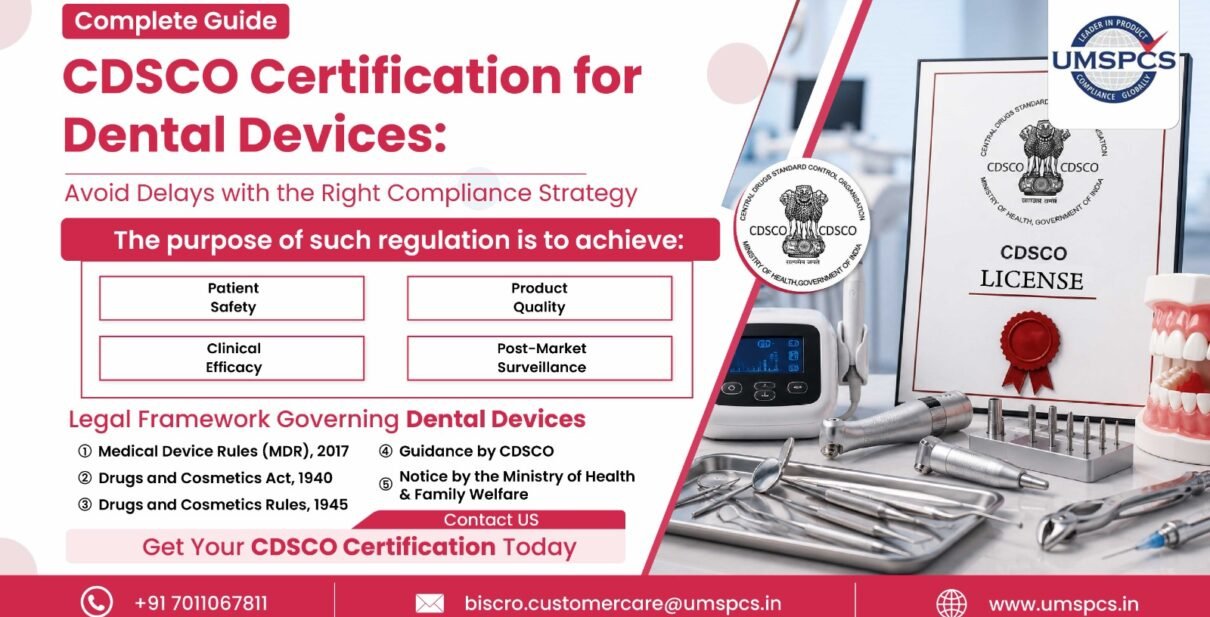
The purpose of such regulation is to achieve:
- Patient safety
- Product quality
- Clinical efficacy
- Manufacturing reproducibility
- Traceability
- Post-market surveillance
Understanding CDSCO Certification for Dental Devices
CDSCO Certification for Dental Devices stands for the authorization procedure that enables eligible dental devices to be legally manufactured, imported, distributed, or sold in India.
Based on the device classification and business function, businesses can be required to have:
- License for Manufacturing
- License for Import
- Registration via the online Sugam Portal
- Indian Authorized Agent (in case of foreign manufacturers)
- Quality Management System compliance
- Technical Documentation review
Legal Framework Governing Dental Devices
Structure of Regulatory Authority Includes the Following:
- Medical Device Rules (MDR), 2017
- Drugs and Cosmetics Act, 1940
- Drugs and Cosmetics Rules, 1945
- Notice by the Ministry of Health & Family Welfare
- Guidance by CDSCO
The above set of regulations contains guidelines on classification of devices, licensing, documentation, clinical testing, labeling, and post-market surveillance monitoring.
Understanding Device Classification
CDSCO categorizes medical devices into four types on the basis of risk level.
| Classification | Risk Level |
| Class A | Low Risk |
| Class B | Low-Moderate Risk |
| Class C | Moderate-High Risk |
| Class D | High Risk |
The classification will decide:
- License authority
- Documentation
- Review
- Inspection
- Approval process
Proper classification of the device is one of the most crucial aspects of Dental Device Regulatory Compliance.
Basic Eligibility Requirements
The applicants usually comprise:
- Indian Manufacturers
- Foreign Manufacturers
- Importers
- Indian Authorized Agents
- Brand Owners (if any)
The applicant must possess:
- Business Registration
- Manufacturing details
- Quality Management Systems
- Technical Data
- Specifications of product
- Device Labeling
- Risk Management
- Necessary declarations
Essential Documents Required
The nature of the documentation differs based on the device class and application type.
Documentation typically includes:
- Application for CE Mark through CDSCO Sugam Portal
- License to Manufacture (if any)
- ISO 13485 Certification
- Device Master File
- Plant Master File
- Free Sale Certificate (for imports)
- CE Certificate (where applicable)
- Product Specifications
- Labeling of Device
- Instructions for Use (IFU)
- Risk Analysis Report
- Clinical Evaluation Report (where applicable)
- Test Reports
- Quality Certificates
- Authorized Agent Agreement (for manufacturers from abroad)
- Power of Attorney
- Declaration of Conformity
Sound Documentation considerably helps avoid regulatory questions.
Step-by-Step Procedure for CDSCO Certification for Dental Devices
Step 1: Register on the CDSCO SUGAM Portal
Firstly, the applicant needs to register his company on the CDSCO SUGAM portal, where he will have to fill in the required business and applicant details to proceed with the CDSCO Certification for Dental Devices procedure.
Step 2: Submit CDSCO Application
Fill out and submit the correct CDSCO application form, providing all the necessary information about your products, their intended use, manufacturing data, etc.
Step 3: Submission of Required Documents
Submit all the necessary documents that will be required, including Device Master File (DMF), Plant Master File (PMF), ISO 13485 Certificate, testing results of the product, technical specification, labelling information, and others.
Step 4: Payment of Government Fees
Pay the relevant government fees according to the device classification, nature of your application (manufacture), and the number of dental devices listed in your application.
Step 5: CDSCO Licensing Procedure
The licensing body will review the application and all the attached documentation, and once the evaluation is completed successfully, the appropriate CDSCO license will be granted.
CDSCO Certification Fees for Dental Devices
The government fee for the CDSCO Certification for Dental Devices is based on the risk category of the device and the type of license that needs to be obtained.
- Class A & Class B devices: The manufacturing license fee is ₹5,000, and there is a charge of ₹500 for each different dental device that is covered in the application.
- Class C & Class D devices: The manufacturing license fee is ₹50,000, and ₹1,000 for each different dental device that is covered in the application.
In addition to the aforementioned government fees, certain other costs associated with the testing of the product (wherever required), audits, documentation, compliance, and consultancy services need to be borne by the applicant.
Typical Timeline of CDSCO Certification
Approval process timing varies depending on:
- Classification of device
- Completeness of documentation
- Regulatory questions
- Inspections required
- Complexity of product
On average, approvals can take from several weeks up to a few months, depending on the risk level of the device.
Common Reasons Behind Approval Delays
Delays are experienced in many companies because of some avoidable errors.
The following is a list of the commonly encountered problems:
- Wrong classification of products
- Documentation problems
- Labeling problems
- Technical files not complete
- Form filling problems
- Quality Management Documentation problems
- Delayed response to CDSCO inquiries
- Incorrectly documented Authorized Agent
- No proper regulatory planning
These issues can significantly increase approval timelines.
Benefits of Obtaining CDSCO Certification for Dental Devices
Some of the benefits associated with attaining CDSCO Certification in India.
With include:
- Legal market entry
- Improved customer trust
- Regulatory compliance
- Risk reduction for the business
- Market reputation enhancement
- Government procurement ease
- Long-term business growth
Compliance Strategy That Helps Avoid Delays
Companies can streamline the process of getting approvals through the following actions:
- Correctly identifying the appropriate regulatory pathway
- Proper product classification
- Technical documentation preparation
- ISO 13485 compliance
- Product labeling review
- Document audit before filing
- Prompt addressing of regulatory questions
- Hiring regulatory consultants
This approach to compliance helps to avoid surprises.
Why Businesses Trust UMSPCS for CDSCO Certification
Following medical device regulations could be a daunting task, particularly if you have never applied for such before or are a foreign manufacturer. At UMSPCS, we ease your journey from the initial steps to the end through regulatory guidance.
Having 6+ years of experience in the industry and successfully assisting more than 600 product compliance cases, our team will enable your business to enjoy faster, precise, and trouble-free approval processes.
Some of our services include:
- Product classification assistance
- Regulatory strategy formulation
- Document creation
- Device master file analysis
- Plant master file preparation
- Filing Sugam portal application
- Import license assistance
- Authorized Indian agent services
- Regulatory queries handling
- Post-approval assistance
We assist Indian manufacturers, importers, or exporters in making sure their CDSCO Medical Device Registration process goes smoothly and without delays.
Conclusion
The dental device market in India remains dynamic, and compliance with regulatory requirements has emerged as a very crucial requirement for manufacturers as well as importers of the same. CDSCO Certification for Dental Devices is very crucial not only in terms of accessing the market legally but also in terms of ensuring that the device is safe and of high quality.
Getting your device approved requires proper planning and documentation, the right device classification, and knowledge of the CDSCO rules and regulations governing the same. Any mistake made during the process may prove costly, time-consuming, and unnecessary.
In case you plan on manufacturing, importing, or distributing your dental device in India, then we are here to help you with your CDSCO Certification process. Our team of regulatory experts will assist you throughout the entire process, from device classification and documentation to application filing and post-approval regulatory compliance.
Connect with us now to obtain faster approvals with our assistance for your CDSCO Certification for Dental Devices in India.
Read more also: CDSCO Registration & Approval for Ear Nose Throat (ENT).
FAQs
- Is CDSCO Certification for Dental Devices Compulsory in India?
Yes,Regulated dental devices listed under the Medical Devices Rules, 2017 shall obtain the relevant CDSCO certification prior to manufacture, import or sale in India.
- Who regulates Dental devices in India?
Central Drugs Standard Control Organization (CDSCO) regulates both medical devices and dental devices according to Medical Devices Rules, 2017.
- How are dental devices classified?
Dental devices are divided into Class A, B, C, and D depending upon their purpose and the degree of risk involved.
- How long does the process take?
It usually depends upon the class of the device and the quality of documents. The complete set of documents is processed quicker than documents which require clarification.
- What documents are needed for CDSCO certification?
The list includes ISO 13485 certification, Device Master File, Plant Master File, technical documents, labelings, test reports, quality certificate, etc.
- Are foreign manufacturers able to make direct applications to the CDSCO for approval?
Foreign manufacturers will usually need to appoint an Authorized Indian Agent to apply for their import license.
- What if there are errors in my application?
Errors in applications may result in inquiries from the CDSCO and potential delays or rejections.
❓ Ask a Question
Have any doubts? Fill the form below and our team will respond shortly.