In a fast-changing world of 2026, electronics are made not only as a tool, but also as the very basis of our day-to-day lives. With the utilisation of AI-integrated devices and ultra-high-definition screens, the reliance on electronic equipment is more than ever. However, it becomes a very important responsibility, and that is to ensure that all the devices entering the Indian market are safe, reliable and in compliance with the regulations of the country.
For manufacturers, importers, and brand owners, navigating the regulatory waters in India can be complex. The most important part of this regulatory system is the BIS CRS Certification of Electronic Products. This guide is a detailed conversation of the standards, processes and strategic importance of BIS certification in the current year.
What is BIS Certification for Electronics?
The Bureau of Indian Standards (BIS) is the National Standards Body of India, which is concerned with standardisation and certification of quality. In the case of the electronics industry, it is applying the Compulsory Registration Scheme (CRS).
Unlike the ISI scheme that requires factory audit, the BIS CRS Certification of Electronic Product is a type of self-conformance model in which auditing of the factories is not required. Indeed, initiated by MeitY and MNRE, it is an assurance that high-volume goods, such as complex high-technology home automation systems, are taken to safety standards before they reach consumers.
Key Objectives:
- Guarantees the consumers against incompetent or hazardous products.
- Prevent unfair market practices.
- Ensures “Made in India” markings are in accordance with international quality standards.
Importance of BIS Certification in 2026
In 2026, it will not only be legal compliance that will allow a company to manoeuvre the already saturated electronics market, but it will also be a crucial competitive strategy. We can enable you to enjoy the following important benefits:
- Safety and Risk Mitigation: Certification is an intensive testing against hazards such as thermal runaway, electrical shorts, and electromagnetic interference in order to prevent fires or shocks.
- Unlimited Market Access: An authentic R-Number, in turn, prevents customs seizure and removal of e-commerce products in dozens of product categories that are obligatory registered.
- Enhanced Consumer Confidence: The BIS Standard Mark will give real-time confidence to the present-day, highly conscious consumers that a product has a government-verified standard of safety.
- High-Tech Integration: These safeguards are essential with advanced high-tech home automation systems to ensure that they are safely used in interconnected environments.
Key BIS Standards for Electronics
The first thing to do on the compliance journey is to understand which standard to apply to your product. The following are the most pertinent standards regulated by the framework of the BIS CRS Certification of Electronic Products:
1. IS 13252: Safety of IT Equipment
This includes computers, laptops, printers, scanners, and networking equipment. It focuses on:
- Electrical Safety: Insulation, grounding, and clearance distances to avoid shocks.
- Fire Protection: Enclosures to be made of flame-retardant materials.
- EMC Compliance: This ensures the device does not interfere with other wireless communications.
2. IS 14151: Safety of Household Appliances
This standard applies to the white goods like refrigerators, washing machines and air conditioners. This standard, published in 2026, will also contain protocols to enable smart devices to be connected, as well as to ensure that physically dangerous hardware remains physically secure.
3. IS 16046: Safety of Battery-Powered Devices
This is vital to the mobile and EV revolution and includes secondary cells and batteries. It includes checking against overcharging, forced discharge, mechanical shock and vibration to avoid accidents.
4. IS 16419: Audio, Video, and Multimedia Equipment
This establishes safety and performance standards for televisions, amplifiers and digital cameras. With the emergence of 8K displays becoming standardised, this will make sure that the high-power components will be sufficiently cooled and insulated.
The BIS CRS Certification Process: A Step-by-Step Guide
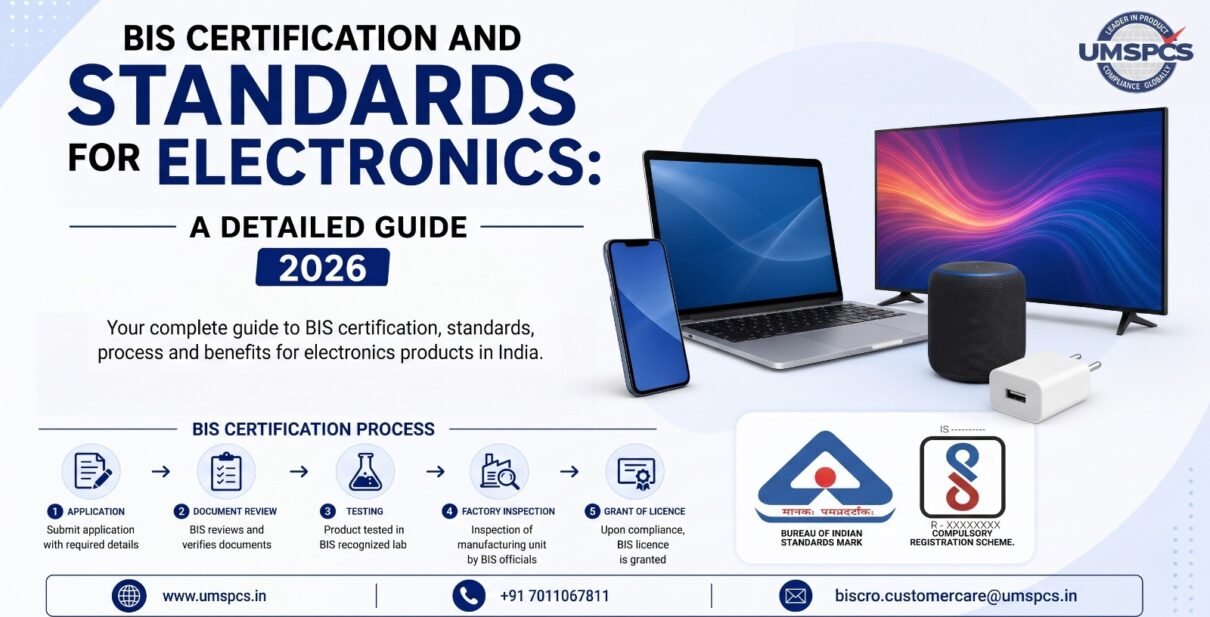
The process of navigating the path to compliance is a structured process that is aimed at verifying all aspects of the integrity of a product. In UMSPCS, we simplify these seven key steps so that customers can have a hassle-free experience:
- Product Profiling & IS Code Identification: This is done by analysing the specifications and features of your product so that we identify the correct Indian Standard (IS) under BIS CRS. Early mapping up of the right standard helps in avoiding wrong classification and rejection of applications.
- Sample Testing & Lab Coordination: We set up testing by means of BIS-recognised and accredited laboratories. The team takes care of scheduling and checking compliance to make sure that the results are in line with strict BIS standards.
- Documentation & Application Preparation: Our experts create the entire technical package, which includes circuit diagrams, user documentation, and manufacturing documentation. In the case of foreign brands, we also do the Authorised Indian Representative (AIR), which is mandatory.
- Application Submission & BIS Review: We submit the entire application through the BIS CRS portal. Our group has a close working relationship with the officials of BIS to swiftly address any technical or procedural inquiries.
- Grant of R-Number & BIS Registration: BIS gives the CRS Registration Certificate and a unique R-number on successful review. The product, which is as simple as a set of simple components or as advanced as a home automation system, can be legally sold in India.
- Marking & Labelling Compliance: We help you on how to properly use the Standard Mark and R-number. This involves proper font size, positioning and visibility on the product, as well as the packaging.
- Renewal, Model Inclusion & Surveillance Support: We handle ongoing requirements, such as registering renewals and adding new models to your existing license. We also train your team to audit surveillance or check a sample of the market.
Documents Required for BIS Certification for Electronics
The key to successful BIS CRS Certification of Electronic Product directly affects the speed of approval, and costly rejection can be avoided. A simple mistake may cause severe delays or rejection of the application.
Essential Documentation Checklist:
- Business Registration Certificate
- Product Detail & Specification
- Test Reports
- Trademark Certification
- Authorisation Letter
- AIR Documents
Advantages of BIS Certification for Electronics
Securing a BIS CRS Certification of Electronic Product is a revolutionary process that will have far-reaching consequences throughout the entire supply chain.
- Elevated Market Credibility: ISI mark is a silent salesperson that increases brand prestige, and consumers trust it.
- Fluid Regulatory Coherence: Certification guarantees full adherence to Indian laws, eliminating legal issues or customs delays.
- Consistency of Production: Conformity to the standards of BIS ensures consistency in production, thereby reducing the number of defects.
- Unsparing Product Safety: In all types of products (basic chargers to advanced home automation systems), it ensures that devices are able to pass critical safety tests.
- Informed Consumer Confidence: It is a visible mark of trustworthiness that buyers are sure that products are tested and reliable.
- Commitment to Sustainability: Standards assure electronics compliance with environmental regulations and energy-saving goals.
Benefits of Partnering with UMS Product Compliance Services (UMSPCS)
UMSPCS has over 600+ successful projects with their primary focus on the BIS certification services in India. We have enabled hundreds of manufacturers and importers to be able to set their ISI mark license at an efficient pace to ensure a smooth and timely entry into the Indian market.
Collaborating with us has unique benefits:
- Knowledge in 2026 Regulations: We keep up with the recent MeitY announcements and changes.
- End-to-End Management: We will take care of the complete lifecycle, lab coordination through the acts of being your AIR.
- Shorter Time-to-Market: Our well-developed relationships contribute to the minimisation of the time delays in testing.
- Post-Certification Service: We can help with licence renewals and with the formation of series to optimise costs when there are many variants of a product.
Read more also: BIS Certificate for Foreign Manufacture
Conclusion
India is still on its path towards becoming a global electronics manufacturing centre, and quality control is the order of the day. BIS CRS Certification of Electronic Product is the keystone of this movement, balancing the adoption of technology with the safety of humans.
With or without a startup or a global giant, compliance is your base. At UMS Product Compliance Services (UMSPCS), we are dedicated to assisting you in manoeuvring around these standards with accuracy.
Are you ready to certify your electronics for the Indian market?
Call UMSPCS today at +91 7011067811, talk to our regulatory experts and make your journey to the Indian market a smooth ride. We will see to it that your products are safe, compliant and prepared to spearhead the industry in 2026.
FAQs- BIS Certification and Standards for Electronics
- Will BIS CRS certification be required on all electronics in 2026?
No, but it is obligatory over 70 particular categories, such as mobile phones, laptops, and smartwatches. In India, it is an illegal act to sell them without a valid R-Number.
- How long does the certification process take?
Usually, the time is between 4 and 8 weeks. This will involve some 15-20 days where the lab testing will be done, and another couple of days where the BIS portal processing will be done.
- Is it possible to apply to BIS as a foreign brand without a local office?
No, foreign manufacturers have to have an Authorised Indian Representative (AIR) in India who will serve as their local liaison. To handle this need, we offer professional AIR services.
- What is the duration of the certificate?
The first registration has a life of two years. It can then be renewed for up to two to five years as long as the product continues to meet the current standards.
- Is it possible to certify multiple models under one license?
Yes, by means of “Series Formation”. Similar-designed models that share common safety elements can be clustered together so as to save a lot on testing costs.
- What will be the situation in case my product fails the lab test?
You will have to provide the technical non-compliance (e.g., faulty insulation) and send a new sample to be retested. We provide design reviews to help identify such problems before you spend money on formal testing.
- Do you have any labelling requirements?
Yes, certified products shall bear both the Standard Mark and the unique R-Number and the applicable IS number on the product and packaging.
- Why not do it in-house rather than purchasing UMSPCS?
The BIS regulations of 2026 are intricate and undergo changes regularly. We take care of the whole lifecycle, documentation, lab testing and renewals so that you can concentrate on the development of your business.
❓ Ask a Question
Have any doubts? Fill the form below and our team will respond shortly.