Think about having spent several months searching for distributors, making deals, and preparing goods for shipping to India, only to find out that you cannot legally sell your products on their market since they do not have all the necessary certifications. This is what many foreign producers face when trying to export to India.
With the ongoing increase in product quality standards in India in 2026, adherence to the Bureau of Indian Standards (BIS) becomes more crucial than ever. For Spanish manufacturers who want to enter the territory of one of the most rapidly developing countries in the world, getting the BIS approval becomes essential.
No matter whether you produce steel products, electrical appliances, electronic goods, consumer products, chemicals, machinery, or building materials, knowledge of the BIS requirements can determine your future success in the Indian market.
The following blog post will talk about the importance of a BIS Certification consultant in Spain, the certification process itself, certification schemes, fees, timeframes, difficulties involved, and the help from UMSPCS.
What is BIS Certification?
The Bureau of Indian Standards acts as the National Standards Body of India, with respect to the Ministry of Consumer Affairs, Food and Public Distribution of India. The development of Indian Standards takes place through BIS, and the certification of products takes place through BIS.
Those products that fall under the Quality Control Order (QCO) of the Government of India should conform to the standards set by BIS. Foreign manufacturers have to adhere to the BIS specifications based on two schemes. They include the Foreign Manufacturer’s Certification Scheme (FMCS) and Compulsory Registration Scheme (CRS).
Importance of BIS Certification in 2026
The regulatory framework in India has witnessed considerable growth in recent years. BIS QCOs (Quality Control Orders) have been issued by the government in different fields for improving the quality of products and avoiding low-quality imports.
Consequently:
- There will be an increase in the number of products requiring mandatory BIS Certification.
- The customs will undertake strict checks on import consignments.
- Incompliant consignments may face delays, rejections, or sanctions.
- Certified suppliers are becoming preferred by Indian purchasers.
Spanish producers now need to comply with the regulations strategically.
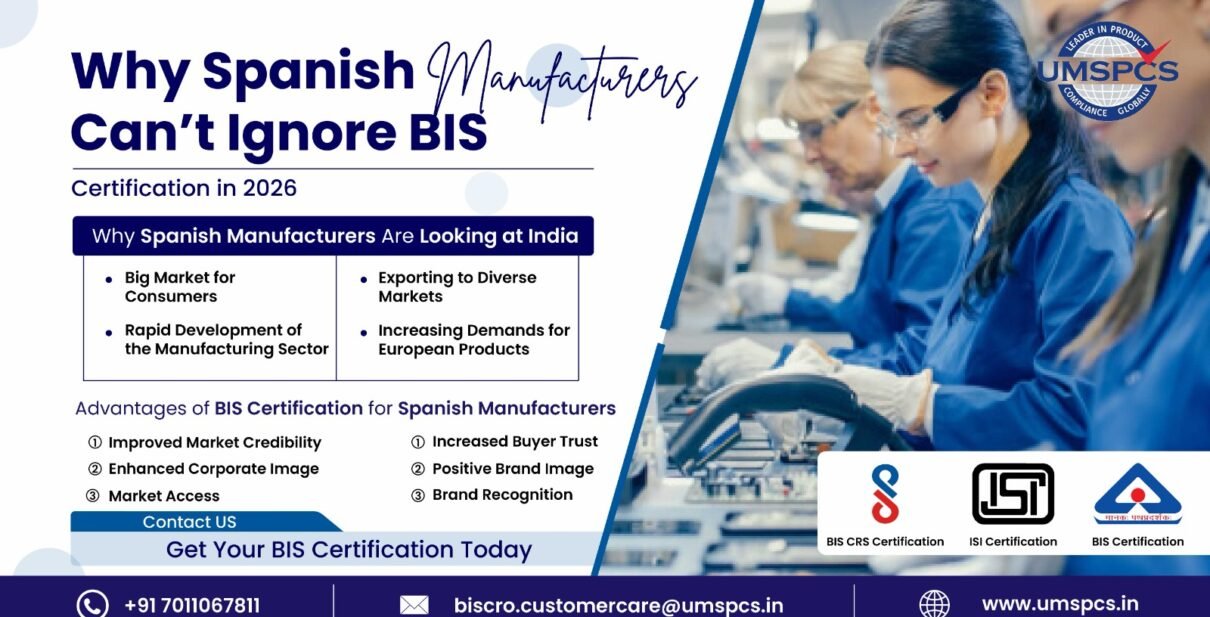
Why Spanish Manufacturers Are Looking at India
Opportunities for the manufacturers from Spain in India include:
- Big Market for Consumers: India has one of the biggest consumer markets in the world, with increasing purchasing capacity.
- Rapid Development of the Manufacturing Sector: Various government schemes like “Make in India” help develop India’s manufacturing sector further.
- Increasing Demands for European Products: The products made in Spain are known for their quality and innovation.
- Exporting to Diverse Markets: Spanish companies are now expanding into India.
But market entry is dependent on BIS norms.
Key Eligibility Requirements for Spanish Manufacturers
Before making their application, certain requirements must first be met by the manufacturer:
- Manufacturing Establishment: The company must have a manufacturing establishment.
- Quality Assurance Program: A quality assurance program is usually required by documentation.
- Product Test Results: The products must meet Indian standards.
- Authorised Indian Representative (AIR): An Authorised Indian Representative is usually required for foreign manufacturers.
- Technical and Manufacturing Data: Technical and manufacturing data should be complete.
Applicable Testing Requirements
Testing is very important in BIS certification. Depending on the product category, testing can assess the following:
- Safety Parameters: To ensure the product is safe for the user.
- Performance Parameters: To check whether the product functions in accordance with Indian standards.
- Durability Testing: To assess the product’s reliability over time.
- Electrical Testing: For electrical and electronic products.
- Materials Testing: To confirm compliance with technical specifications.
BIS Certification Process for Spanish Manufacturers
Step 1: Application Preparation & Filing
This stage begins with the preparation of documents and filing of the BIS application. Proper document preparation will lead to seamless processing and ensure that the BIS standards are met.
Includes:
- Document preparation
- Application filing
- Government fees
- Scrutiny of the application by BIS
Stage 2: BIS Queries Handling
Technical and document-related queries can be raised by BIS during the evaluation process.
Includes:
- Analysis and review of the queries
- Technical clarifications
- Additional document submission
- Communication with the BIS officials
Stage 3: Factory Inspection
Inspection of the manufacturing factory will be done to ensure that the applicable Indian Standards are met.
Includes:
- Manufacturing process review
- Quality system review
- Testing facilities review
- Review of the compliance
Stage 4: Product Testing
During the factory inspection process, product samples are selected and tested in recognised laboratories to ensure that Indian standards are met.
Includes:
- Selection and sealing of the samples
- Laboratory testing of the samples
- Test reports submission
- Review of the test results
Stage 5: Issue of the BIS Licence
Following the successful factory inspection and product testing, the BIS licence will be issued.
Includes:
- Approval of the license
- Authorisation to use the BIS Standard Mark
- Access to the Indian market
Step 6: AIR, Indemnity Bond & PBG Compliance
Foreign manufacturers will have to get themselves involved in completing formalities such as AIR appointment, signing of the Indemnity Bond and submitting PBG.
Includes:
- AIR appointment
- Submitting Indemnity Bond
- Performance Bank Guarantee (PBG)
- Completion of compliance formalities
Documents Required for BIS Certification in Spain
Document requirement package can consist of:
- Letter appointing Authorised Indian Representative (AIR).
- ID and address proof of AIR.
- Documents of overseas factory: Layout documents, documents of machine manufacturing and quality assurance control.
- Undertaking and affidavits in the BIS prescribed format.
- Consent for inspection of the foreign manufacturing unit from BIS.
The specific requirements vary depending on the BIS scheme applied.
Cost of BIS Certification in Spain
The price varies depending on many factors:
- Product category
- BIS scheme used
- Number of product variations
- Cost of factory inspection
- Government charges
| Particulars | Estimated Cost (Dollars) |
| Application Fees (BIS) | $12.00 |
| Per Diem Expenses for Bis Officers- 3 Days | $900.00 |
| Charges for the Visit | $466.66 |
| Contingency Funds | $111.11 |
| Bis Charges- Travel/Visa etc. -Estimate | $2173.00 |
| Marking Fee (Min.) | $2744.00 |
| Sample Testing | $400 to $3000 |
| Total Bis Cost | $6850.77 to $10000.77 |
As all product categories vary, manufacturers need to undertake a specific compliance review before estimating. The entire procedure usually takes between 8 and 20 weeks.
Common Challenges Faced by Spanish Manufacturers
Although their products may be of high quality, manufacturers could face hurdles such as:
- Identification of Relevant Standard: Most products will be subject to different Indian laws.
- Documentation Problem: Inadequate documentation leads to delays.
- Laboratory Issues: The testing process might be complicated technically.
- Factory Audit Preparedness: Manufacturers may not be familiar with BIS requirements.
- Regulatory Changes: The Quality Control Orders change frequently.
Professional assistance greatly helps with all the above.
Advantages of BIS Certification for Spanish Manufacturers
- Market Access: Legal entry to sell and distribute products in India.
- Buyer Trust: BIS-certified products are favoured by several Indian distributors.
- Competitive Edge: It demonstrates dedication towards high quality.
- Minimal Risk Of Non-Compliance: No issues with customs.
- Enhanced Corporate Image: The BIS mark is recognised throughout India.
- Market Growth: It ensures sustainable growth in the Indian market.
Why Choose UMSPCS as a BIS Certification Consultant in Spain?
With over 600+ successful project experiences in product compliance, UMSPCS assists manufacturers in complying with the Indian regulations effectively.
The services provided by us are as follows:
- Product Applicability Analysis
- Documentation Services
- Testing Services
- Assistance for Authorised Indian Representative
- Facility Audit Assistance
- Enquiry Handling
- Full Project Management
Our team facilitates Spanish manufacturers in obtaining quick approvals with minimum compliance issues.
Business Risks of Skipping BIS Certification in 2026
While many companies concentrate on manufacturing, distribution, and sales, they often forget about regulations.
It may result in:
- Seizure of the shipment
- Rejection by customs authorities
- Product recall
- Money loss
- Late launch in the market
- Distributor disappointment
In 2026, being BIS-compliant will be an absolute necessity rather than a mere requirement.
Conclusion
India continues to be one of the most lucrative export markets for Spanish manufacturers. With tightening regulations and increased compliance pressure, however, compliance cannot be taken lightly anymore.
Be it BIS certification for foreign manufacturers, BIS CRS certification for electrical products or approval for your products under FMCS scheme, getting the certification beforehand will save you from possible delays and open new avenues of growth for you.
UMSPCS offers a BIS Certification consultant in Spain for your full support in securing BIS certification for your business.
Read more about: BIS Certification Consultant in China
Ready to Export to India?
Talk to our experts at UMSPCS today for a comprehensive BIS compliance evaluation of your products and the fastest route to get certified and enter the Indian market.
FAQs
- What is the need for BIS Certification for manufacturers in Spain to export products to India?
If the products being manufactured in Spain are covered by the mandatory Indian regulations and/or Quality Control Orders (QCOs), manufacturers are required to get BIS certification. Products may not be able to enter the Indian market without BIS clearance, or face restrictions on entry into the Indian market or customs delays.
- What are the advantages of hiring a BIS Certification Consultant in Spain for the certification process?
A BIS Certification Consultant in Spain helps manufacturers perform product applicability checks, documentation, coordination of testing, BIS applications, audit preparation and compliance management, to make the process of getting BIS certification smoother.
- What are the products that have to be BIS CRS certified for export to India?
Whether it be LED lights, power adapters, IT equipment or consumer electronics, a large number of electronic and electrical products produced in Spain might need BIS CRS certification for electrical products before entering the Indian market.
- What is the time frame for foreign manufacturers to get BIS certification in Spain?
The time taken for getting BIS certification in Spain varies according to the type, testing requirements, document preparation, factory inspection schedules, BIS approval timelines, etc.
- Can BIS certification be applied for by any company in Spain without setting up an office in India?
Yes, BIS certification for foreign manufacturers can be obtained in Spain by appointing an Authorised Indian Representative (AIR) as the liaison with the BIS authorities in India.
❓ Ask a Question
Have any doubts? Fill the form below and our team will respond shortly.