The Indian digital payment market is a rapidly expanding market in the world. Point of Sale (POS) terminals are now utilized in all places from local grocers to huge shopping malls, giving rapid and secure digital exchanges.
Today businesses depend a lot on the POS system, particularly if they accept card payments, integrate UPI payment, and need to offer ease of use to their customers when billing. As the digital payment devices have increased rapidly, however, product safety, quality and electronic compliance is another critical issue of concern.
The manufacturers and importers might not be able to legally sell or import POS terminals in India if they don’t have BIS approval. Thus, it is essential for the industries producing or importing POEs to know its importance in India with the BIS-certification.
UMSPCS provides a detailed guide to BIS certification for Point of Sale (POS) terminals in India IS 13252 (Part 1), explaining why, who should pursue it, how, the documents needed, the timeline and cost involved, as well as the benefits of having your POS terminals certified and how expert consultancy support can help.
What is BIS Certification for POS Terminals?
The Compulsory Registration Scheme (CRS) has been launched by the Bureau of Indian Standards (BIS) to oversee the sale of Electronic Goods and IT Goods in India.
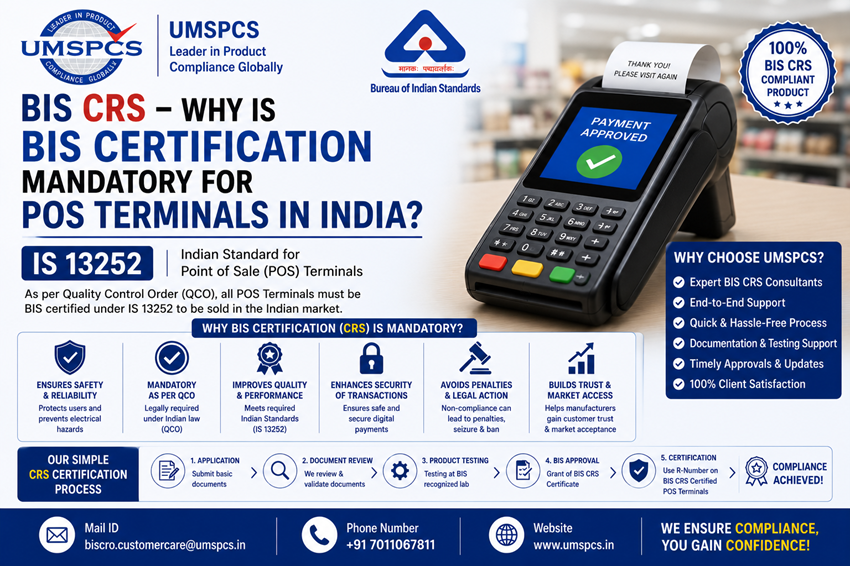
In this scheme, the export of POS terminals in the Indian market IS 13252 is prohibited if they do not meet with Indian Standards. Once the product has been successfully certified, it will receive BIS registration and the product may be marked with the CRS marking.
This is the certification that ensures the product is safe and of quality in India.
Main Reasons Behind Mandatory BIS Certification
To ensure that the electronic products in the market are safe, reliable and meet Indian standards, the Indian government has made BIS certification compulsory.
- Consumer Safety
- Quality Control
- Prevention of Substandard Imports
- Helping prevent product failure
- Legal Market Access
That’s why it’s crucial to manufacturers and importers to adhere to BIS standards.
Basic Requirements for BIS Certification for POS Terminals IS 13252
Businesses are required to meet some basic criteria prior to being certified.
- Manufacturer Details
BIS certification is a process that can only be done by the manufacturer. Individuals seeking to be a trader, dealer or distributor cannot apply directly.
- Factory Location
BIS Registration is to be done separately for each manufacturing site. In the case of more than one factory, each factory will have to apply separately.
- Product Category
The product should be in the notified category of the product for the POS terminal IS 13252(Part 1). The correct classification of products is extremely critical.
- Trademark Requirement
The trademark or brand name should be correctly registered and/or authorized. Documents of authorization may be required for the applicant (not the trademark owner).
- Authorized Indian Representative (AIR)
An Authorized Indian Representative (AIR) has to be appointed by the foreign manufacturers for BIS Certification in India. The AIR serves as a liaison between BIS and foreign manufacturers.
Products Covered Under BIS CRS for POS Terminals IS 13252(Part 1)
The technical configuration and product category of various types of POS and payment-related devices can pose risk of non-compliance with the BIS criteria and thus necessitate certification.
Common Products Covered
- Point of Sale (POS) Terminals IS 13252(Part 1)
- Smart POS Devices
- Wireless POS Machines
- Android POS Systems
- Card Payment Machines
- Handheld POS Devices
- Electronic Payment Terminals
- Mobile POS Devices
The Indian Standard that will apply will depend on the product type and technical specifications.
BIS Certification Procedure for POS Terminals IS 13252
The BIS CRS registration process IS 13252 includes product testing, documentation and product approval.
UMSPCS assists businesses to both manage and streamline the process.
Step 1: Product Profiling & IS Code Identification
The product specifications, features and technical information is analysed to find the right Indian Standard (IS) under BIS CRS.
To prevent the following, it is best to classify correctly:
- Wrong testing
- Application rejection
- Compliance delays
Step 2: Sample Testing & Laboratory Coordination
Product samples are tested at a lab which is recognized by BIS.
UMSPCS assists with:
- Lab coordination
- Sample submission
- Test scheduling
- Compliance verification
- Test report management
Step 3: Documentation & Application Preparation
All necessary documents (e.g. are prepared and verified by our team):
- Technical documents
- Circuit diagrams
- Product specifications
- User manuals
- Quality control documents
- AIR documents (foreign manufacturers)
All Documents are prepared in accordance with the BIS CRS guidelines.
Step 4: Application Submission & BIS Review
The BIS application is submitted via BIS portal and test reports and supporting documents are submitted.
We also assist our clients with BIS enquiries and technical clarifications while going through the review process.
Step 5: Grant of R-Number & BIS Registration
On successful approval BIS issues the CRS Registration Certificate in addition to the R-number. Certified POS terminals can then be legally manufactured, imported and sold in India.
Step 6: Marking & Labeling Compliance
We can assist companies to comply with the BIS marking regulations such as:
- Standard Mark is applied appropriately
- Correct R-number display
- Labeling and packaging compliance
Step 7: Renewal & Compliance Support
In addition to UMSPCS offering support after certification, they offer the following:
- CRS renewal
- Explain how to add new models
- BIS surveillance support
- Compliance updates
This aids enterprises to operate long term compliant with BIS.
Documents Required for BIS Certification
Proper documentation is a critical element to successful approval.
- Business Registration Certificate: Document showing that the company is incorporated or is a legal entity.
- Product Details & Specifications: Complete Technical information of the product.
- Test Reports: These are issued by BIS recognised laboratories to test the compliance.
- Business Plan: Outline of business plans (if applicable)
- Representative letter: For a person who is authorised to sign and/or represent.
- Foreign Manufacturers appointing an Authorized Indian Representative should have AIR Documents.
Cost and Timeline of BIS Certification for POS Terminals
The fee for certification is based on various factors:
- Type of product
- Complexity of documents
- BIS government fees
| Category | Total Cost (Excluding GST) |
| Indian Manufacturer | ₹55,000 + GST |
| Overseas Client | ₹90,000 + GST |
Generally, it takes between 20 – 30 days for certification by CRS, depending on the level of preparation of your products and documents.
- Documentation: 5 – 7 days
- Product Testing: 10 – 15 days
- BIS Approval: 7 – 10 days
Benefits of Hiring a BIS Consultant
Inaccuracies or technical errors often cause delays in many businesses. Hiring a consultant makes it easier.
Benefits of Professional Consultancy
- Faster approval process
- Reduced rejection chances
- Proper documentation support
- Technical compliance guidance
- Testing coordination
- BIS query handling
- Complete process management
This will save both time and cost of operation.
Why Choose UMSPCS For BIS certification for POS terminals?
The UMSPCS Official Website is a reliable BIS certification for POS terminals consultancy to assist the manufacturers from India and abroad to achieve regulatory compliance easily.
We have successfully helped businesses in various industries to obtain BIS certification, CRS registration, ISI certification and compliance.
- Experienced compliance professionals
- End-to-end certification support
- Fast process handling
- Strong technical expertise
- Affordable consultancy services
- Import of Indian & foreign manufacturers is allowed
We have a team of experts who are in close collaboration with businesses and facilitate smooth and hassle-free approval.
Conclusion
POS terminals (IS 13252) are a crucial component of the ever-expanding digital payment ecosystem in India. The quality and safety of these products are of paramount importance, as they are used to process everyday financial transactions.
That is why the BIS has made it a compulsory certification for the POS terminals in India, as per the CRS scheme. The failure to do so can result in import restrictions, penalties or rejection of the market by the manufacturer and importer. Alternatively, certified products receive enhanced trust, access to the market and improved business opportunities.
UMSPCS offers end-to-end solutions for BIS certification in India ranging from documentation, testing coordination, application filing to compliance management.
Call UMSPCS now and experience the ease and hassle-free nature of getting your POS terminals BIS certified.
Read more also: BIS ISI Certification for Marine Plywood IS 710 – Specification
FAQs- BIS Certification for POS Terminals in India
- Are there any conditions for the certification for the POS terminals by BIS?
Yes, if your point of sale system is under the CRT System then it should be BIS certified in India.
- Who is eligible to take BIS certification?
BIS certification is only given by the manufacturer.
- Is there any possibility for foreign manufacturers to apply for BIS certification?
Yes, the application can be made using an authorized Indian representative (AIR) by foreign manufacturers.
- Are the products required to be subjected to testing?
The testing in laboratories approved by BIS is compulsory.
- What is the time required for BIS certification for POS terminals?
Typically 20 – 45 days, dependent on testing and documentation requirements.
- Will UMSPCS be able to conduct the entire BIS process?
Yes, UMSPCS can offer you complete end to end BIS certification for POS terminals consultancy support.
❓ Ask a Question
Have any doubts? Fill the form below and our team will respond shortly.