Marine plywood is not ordinary plywood. It has special waterproof, water-resistant, moisture-resistant and anti-environmental performance. This is the reason why it is widely used in kitchens, bathrooms, boats, coastal projects, outdoor furniture and commercial interiors where durability is the prime requirement.
The thing is, however, this is the concern. Not all marine plywood products in the market exceed their claims. Wetness can cause poor quality plywood to weaken, crack, bend or be damaged in a matter of hours. The Government of India has imposed BIS mandatory standards for several wood-based products as a part of Quality Control Order (QCO) to regulate poor quality products and promote quality assurance in the Indian market.
For manufacturers and importers, it isn’t just a requirement of the law. It is now a crucial necessity for business. BIS certification with ISI marking helps to build the trust in the market and boosts the acceptance of the product among dealers, builders, architects and consumers.
In this guide, UMSPCS outlines the complete information on BIS ISI Certification for Marine Plywood, from IS 710 specification to approval process, the required documents, costs, timelines, advantages, and how expert consultancy support can ease the entire process.
What is BIS ISI Certification for Marine Plywood?
In order to guarantee proper quality and safety of products offered for sale in the Indian market, the Government of India had issued Quality Control Orders (QCOs). To sell plywood products in India, it is mandatory for manufacturers and importers that they get BIS certification from the BIS based on the applicable BIS ISI Certification for Marine Plywood.
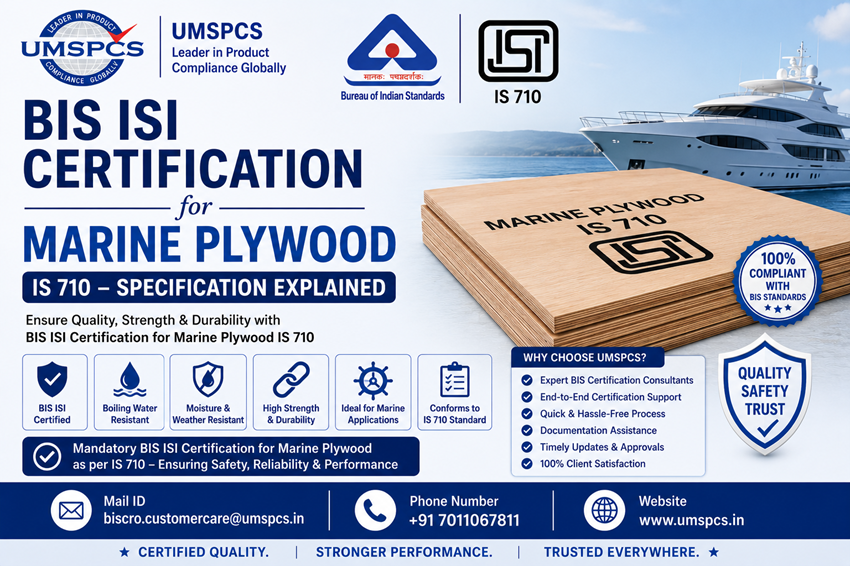
The marine plywood products should be as per the requirement of IS 710. On successful approval, the manufacturer can affix the ISI Mark to their products.
This is the certification which certifies the product as per the quality norms laid down by the Indian market.
Why BIS Certification for Marine Plywood Mandatory?
The government made BIS Certification for Marine Plywood mandatory to improve product quality and protect consumers from substandard products.
Main Reasons Behind the QCO
- Consumer Safety: Certified products have a more durable quality and are reliable.
- Quality Standardization: Indian Standard has to be followed by all manufacturers.
- Prevention of Low Quality Products: To prevent entry of low quality plywood into the market, the QCO is used.
- Better Industry Regulation: Improves manufacturing practices and quality control systems.
- Import Quality Monitoring: Marine plywood products that are imported to India need to meet the standards of India as well.
Businesses can be penalized, their product seized or sales and distribution restricted without proper BIS certification in India.
Importance of BIS Certification in India for Marine Plywood
Today customers are more quality oriented. Consumer, Contractors, Dealer and Architects want certified products which are proved to be standard in India. Hence, BIS certification in India becomes an integral part of the plywood industry.
Key Benefits of BIS Certification
- Builds customer trust
- Improves product credibility
- Enhances market reputation
- Supports dealer confidence
- Participates in tenders with government
- Increases product acceptance
- Improves competitive advantage
ISI marked products are more likely to be found reliable in the market.
Products Covered Under BIS Certification
This Quality Control Order can be used for various wood-based and plywood products.
Common Products Covered
- Marine plywood
- Commercial plywood
- Block boards
- Flush doors
- Decorative plywood
- Veneered boards
- Shuttering plywood
- Flexible plywood
- Wooden panel products
There is an Indian Standard for each product category. Specific to marine plywood is the IS 710.
BIS Certification Process for Marine Plywood
To get BIS certification in India, the process includes technical evaluation, product testing and compliance verification.
UMSPCS facilitates businesses to deal with the process smoothly from start to finish.
Step 1: Align Manufacturing Unit with Applicable Indian Standard
The first step is to know which Indian Standard the product is covered. All marine plywood products should meet requirements of IS 710.
Now, manufacturers may have to perform some enhancement or upgradation of the production process to comply with the quality standards of BIS.
This step may involve:
- Reviewing manufacturing practices
- Enhancing quality control programs
- Improving equipment and production line
- Establishing correct testing/calibration facilities
- Establishment of an in-house laboratory as needed
If done properly this is a crucial step to prevent future compliance problems.
Step 2: Application Filing & Documentation
The product samples need to be tested in a BIS recognised laboratory and an NABL Accredited laboratory in accordance with Indian Standard before filing BIS application.
Meanwhile, all the necessary paperwork is carefully completed.
Documents generally include:
- Factory details
- Manufacturing process details
- Machinery list
- Quality control setup
- Product specifications
- Test reports
- Business registration documents
After documentation preparation:
- BIS application is submitted online via BIS portal
- There are no paper application fees, which are paid online.
- The complete application was submitted to the concerned BIS Branch Office.
Correct documentation is key to proper approval.
Step 3: BIS Factory Inspection
Once the application is reviewed, the officials of BIS may go for an onsite inspection at the factory.
The aim of inspection is to ensure that the manufacturing unit is capable of making products to meet IS 710 requirements.
On inspection, BIS officers will inspect:
- Manufacturing facility
- Production process
- Quality control system
- In-house testing capability
- Laboratory setup
The inspection officer can also take samples of products at random from the factory. These samples are securely stored and forwarded to a third party lab for testing.
Step 4: Product Testing & Laboratory Test Report
All the product samples are tested in laboratories which are recognized and accredited by BIS and NABL.
On completion of the test the Laboratory Test Report (LTR) will be directly submitted by the testing laboratory to BIS. If the product passes all of the necessary tests, the approval process continues.
Step 5: Closure of Non-Conformities (If Any)
During inspection or a document review, BIS can identify non-conformities (NCs) in some cases.
These may be issues that could be related to:
- Manufacturing process
- Product quality
- Documentation gaps
- Testing issues
- Quality control systems
Corrective actions would need to be taken by the manufacturer and submission of compliance documentation to close NCRs. Handling NCs is important to avoid delays for approval.
Step 6: License & Marking Fee Payment
Once BIS verifies that the manufacturer has met all the requirements, the manufacturer is required to pay:
- Annual license fee
- Marking fee
These charges must be paid prior to the Grant of Certification.
Step 7: Grant of ISI License
Once the product has been successfully inspected, tested, verified it meets the standards and the fee has been paid, the manufacturer is issued with the ISI Mark license.
This certificate certifies the product as being in accordance with Indian quality and safety requirements, as per IS 710.
Documents Required for BIS Certification
Documentation is one of the most important parts of the certification process.
- Basic information of the manufacturing unit and product category
- Evidence of manufacturing unit address (ownership or lease deed, utility bill, etc.)
- Trademark registration certificate (when the brand name is used and registered)
- Manufacturing license / statutory approvals (where applicable) such as pollution control, industry specific approvals etc
- Product drawings/design schematics
- Installed manufacturing capacity
- List and specifications of raw materials used
- Details of manufacturing machinery and equipment
- Factory layout plan (showing production, testing, and storage areas)
- Detailed manufacturing process flow
- List of in-house test equipment and calibration details
- Details of quality control personnel
- Factory organizational chart
UMSPCS helps businesses prepare all documents professionally to avoid delays.
BIS Certification for Marine Plywood Costing and Timeline
Length of time is dependent on the quantity of documentation, product testing and BIS processing time. The typical time is 30-40 business days.
There are several factors which affect the BIS certification in India.
| Particulars | Estimated Cost (INR) |
| Application Fees (BIS) | ₹1,000 |
| Testing Charges (Lab Fees) | 15000 – ₹2,50,000 |
| Factory Inspection Charges | ₹7000 |
| Annual License Fees | ₹1,000 |
| Marking Fees (ISI Mark Usage) | As per BIS norms (based on production) |
| Consultancy Charges (UMSPCS) | ₹ 50000 |
Common Challenges Faced by Manufacturers
Technical and procedural issues are common problems encountered by businesses when they are being certified.
Common Issues
- The IS standard is not selected
- Incomplete documentation
- Product testing failure
- BIS query delays
- Insufficient knowledge of compliance.
- Improper factory preparation
Businesses can overcome these challenges with the help of professional consultancy services.
Benefits of Professional BIS Consultant for Certification
There is a simpler approach to the certification process with an experienced consultant.
Advantages
- Faster process management
- Reduced rejection chances
- Proper technical guidance
- Accurate documentation
- Testing coordination support
- BIS query handling
- Complete compliance management
This provides a timesaving and operating cost reduction. Read more: BIS Certificate for Foreign Manufacture
How Can UMSPCS Help You?
Complete consultancy services for BIS ISI Certification for Marine Plywood and other certification requirements are provided by UMSPCS Official Website. We support Indian and foreign manufacturers to acquire –
- Experienced compliance experts
- Fast process handling
- Affordable consultancy services
- Strong technical expertise
- A smooth and hassle-free approval
- End-to-end certification assistance
Our team collaborates closely with manufacturers to ensure expedient and smooth approval.
Conclusion
Marine plywood is very widely used for applications where strength, durability and water resistance are very critical. The Government of India has decided that BIS Certification for Marine Plywood should be made to maintain good quality in the market.
The products which are a part of IS 710 – Specification need to be appropriately BIS certified in India for production, import, and sale on the Indian market. Non-compliance could result in significant business and regulatory issues for manufacturers and importers.
Looking to get your marine plywood BIS Certified? We can help you!
UMSPCS offers end-to-end services for documentation, testing coordination, preparation of factory inspections, application filing and compliance management.
Contact UMSPCS today and don’t delay to get your marine plywood products completely BIS compliant.
Read more also: BIS CRS Certification for Electronic Musical Audio Systems – 2026
FAQs- BIS Certification for Marine Plywood IS 710
- Is BIS Certification for Marine Plywood obligatory?
Yes, marine plywood products falling within IS 710 need the mandatory BIS certification.
- What is the standard of marine plywood?
Marine plywood shall have to meet IS-710 standard.
- What is the need of BIS certification in India?
It provides assurance of product quality and safety according to Indian standards.
- Do you have to take a laboratory test?
Yes, it is compulsory to test at BIS registered laboratories.
- What is the time required for BIS certification?
The process generally takes around 30 – 40 days.
- Will UMSPCS be able to manage the entire certification process?
Yes, UMSPCS offers end to end BIS certification consultancy services.
❓ Ask a Question
Have any doubts? Fill the form below and our team will respond shortly.