

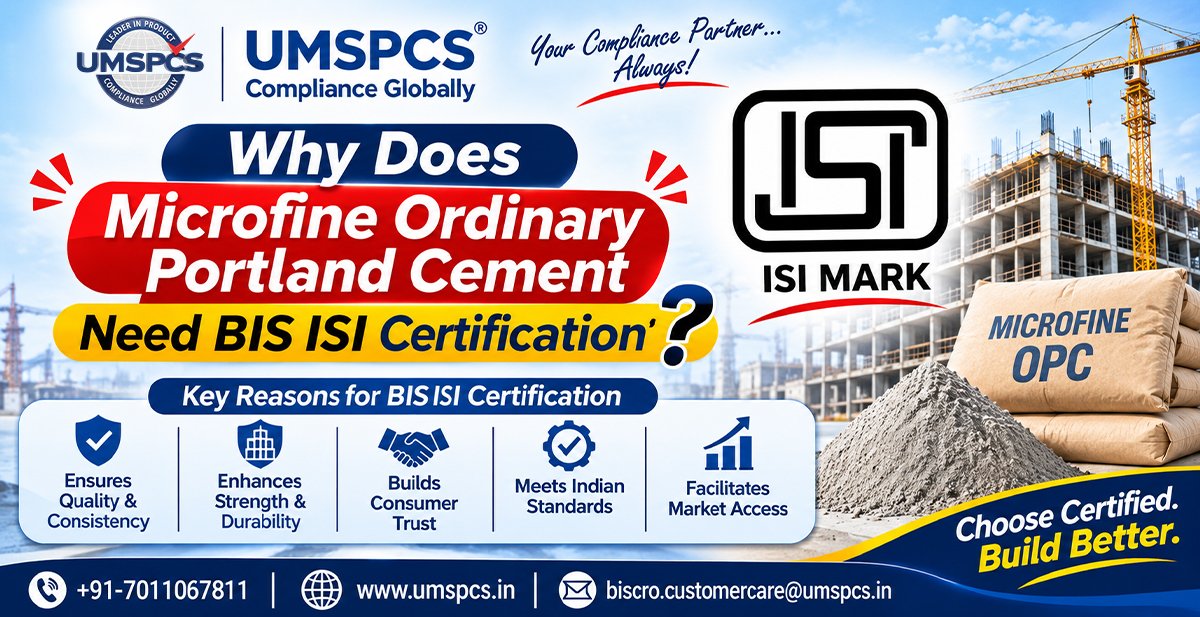
Microfine Ordinary Portland Cement (OPC) is a high-performance special cement that fills very narrow cracks and other gaps and provides superior performance over general-purpose cement. Like any performance chemical, its performance could be adversely affected by small changes in its fineness, strength, and other characteristics. This underscores the need for BIS ISI Certification for Microfine OPC.
Portland cement finds numerous applications in construction. However, to meet performance requirements, specific chemicals and additives are usually incorporated in the base cement. Certain additives are added to improve the setting time of the cement. Ordinary Portland Cement is manufactured in fine and coarse grades to suit application requirements. Unlike specialty cements, normal cements do not require approval for sale in India.
The Indian standard IS 16993:2018 specifies the requirements for Microfine Ordinary Portland Cement and provides a framework for assessment of the product. The BIS certification ensures compliance with the Indian Standard and provides quality assurance.
For manufacturers wishing to enter or expand their business in the Indian market, understanding the certification, testing, and regulatory processes becomes essential.
What Differentiation does Microfine Ordinary Portland Cement Offer?
Microfine Ordinary Portland Cement is a fine particle size, processed and specially classified Portland cement. As compared to regular Portland cement, its smaller particle size provides the capability to fill narrower cracks and other voids. As a result, it is commonly used in special construction and repair activities.
The BIS Compendium of Indian Standards on Cement lists the main applications of Microfine Ordinary Portland Cement (OPC) as being in rock grouting, concrete structure grouting, soil stabilization, underground construction, leak sealing and preventative measures.
The product comes under the purview of IS 16993:2018, which defines Microfine Sulphate Resisting Portland Cement as well.
Why Is BIS ISI Certification Necessary for Microfine Ordinary Portland Cement?
BIS certification is not a quality label. It represents the ability of manufacturers to show that their products conform to the Indian Standards. In this context, certification is important since the product is in the category of cement, which attracts compulsory BIS certification.
In the BIS standard detail portal, IS 16993:2018 is recognized as a product for which certification is mandatory. It is also in the BIS Scheme-I list of products for which certification is obligatory.
The primary benefits of BIS Certification are listed below:
- Compliance with Legal Requirements of India
- Assurance of Product Quality
- Improves Winning Probability for Infrastructure Projects
- Improves Market Acceptance
- Earns Credibility in Domestic and International Business
What are the Key Requirements for Obtaining BIS Certification?
It is important for manufacturers to ensure that their production and testing facilities are ready prior to making an application to BIS ISI Certification for Microfine Ordinary Portland Cement.
- Principal Requirements
- Manufacturing infrastructure
- Control of raw materials
- In-house laboratory
- Testing Equipment
- Quality control system
- Product conformity
BIS Product Manual also lays down sample requirements of 9 kg for physical tests and 1 kg for chemical tests.
Obtaining the BIS ISI Certification for Microfine Ordinary Portland Cement
The certification is granted under the BIS Scheme-I (ISI Mark Scheme). The process comprises assessment of the application, factory inspection, testing of the product, and grant of license.
Step 1: Knowledge of the Indian Standard
The applicant should be aware of the latest Indian Standard relating to their product, i.e., IS 16993:2018 and any subsequent amendments thereto, and should:
- Study the BIS standard and product manual.
- Identify product specifications and product testing requirements.
- Tune their manufacturing and quality control processes as per the requirements of the standard.
Step 2: Product Testing and Documentation
Prepare samples of the product and provide the following documents.
- Specifications and test requirements of the product.
- Factory and manufacturing information.
- Details of raw materials and quality control.
- Details of laboratory equipment and calibration.
3. Submission of BIS Application
Submit the BIS application through the applicable route for certification and pay the prescribed fee. The BIS reviews the application and may request more information.
4. BIS Factory Inspection
BIS officials check the manufacturing facility to see if the following are as described in the application.
- Infrastructure and equipment for manufacturing.
- Manufacturing and quality control processes.
- Laboratory and testing equipment.
5. Testing of Samples and Submission of LTR
Product samples are tested against the requirements of IS 16993:2018. The laboratory test the samples and submits Laboratory Test Reports (LTRs) to BIS.
Step 6: Rectification of Non-conformities
Deficiencies noted during any examination shall be addressed by the manufacturer and supporting evidence shall be submitted to BIS.
Step 7: Payment of Certification Fees
Application fee along with inspection, testing, licence, and marking fee to be paid as per the latest BIS fee structure.
Step 8: Grant of BIS ISI Licence
On successful completion of all applicable assessments, BIS issues a licence for the product scope approved by BIS, authorizing the manufacturer to affix the ISI Mark in accordance with the conditions mentioned therein.
Documents Required for BIS ISI Certification
Appropriate documents help avoid application deficiencies and delays during certification.
- The basic data of the manufacturing unit and product segment would include
- Ownership document of the unit
- Address proof of the unit, eg., utility bill
- Brand name is to be protected and registered, and a copy of trademark registration to be submitted.
- Statutory approvals, licenses and authorizations, e.g. pollution control and other industry-specific approvals
- Product drawings/schematics
- Installed capacity of the product
- List of raw materials used
- Details of machinery and equipment used in the process
- Factory layout plan showing production, test and storage areas
- A detailed description of the process flow
- In-house test equipment and calibration
- Quality control personnel
- Organizational chart of the factory
BIS may require additional documents, based on the applicant’s manufacturing arrangement and product varieties and the certification route.
Cost of BIS ISI Certification for Microfine Ordinary Portland Cement
The cost of BIS ISI Certification for Microfine Ordinary Portland Cement (IS 16993: 2018) comprises the cost of testing the product, cost of factory inspection, cost of services of consultants, and cost of preparing the required documents.
| Particulars | Estimated Cost |
| BIS Application Fee | ₹1,000 |
| Testing/Laboratory Charges | ₹15,000 – ₹2,50,000 |
| Factory Inspection | ₹7,000 |
| Annual Licence Fee | ₹1,000 |
| ISI Marking Fee | As per BIS norms |
| UMSPCS Consultancy | ₹50,000 |
These costs are estimated, and actual costs may vary from the above, depending on actual project requirements. The final cost will also depend on the facilities, equipment, and product specifications of the manufacturer.
Timeline & Validity of BIS Certification for Microfine Ordinary Portland Cement
- Timeline: Depending on various factors like product documentation, product testing, factory inspection, and BIS approval, it may take approximately 30 to 40 working days.
- Foreign Manufacturers: Obtaining Certification may take longer due to the need for factory inspections in the country of origin, as well as additional documentation and assessment by the FMCS.
- Licence Validity: The BIS licence is subject to terms and conditions. The licence is valid for a definite period, and to continue using the ISI Mark, it has to be renewed as per the requirements of BIS.
Common Challenges During BIS Certification
Even manufacturing units with established Microfine Ordinary Portland Cement production units may face difficulties during certification.
Some of the challenges are:
- Incorrect classification of the product
- Testing equipment may not be adequate
- Variations in particle size
- Inadequate quality of raw materials
- Inadequate documentation
- Poor calibration
- Lack of Quality Control
In such cases, until the issues are resolved, a cease and desist order may be imposed by BIS. Manufacturing units should address these issues to ensure that their application does not face any avoidable delays. You can also read more about BIS ISI Certification for Sulphate Resist Portland Cement
How UMSPCS Aids Manufacturers in Acquiring BIS ISI Certification for Microfine OPC?
Acquiring the BIS certification is a process that includes various administrative and technical procedures. The process requires manufacturers to understand the applicable Indian Standard, perform tests on the sample as per the standard, prepare technical documentation, and ensure the readiness of the factory for the production of the product.
UMSPCS has over 6+ years of compliance experience and support in helping manufacturers with understanding and adhering to over 600+ product compliance requirements.
UMSPCS can provide the following during the course of the certification process:
- Identify the applicable standard and assess the compliance status.
- Assist with preparation of technical documentation.
- Ensure factory readiness.
- Support with laboratory testing
- Complete the application process.
- Post-certification, assist with BIS licensing renewal.
Conclusion
Microfine Ordinary Portland Cement is a special construction material, where the intended performance of the product is directly impacted by the fineness of the product, particle-size distribution, setting behavior, and strength. Therefore, the manufacturers of this product must conform to IS 16993:2018 to supply this product in the Indian Market.
Achieving BIS ISI Certification for Cement ensures compliance with India’s legal requirements, improves consistency in product quality, and builds credibility in the market. It is always advisable to perform due diligence and investigate product certification in India prior to the launch of a new product in India, or before making the decision to export to the Indian market.
If your objective is to obtain BIS ISI certification for Microfine Ordinary Portland Cement,
UMSPCS has the expertise to perform documentation, testing, factory evaluation, and BIS licensing for you.
Read more also: How Manufacturer Can Get BIS CRS for Laptops, Notes & Tablets
FAQs
- Is BIS ISI Certification mandatory for Microfine Ordinary Portland Cement?
Yes. As per the latest notification of BIS, IS 16993:2018 is on the mandatory list of certifications. Therefore, to supply this product in the Indian market, the manufacturers must obtain the applicable BIS license.
- What Indian Standard does Microfine Ordinary Portland Cement come under?
IS 16993:2018 is the Indian Standard that applies to Microfine Ordinary Portland Cement as well as Microfine Sulphate Resisting Portland Cement.
- Can Microfine Ordinary Portland Cement be sold without the ISI mark?
Products under a compulsory certification scheme cannot be manufactured and/or sold in the Indian market without fulfilling the applicable BIS licensing requirements.
- Can a foreign manufacturer get a BIS certificate for Microfine Ordinary Portland Cement?
Yes, foreign manufacturers can apply under the FMCS scheme and have to nominate an Authorized Indian Representative.
- Is BIS CRS Certification applicable to Microfine Ordinary Portland Cement?
No, the CRS scheme is the Compulsory Registration Scheme for certain electronic and IT products. Microfine Cement requires the applicable BIS ISI certification under Scheme-I.
❓ Ask a Question
Have any doubts? Fill the form below and our team will respond shortly.
