Paper may appear to be a very simple product, but the quality of paper is of the utmost importance in printing, writing, packaging, publishing, education, and a number of other industrial applications. The differences in strength, thickness, brightness, smoothness and absorbency can have a direct bearing on the performance and usefulness of the paper. This is why quality standardisation is such an important issue for the paper manufacturers who are supplying the Indian market.
But how can a paper manufacturer be confident that its products meet the quality specifications laid down in India? That’s where the BIS ISI Certification for Paper comes in.
Bureau of Indian Standards (BIS) runs a product certification programme wherein manufacturers can prove that their product complies with the Indian Standard that is applicable. Before getting started with the application for a BIS certificate for paper, it is necessary to look at the type of paper, relevant Indian standard, certification conditions, and government notifications.
For Indian and foreign manufacturers, it is essential to understand the certification process, its technical specifications and testing, along with factory inspection beforehand in order to avoid delays. The blog describes the whole procedure of getting BIS certification in India for Paper, starting from determining the necessary Indian Standard and ending with receiving and maintaining a BIS certificate.
What is BIS ISI Certification for Different Kinds of Paper
BIS certification is related to the conformity assessment procedure that confirms that the product conforms to the requirements of the applicable Indian Standard, and the ISI Mark signifies that the product is certified by BIS.
However, not all paper products are subject to the same certification requirements. The applicable Indian Standard will vary according to the type of paper, the grade of paper, the application, and the product class.
Some relevant Indian Standards include:
| Indian Standard | Product category |
| IS 14490:2018 | Plain Copier Paper |
BIS certification is normally voluntary unless the Central Government makes it mandatory via a Quality Control Order (QCO). The BIS November 2024 implementation circular explicitly lists IS 1848 (Part 1):2018 as a product which is subject to voluntary certification. So manufacturers should not assume that every variety of paper is subject to mandatory ISI certification. They need to check the relevant QCO and its latest amendments for their particular product.
What Are the Basic Requirements for Obtaining a BIS Licence for Paper?
Before you start the process of BIS certification for paper, you must ensure that your production facilities and your quality control systems are capable of meeting the relevant Indian Standard.
The following requirements generally need to be fulfilled:
- Manufacturing facility
- Product conformity
- Testing facilities
- Quality-control personnel
- Production records
- Standard marking
BIS looks at the manufacturing infrastructure, the process controls, the testing capability, and product conformity prior to issuing a licence.
How can manufacturers obtain BIS ISI certification for paper?
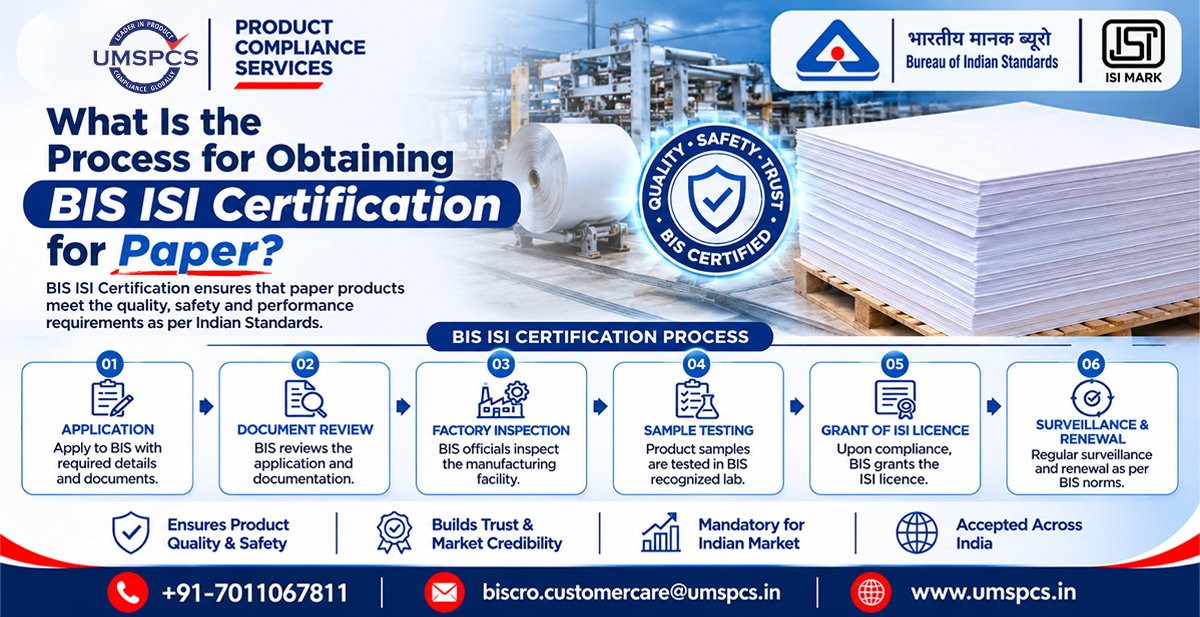
The process of getting BIS ISI certification for paper is to identify the relevant Indian Standard, produce the technical documentation, carry out the product testing, and complete the factory assessment by BIS.
The general certification process includes the following steps:
Step 1: Identifying the Indian Standard
The manufacturer must ascertain the relevant Indian Standard regarding paper classification.
- IS 1848 (Part 1):2018, which applies to writing and printing paper.
- IS 1848 (Part 2):2018, which is applicable for particular specialty paper.
- Identify product grade, use, and technical specifications.
Step 2: Preparing the Product for Certification
Prepare product samples and relevant documentation required for certification.
- Prepare product characteristics and manufacturing information.
- Provide information on raw materials and factory/machinery manufacturing hours.
- Provide representative paper samples for laboratory analysis.
Step 3: Applying for BIS
Submit an application for certification through the Manakonline portal of the BIS.
- Present the company and factory information.
- Choose the correct Indian Standard.
- Provide required documentation and pay the application fee.
Step 4: Inspection of the Factory
BIS officials will make a trip to the factory to inspect the manufacturing process and quality control.
- Examine the machines used for paper making.
- Verify the test tools and calibration records.
- Review the Quality Control process followed in production.
Step 5: Testing and Report Generation
Paper samples will be tested as per Indian Standards.
- Perform relevant tests to determine the thickness, brightness, opacity, and strength of paper.
- Evaluate all the other prescribed quality parameters.
- Just submit the lab report to BIS for assessment.
Step 6: Rectification of Non-Conformities
If defects are found, then the manufacturer must take corrective action.
- Resolve product testing failures.
- Improve the manufacturing and quality control arrangements.
- If you’re required to submit any further documentation or samples, then do so.
Step 7: Payment of Licence and Marking Fees
Once the assessment has been successfully completed, complete the relevant financial formalities.
- Pay the required BIS licence fees.
- Fulfil the ISI marking fee requirements.
- Clear any other relevant certification fees.
Step 8: Grant of BIS ISI Licence
Once the verification has been successfully completed, BIS will issue the licence to use the ISI Standard Mark.
- Get approval for the relevant paper category.
- Apply the ISI Mark in accordance with the BIS guidelines.
- Maintain product quality and meet all surveillance and renewal requirements.
Documents Required for BIS ISI Certification for Paper
Good documentation will assist the BIS in its assessment of the applicant’s manufacturing operations and its quality management arrangements.
The commonly required documents include:
- Basic data of the manufacturing unit and the product segment
- For example, a title deed showing the ownership or a utility bill could be submitted as proof of the address of the manufacturing unit.
- Trademark registration certificate (if brand name is used and registered)
- Manufacturing licence / statutory approvals (where relevant – such as pollution
- control and industry-specific approvals)
- Product drawings/design schematics
- Installed manufacturing capacity
- List of materials used, and specifications
- Details of manufacturing machinery and equipment
- The layout plan of the factory, including production and testing areas, and storage areas
- A detailed manufacturing process flow is given
- In-house test equipment and calibration information
- Information about the quality control personnel
- Factory organisational chart
The final document checklist will vary depending on the relevant Indian Standard, certification route, and manufacturer category.
Cost of BIS ISI Certification for Paper
The total cost of getting BIS ISI certification for paper is worked out on the basis of the product category, the applicable Indian Standard, the test parameters, the manufacturing setup, and the certification formalities. It will also vary depending on whether the application is being made by an Indian manufacturer or an overseas manufacturer.
For an initial budget estimate, manufacturers can refer to the following indicative cost structure:
| Particulars | Estimated Cost (INR) |
| BIS Application Fees | ₹1,000 |
| Laboratory Testing Charges | ₹15,000 – ₹2,50,000 |
| Factory Inspection Charges | ₹7,000 |
| Annual Licence Fees | ₹1,000 |
| ISI Marking Fees | As per BIS norms and production |
| UMSPCS Consultancy Charges | ₹50,000 |
The figures above are indicative estimates for planning purposes and are not the official BIS fee schedule. The actual outlay will vary depending on the product and the certification required.
Timeline and Validity of BIS Certification for Paper
The process of BIS certification for paper is a multi-stage affair, and the total time taken to complete it will vary depending on how well each stage is managed. The various factors that can affect the time taken are the product sample preparation, the capacity of the lab, the readiness of the factory, the evaluation of the application, and compliance with BIS observations.
Manufacturers can use the following estimates to plan their certification activities:
| Certification Stage | Estimated Time |
| Documentation and Application | 5 – 7 working days |
| Product Testing | 10 – 15 working days |
| Factory Inspection and BIS Evaluation | 10 – 18 working days |
| Overall Estimated Timeline | 30 – 40 working days |
Validity of the BIS ISI Licence: The BIS licence is initially issued for a specified period (generally one to two years) and can be renewed for up to five years depending on the certification scheme, payment of the prescribed fees, and compliance with BIS conditions. Foreign manufacturers applying under the FMCS will also have to meet the scheme-specific renewal requirements.
Common Challenges Manufacturers May Face During Paper Certification
Even when the manufacturers have got their production facilities up and running, there can still be technical and procedural issues that will delay certification.
- Incorrect Standard Identification
- Inadequate Testing Facilities
- Product Testing Failures
- Incomplete Documentation
- Factory Inspection Observations
- Regulatory Changes
How UMSPCS Helps Manufacturers Obtain BIS ISI Certification for Paper
To get a BIS licence, you need the manufacturer to co-ordinate a number of things: standard identification, technical documentation, product testing, factory preparation, and regulatory communication.
With over 6 years of experience in compliance and having worked on well over 600 product compliance requirements across a wide range of industries, UMSPCS has developed a very structured and product-specific way of approaching certification requirements.
Our support includes:
- Standard Identification
- Documentation Assistance
- Testing Coordination
- Factory Audit Preparation
- Application Support
- FMCS Assistance
- Post-Certification Guidance
Conclusion
Getting BIS ISI certification for paper is more than just filling in an application form. The manufacturer has to identify the correct Indian Standard, understand the regulatory requirements that apply, have the appropriate testing facilities in place, and be able to prove that their product consistently meets the quality requirements specified.
Whether you’re an Indian manufacturer looking to get a BIS licence or an overseas company looking at BIS certification for foreign manufacturers, it’s absolutely vital that you understand the certification process. It will help you to avoid all the pitfalls of documentation gaps, testing problems and the inevitable delays.
At UMSPCS, we take the hassle out of certification with a structured approach to compliance support, technical documentation, lab coordination, and factory inspection prep.
Planning to get BIS ISI certification for paper?
Partner with UMSPCS for expert guidance at every stage of your certification.
Read more also: What Power Bank Brands Need for BIS Registration India
FAQs
Q1. Is BIS ISI certification required for all types of paper in India?
No, BIS certification is normally voluntary unless the particular paper product in question is covered by an applicable Quality Control Order. The manufacturer should check the latest notification for their product.
Q2. Which Indian Standard applies to writing and printing paper?
IS 1848 (Part 1):2018 relates to a number of grades of writing and printing paper, including bond, cream laid, maplitho, and account book paper.
Q3. Can Indian manufacturers apply for BIS ISI Certification for Paper?
Yes, Indian manufacturers can apply via the BIS Manakonline portal under the relevant product certification scheme.
Q4. Can foreign paper manufacturers get BIS certification in India?
Yes, foreign manufacturers can get certification via the Foreign Manufacturers Certification Scheme (FMCS), subject to the relevant eligibility and technical requirements.
Q5. Is an Authorised Indian Representative necessary for foreign manufacturers?
Yes, foreign manufacturers applying under FMCS will be required to appoint an eligible Authorised Indian Representative to undertake the prescribed regulatory responsibilities in India.
Q6. What happens if the paper samples fail BIS lab testing?
If the samples fail to meet the applicable standard, the manufacturer will need to investigate the non-conformity, put in place any necessary corrective action, and then follow the relevant BIS retesting and application procedures.
❓ Ask a Question
Have any doubts? Fill the form below and our team will respond shortly.