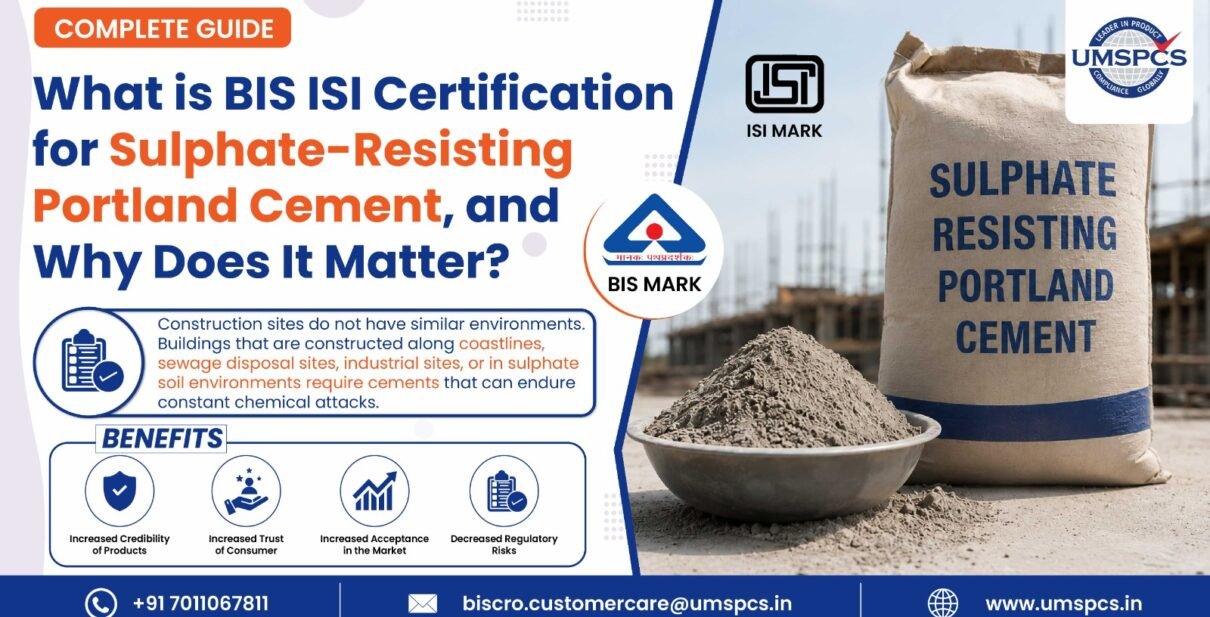
Construction sites do not have similar environments. Buildings that are constructed along coastlines, sewage disposal sites, industrial sites, or in sulphate soil environments require cements that can endure constant chemical attacks. The presence of sulphates in soils and groundwater may cause a reaction within cement, causing cracking, expansion, and decay of concrete. Special cement called Sulphate Resistant Portland Cement (SRPC) is required for areas where the possibility of sulphates exists.
But producing good cement is not enough. To sell BIS ISI Certification for Sulphate-Resisting Portland Cement in India, the manufacturers are required to meet the quality and safety specifications prescribed by the Bureau of Indian Standards (BIS). As per the applicable Quality Control Order (QCO), to obtain BIS ISI Certification for products covered under IS 12330, it is essential.
The scope of IS 12330, the significance of certification, who should be certified, and how to apply IS 12330 are all covered in the aforementioned guide.
Every stage of the certification process, including product evaluation, documentation, factory testing coordination, factory inspection preparation, and BIS certification, can be handled by UMSPCS.
What is Sulphate Resistant Portland Cement (as per IS 12330)?
A special Portland cement formulation called SRPC offers enhanced defence against sulphate attack. In order to reduce the reaction between the cement and sulphates present in soil, groundwater, or seawater, it is made using carefully regulated chemistry.
Due to this property, SRPC is broadly used in projects where structures made of concrete are exposed to tough environmental circumstances and are planned for extended durations.
The quality requirements for BIS ISI Certification of Sulphate-Resisting Portland Cement are given by the Bureau of Indian Standards in IS 12330. The standard sets out the requirements for manufacturing, quality parameters, testing, sampling and marking to ensure consistent product performance and reliability.
SRPC is not used for ordinary concrete but in particular applications to provide additional sulphate resistance for the service life of concrete structures.
Why Does Sulphate-Resisting Portland Cement Require BIS ISI Certification?
Structural safety is crucial, and therefore there are some cement products regulated through mandatory quality standards by the Government of India. IS 12330 covers Sulphate-Resisting Portland Cement, which must meet the relevant Quality Control Order (QCO) before being manufactured, sold, or distributed in the Indian market.
The BIS licence is a document issued to the manufacturer to allow the use of the ISI Mark, which is used to show that the product meets the applicable Indian Standard.
Obtaining BIS certification helps manufacturers; they benefit in the following ways:
- Meet statutory requirements before market entry.
- Prove the product to be of Indian quality.
- Increase the confidence of contractors, infrastructure developers and government buyers.
- Increase market acceptance and credibility.
- Minimize the likelihood of penalties for non-compliance.
If the manufacturing or supply of notified cement products is done without a BIS licence, it can result in restrictions on sale, etc.
Who Needs BIS ISI Certification for IS 12330?
All manufacturers of BIS ISI Certification for Sulphate-Resisting Portland Cement with reference to its use in India shall ensure that such cement is obtained from BIS for undertaking commercial supply before the commencement of business.
This generally includes:
- Combined cement plants.
- Cement Grinding Units
- Private cement manufacturers.
- Producers of cement in the public sector.
- Manufacturers of infrastructure and Government cement.
A BIS licence is granted to the manufacturing unit based on the evaluation of its production capacity, quality management system, testing facilities, and compliance with the applicable requirements of IS 12330.
Where is Sulphate-Resisting Portland Cement Commonly Used?
Not all construction projects have to use Sulphate-Resisting Portland Cement. It is mainly used where there are high levels of sulphates in the concrete that might adversely affect the durability of the concrete over time.
Common applications include:
- Marine and coastal structures.
- Plants that treat wastewater and sewage.
- The soil where the foundations are located is rich in sulphate.
- Structures with basements and tunnels underground.
- Facilities for processing chemicals that contain sulphuric acid.
- Retaining walls, canal linings, and hydraulic structures.
Why Do Some BIS Applications Get Delayed?
There are many delays in certifications that are due to non-compliant, non-technical problems that could be avoided.
Common reasons include:
- Wrong or inadequate records.
- Reports from a laboratory that are not acceptable for BIS.
- Missing calibration records.
- Poor documentation of quality control.
- Delayed answers to BIS questions.
- Non-compliance found in the factory during the inspection.
Complete BIS ISI Certification Process for IS 12330
Our BIS ISI Certification for Sulphate-Resisting Portland Cement procedure at UMSPCS follows a clear procedure for effective execution.
Step 1: Product Profiling & Indian Standard Identification
The BIS ISI certificate identifies the relevant Indian Standard (IS code).
Our team considers:
- Details of the product
- Production process
- BIS requirements
- Quality Control Orders, or QCOs
To avoid problems with product classification, testing, and application process delays, it is essential to accurately identify the Indian Standard.
Step 2: Product Testing & Documentation
The laboratory that has been approved by the National Accreditation Board for Certification Bodies (NABL) will test products and prepare documentation in compliance with the relevant Indian standard.
The assistance procedure entails:
- Organising the process of product testing
- Creating technical documentation
- Gathering data about the factory
- Documentation for quality control
- Making application forms
An application for BIS registration is built upon solid documentation and test results.
Step 3: BIS Application Filing
When testing and documentation are completed, the BIS registration application is filed with the BIS portal.
Application filing usually consists of:
- Test reports
- Factory and production information
- Technical records
- Fees set by the government
After that, the application is sent to the BIS authorities for additional processing.
Step 4: BIS Factory Inspection
BIS representatives conduct an inspection to determine whether the manufacturer satisfies all certification requirements.
Typically, an inspection consists of the following:
- Production procedure
- Production plant
- System for quality assurance
- The facility’s testing facilities
- Management of product quality
The BIS representative may even collect product samples for independent testing during the inspection.
Step 5: Sampling, Testing, and Evaluation of Lab Report
Testing is done on samples collected during inspection to confirm that the products meet the applicable Indian standards. The testing lab then sends the lab report straight to BIS officials for certification and evaluation.
Step 6: Closure of Observations/Non-Conformity (If Any)
Corrective action must be taken whenever there are observations or non-conformities at any point in the process.
During this phase, some actions that could be taken include:
- Enhancement of processes
- Documentation submission
- Submission of corrective action report
- Conformity submission
All observations must be satisfactorily addressed before certification can proceed.
Step 7: Payment of License & Marking Fees
Following the technical assessment and compliance verification, the manufacturer must pay the following expenses:
- The cost of a BIS licence
- ISI marking charge
- The cost of earning the necessary certification
This signifies the completion of the final phase of the certification procedure.
Step 8: Awarding of the ISI License by BIS
After each of the aforementioned processes is completed, BIS grants the ISI licence. Manufacturers can now use the ISI logo to show that their goods adhere to Indian standards.
Documents Required for BIS ISI Certification
There will be different documentation requirements depending on the nature of the products being offered. Examples of documents that would be needed are:
- Basic details of the manufacturing plant and product line
- A document showing proof of address of the manufacturing plant
- A trademark registration certificate, if there is a brand name that is registered
- Manufacturing license / statutory clearances
- Product drawings/designs
- Manufacturing capacity installed
- Material specification
- Machinery and equipment involved in the manufacturing process
- Layout plan showing the location of the factory, manufacturing area, quality control area, and other relevant sections
- A delineated manufacturing process flow is given.
- Test equipment and calibration
- Details of the quality control team members
- Organogram of the factory
Cost & Timeline of BIS Certification
BIS certification fees depend upon many parameters that include the following:
- Category of the product
- Indian standard applicable to the product
- Number of variants of the product
- Testing and factory inspection requirements
- Government fees of BIS
- Laboratory fees
Timeline
It will take 30 – 45 days for complete certification.
How can UMSPCS help you with BIS ISI Certification?
Getting a BIS licence for Sulphate-Resisting Portland Cement requires proper planning, technical documentation, product testing, factory preparation and constant liaison with BIS officials. For many manufacturers, the challenge of meeting these requirements in-house is a time-consuming task and can slow the approval process for products.
As the manufacturer completes the certification process, UMSPCS offers thorough support, guaranteeing that the procedure is executed effectively and conforms with BIS standards. With more than 600+ successful certificates, it has six years of experience in this field and has assisted manufacturers.
Our services include:
- Product applicability assessment
- The Indian Standard mentioned above is to be identified.
- The development of documentation and verification skills.
- Coordinating with BIS-recognised labs
- BIS application filing
- Factory inspection support
- BIS query handling
- Guidance on post-certificate compliance and renewals
UMSPCS handles the BIS certification process with the manufacturers, reducing and facilitating avoidable delays and ensuring a timely entry into the market.
Conclusion
SRPC is a key component in structures that are subject to aggressive sulphate environments, including marine structures, sewage treatment plants, below-grade foundations and industrial facilities. To maintain consistency in the quality and regulatory compliance, manufacturers of this cement are required to get BIS ISI Certification from IS 12330 before offering the product in the Indian Market. Get to know more about ISI Mark for Products.
For a factory to receive a BIS licence, it is essential to be aware of the certification requirements, have the appropriate quality control systems in place, and be ready for inspection at the factory. If manufacturers can plan the certification process and adhere to the relevant standards, they can minimise delays and build their market positions.
If you intend to produce or sell Sulphate-Resisting Portland Cement, then it’s best to have some professional advice to make the certifying process easier and more efficient. UMSPCS offers a complete package service, including documentation support and coordination, testing, BIS approval and continuing compliance.
Read more also: What are BIS CRS Requirements for Amplifiers with Input Power
FAQs
- BIS ISI Certification mandatory for Sulphate-Resisting Portland Cement?
If there is a QCO for sulphate-resistant Portland Cement, then the companies manufacturing it have to register with BIS.
- What is meant by IS 12330?
The standards for quality, manufacture, tests, and performance of sulphate-resistant Portland Cement are specified in IS 12330.
- What is the usual application of Sulphate-Resisting Portland Cement?
It is mainly used for marine structures, sewage treatment plants, coastal construction, and industrial constructions with a higher requirement of resistance to sulphate attack.
- What is the duration of the BIS process?
The time frame will vary depending on the quality and completeness of the documentation and BIS review. Quick answers to enquiries can minimize approval time.
- What documents are needed for BIS ISI Certification?
In general, all the manufacturing-related documents such as factory registration documents, product specifications, and other supporting documents as required by BIS are desired by the manufacturers.
- What does UMSPCS do to support BIS Certification?
UMSPCS offers comprehensive support, such as product applicability assessment, documentation, laboratory coordination, BIS application filing, factory inspection support, query handling, and compliance post-certification.
❓ Ask a Question
Have any doubts? Fill the form below and our team will respond shortly.