Millions of homes, offices, and even construction infrastructure developments in India will need water supply networks that can provide households with continuous access to clean and dependable drinking water. The most common type of pipe that is used in transporting drinking water is the uPVC Pipe because of its high strength and corrosion resistance.
Nonetheless, before these pipes could be distributed in India, they first had to pass the quality standards set by the Bureau of Indian Standards (BIS). Obtaining the BIS Certification for Unplasticized PVC Pipes in accordance with IS 4985 is of vital importance for ensuring the quality and safety of your product.
If you are a manufacturer who wants to get the BIS Certification in India or an international supplier exporting pipes to India, you should know more about BIS certification according to IS 4985.
In our new blog post, we at UMSPCS provide you with all the necessary information about the process of obtaining BIS certification under IS 4985.
What is BIS Certification for Unplasticized PVC Pipes?
The BIS Certification for Unplasticized PVC Pipes is awarded by the Bureau of Indian Standards under the ISI Mark Scheme for products meeting the criteria as laid down in IS 4985: Unplasticized PVC Pipes for Potable Water Supplies – Specification.
This certification permits manufacturers to place ISI marks on their products and shows conformity to Indian quality and safety standards.
The certification is designed to ensure that the pipes are appropriate for the purpose of carrying water for drinking and meet all the necessary conditions regarding size, rating, strength, and quality of material.
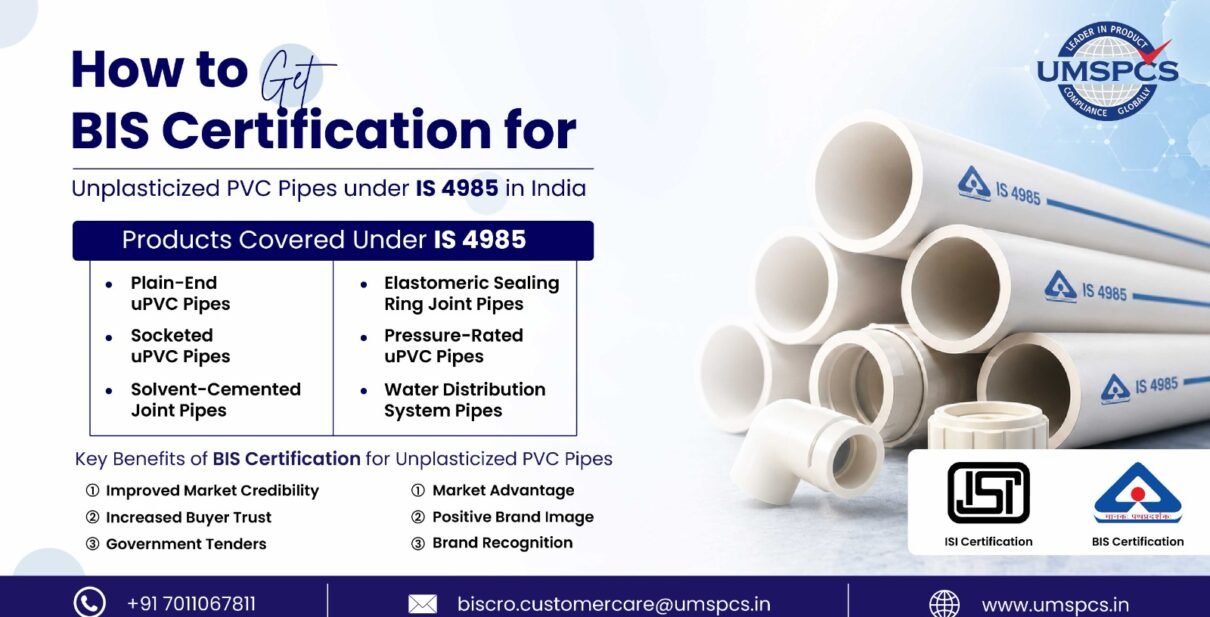
Products Covered Under IS 4985
IS 4985 lays down specifications for various kinds of unplasticized PVC pipes meant for potable water supply purposes.
Such pipes may include:
- Plain-end uPVC pipes
- Socketed uPVC pipes
- Solvent-cemented joint pipes
- Elastomeric sealing ring joint pipes
- Pressure-rated uPVC pipes
- Water distribution system pipes
- Municipal water supply pipes
- Agricultural water supply pipes
Manufacturers manufacturing any one of these kinds need to have BIS certification to sell these pipes in India.
Key Benefits of BIS Certification for Unplasticized PVC Pipes
- Improved Market Credibility: The ISI marking signifies conformity to quality standards acknowledged by the nation.
- Government Tenders: Most government tenders and infrastructure construction projects need BIS certification for their products.
- Increased Buyer Trust: Buyers will have faith in the products due to the certification process.
- Market Advantage: Manufacturers with certifications possess an edge in the market over those without certifications.
- Compliance with Quality Norms: Certification assures adherence to quality norms in India and avoids any problems with the law.
- Positive Brand Image: This ISI certification increases the brand image of a product.
Basic Requirements Before Applying for BIS Certification
Certification Requirements for Manufacturers include:
- Production plant
- Technical competence
- Systems to ensure the quality of raw materials used
- Testing facilities
- Calibration facilities for testing equipment
- Process control information
- Quality assurance procedures
Meeting these requirements significantly improves approval chances.
Applicable Tests for BIS Certification Under IS 4985
In order to prove that the standards laid out in IS 4985 have been complied with, various tests need to be carried out. These include:
- Visual Inspection
- Dimensional Testing
- Opacity Test
- Hydrostatic Pressure Test
- Reversion Test
- Vicat Softening Point Test
- Test for Sulphated Ash Content
- Impact Resistance Test
- Tensile Strength Test
These tests ensure the product is suitable for potable water applications.
Step-by-Step Procedure to Obtain BIS Certification
Step 1: Identification of Applicable Standard
The Indian standard for Unplasticized PVC Pipes is chosen, namely, IS 4985.
This involves:
- Understanding product requirements
- Analysing IS 4985 specification
- Compliance with BIS requirements
Step 2: Product Testing and Technical Documents Preparation
A sample of the product is tested in an ISO certified laboratory accredited by NABL.
During this step:
- Product testing is carried out
- Technical documents are prepared
- Information about the factory is provided
- Application forms are filled out
Step 3: Filing BIS Application
A BIS application is filed, accompanied by necessary documentation and fees.
Typically included in this category are:
- Test report
- Factory information
- Technical documents
- Government fees
Step 4: Factory Visit by BIS Officials
Inspection is done by BIS officials who will inspect:
- Production Process
- Manufacturing plant/infrastructure
- Quality control measures
- Testing infrastructure
Samples might be taken from the manufacturing unit.
Step 5: Testing of Collected Samples
Samples are then tested by approved laboratories, and a copy of the test reports is sent to BIS for evaluation.
Step 6: Closure of Non-Conformities
Non-conformities are addressed, if found, through corrective action, and necessary evidence is sent to BIS.
Step 7: License Fee Payment
If the evaluation is successful, then the following fees have to be paid:
- License Fee
- ISI Marking Fee
Step 8: ISI License Issue
On successful completion of all the steps, BIS awards the ISI license, and thus the manufacturer can use the ISI mark on their product.
Documents Required for BIS Certification
Manufacturers will need to furnish several technical and legal documents.
These will include:
- Basic data of the manufacturer as well as the product segment
- Address proof of the manufacturing unit (title deed, utility bill, etc.)
- Brand/trademark registration certificate (in case the trademarked name is used)
- Manufacturing license/statutory approval (wherever required – like pollution
- control, specific industry licenses)
- Drawings/schematics of the product design
- Capacity of manufacturing facilities
- List of raw materials along with specifications
- Data on manufacturing machines/equipment
- Layout of the manufacturing plant, including manufacturing and testing facilities,
- storage facilities, etc.
- An elaborate process flow for manufacturing is included. An elaborate manufacturing process flow is provided.
- Testing facility within the factory and calibration data
- Data on quality control staff
- Factory organisational structure
Estimated Cost of BIS Certification for Unplasticized PVC Pipes
The total certification expenditure will depend upon:
- Product assortment
- Testing costs
- No. of manufacturing units
- Inspection charges
- Application charges by BIS
- Marking charges
If you are an international manufacturer, then other costs involved could be:
- Authorised Indian Representative’s fee
- Auditing travel costs
- International documentation procedures
Considering the large variation in costs, it is advisable to take the help of a professional for a customised quote.
The time required for obtaining certification will depend on how prepared your documents are and the test results. It takes about 30 to 40 working days on average.
Common Challenges Faced by Manufacturers
Reasons for Delays Among Many Applicants include:
- Incorrect Product Classification: Choosing the wrong standard may lead to application rejection.
- Inadequacy in Documents: Lack of relevant documents leads to BIS queries.
- Testing Failures: The product might not conform to requirements.
- Lack of Quality Control Mechanisms: Insufficient testing facilities might result in delays.
- Non-Conformance in Factory Audits: The manufacturing unit does not satisfy BIS standards during inspection.
- Problems with Foreign Manufacturers: Foreign applicants find it difficult to understand the Indian regulatory system.
Professional Assistance Could Avoid These Pitfalls.
Why Choose UMSPCS as Your BIS Consultant in India?
UMSPCS stands out as an eminent BIS Consultant in India, having completed more than 600+ projects for the compliance and certification of both Indian and foreign manufacturers. We offer full services to our clients for the compliance and certification process by providing assistance in documentations, testing, application, audit, queries, and post-certification.
As an experienced BIS Consultant in India, we at UMSPCS help the manufacturers with the following areas:
- Identification of product standards
- Preparation of documents
- Filing of BIS applications
- Coordination with laboratories
- Technical compliance evaluation
- Preparation of factory audits
- Handling of BIS queries
- Foreign Manufacturer Compliance Service for foreign manufacturers
- Authorised Indian Representative services
- Post-certification compliance management
Our expert and professional team at UMSPCS has been successful in helping many manufacturers obtain BIS certificates. Also can get information more about Best FMCS Certification Consultant in Chennai.
Future Market Opportunities for Certified Manufacturers
Indian investments in:
- smart cities
- urban water networks
- rural water supply programs
- housing complexes
- industrial utilities
are contributing to an increasing demand for top-notch uPVC pipe systems.
Those companies that have BIS accreditation are well-placed to take advantage of this trend.
Conclusion
With the development of water-related infrastructure in India, it becomes imperative that there is strict adherence to quality standards. BIS Certification for Unplasticized PVC Pipes IS 4985 is mandatory for guaranteeing the quality of products, ensuring regulatory compliance, and acceptance by customers.
If you require BIS ISI Certification for Indian Manufacturers or wish to facilitate BIS certification for foreign manufacturers, seek the help of experts to make the task easy and save time on the certification process.
Our team at UMSPCS provides all kinds of assistance for ensuring the successful acquisition of BIS certification.
Do You Require BIS Certification for Unplasticized PVC Pipes?
Contact our experts at UMSPCS today for assistance in documentation, testing, applications, factory inspection, and overall certification services.
Read more about: BIS Certification for UPS/Inverters of Rating ≤10kVA
FAQs
- Is it necessary to have BIS certification for Unplasticized PVC Pipes as per IS 4985?
Yes, the manufacturers wanting to launch their uPVC pipes as products meant for supplying potable water in India need to be compliant with the corresponding BIS regulations and obtain certification, wherever necessary.
- Who can get BIS certification for Unplasticized PVC Pipes?
Both Indian and foreign manufacturers can submit an application for BIS certification of their pipes. However, the latter will require applying via the FMCS procedure and nominating an Authorised Indian Representative.
- What is the duration of certification for BIS under IS 4985?
It normally ranges between 30-40 working days based on testing, documentation and the time taken by BIS for their evaluation.
- What are the important tests carried out under IS 4985?
Among others, these involve hydrostatic pressure testing, opacity test, impact resistance testing, tensile strength testing, dimensional verification, and Vicat softening temperature testing.
- Why do manufacturers need to hire a BIS Consultant in India?
Consultants ensure that there are no mistakes in documentation, testing, answering queries from BIS officials, undergoing inspection, and so forth.
❓ Ask a Question
Have any doubts? Fill the form below and our team will respond shortly.