UPS systems and inverters are now a must-have for buildings such as homes, offices, commercial buildings and industries where power is essential. But before the manufacturers can enter the Indian market with these products, they have to meet the relevant requirements laid out by the BIS.
The BIS certification for UPS/inverters of a rating ≤10kVA is compulsory under the BIS Compulsory Registration Scheme (CRS). The products that come under IS 16242 (Part 1):2014 must be registered with BIS before they can be put on the Indian market for sale, import or manufacturing.
Non-compliance with the BIS requirements could result in restrictions on import, access to the market, regulatory penalties and delay in product introduction. Hence, the manufacturers, importers, foreign manufacturers and brand owners need to understand the certification process.
What is IS 16242 (Part 1):2014?
IS 16242 (Part 1):2014 has been the Indian standard for UPS systems and inverter ratings of 10 kVA and below. The standard outlines safety criteria to provide safe operation and protection from electrical hazards.
This standard intends to ensure that UPS systems and inverters are designed and built in compliance with known safety standards at the point of sale to the consumer.
The typical elements of the standard are:
- Electrical safety requirements
- Protection against electric shock
- Safe product construction
- Reliable operational performance
- The safety of the user and the reliability of the product
UPS/inverters with a rating of ≤10kVA, as per the CRS, shall be compliant with IS 16242 (Part 1):2014 to get BIS certification.
Why do UPS/inverters (rating ≤10kVA) need BIS certification?
UPS systems and inverters are directly connected to electrical installations and are often used as a backup power source. Risks can be created for users and attached equipment due to defects or safety problems.
The BIS CRS scheme ensures the quality and safety of the products before entering the Indian market.
The advantages of BIS certification are discussed below:
- The Indian regulations comply.
- Improved product safety
- Increased customer confidence
- Better market acceptance
- Reduced regulatory risks
- Enhanced brand credibility
Obtaining BIS certification for UPS/inverters of a rating ≤10kVA also demonstrates a manufacturer’s commitment to quality and compliance.
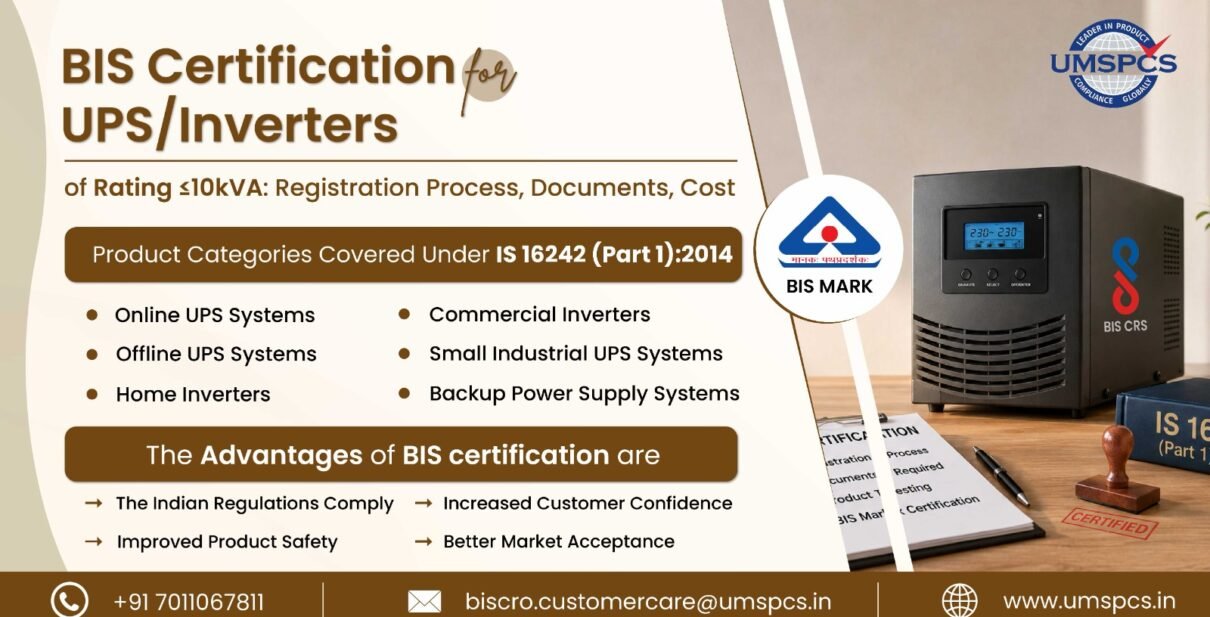
Product Categories Covered Under IS 16242 (Part 1):2014
It can be applicable to a range of UPS and inverter products up to 10kVA.
Examples include:
- Online UPS Systems
- Offline UPS Systems
- UPS systems are classified as line-interactive UPS systems.
- Home Inverters
- Commercial Inverters
- Small Industrial UPS Systems
- Backup Power Supply Systems
The manufacturers need to be cautious while assessing the product specification to ensure its applicability under the BIS CRS scheme.
Who Needs BIS Certification for UPS/Inverters of Rating ≤ 10 kVA?
The general requirement of certification is for manufacturers, importers, brands and suppliers of covered UPS and inverter products in India.
1. Indian Manufacturers
Any manufacturer of UPS/inverters that wants to sell the products covered by BIS CRS registration in the Indian market will need to register with the BIS ISI certificate for Indian manufacturers. The certification ensures that Indian safety and quality standards are followed. To obtain the BIS, Indian manufacturers must undergo factory assessment and product testing.
Key Responsibilities
- Product testing
- Technical documentation
- Application submission
- Compliance management
2. Foreign Manufacturers
In order to export UPS systems and inverters to India, foreign manufacturers must meet the BIS certificate for foreign manufacturer requirements and designate an Authorised Indian Representative (AIR).
Key Responsibilities
- Product compliance
- AIR appointment
- Technical documentation
- Regulatory coordination
3. Brand Owners
The brand owners of UPS systems, or inverters, who sell them with their own trademark, need to ensure that the UPS system or inverter is a registered product of BIS.
Key Responsibilities
- Compliance verification
- Supplier coordination
- Documentation support
- Managing brands and labels. Brand and labelling management.
Complete Process of BIS CRS Registration for UPS/Inverters
There are various important steps required to get BIS registration. Making sure that you are properly planning and documenting your work will help you to prevent any unnecessary delays.
Step 1: Product Assessment and Identification of Relevant Standards
Finding the BIS CRS applicable Indian standard for the product and researching its specifications are the first steps.
This helps businesses:
- Choose the appropriate IS standard.
- Don’t make mistakes in product classification.
- Avoid testing and application problems.
Step 2: Product Testing at BIS-Recognised Laboratories
Before product registration, the product must be tested in BIS-approved laboratories.
During this stage:
- Samples of the products are tested.
- Compliance requirements are checked.
- Laboratory reports are created.
- Testing schedules are planned.
- Successful testing is a crucial part of the registration process.
Step 3: Documentation Preparation
To ensure that approval goes smoothly, it is necessary to document accurately.
The documentation package may contain:
- Technical specifications
- Product design information
- Circuit diagrams
- User manuals
- Details of manufacturing
- Records of quality control
- Declarations and affidavits
- documents that AIR created for overseas producers.
Step 4: Submitting and Examining BIS Applications
Once testing and documentation are finished, the application is submitted via the BIS CRS portal.
Right now:
- The application process is finished.
- Documents are reviewed.
- BIS evaluates compliance
- Questions are promptly addressed.
Step 5: Grant BIS Registration (R-Number)
Following a successful review, BIS registers the product.
Manufacturers are given:
- Certificate of BIS CRS Registration
- A distinct BIS R-number
After that, the product can be manufactured, imported, and sold in India lawfully.
Step 6: Compliance with Product Marking and Labelling
Every registered product must adhere to BIS labelling and marking specifications.
This comprises:
- application of the BIS Standard Mark in compliance with the requirements.
- Display the R number. Display the R number.
- Compliance with product and packaging labelling
Step 7: Continuing Compliance & Renewal Assistance
Compliance even after having been approved for registration.
Businesses may require help with:
- Registration renewal
- Introducing new models
- Addition of new models
- BIS monitoring operations
- Updates on regulations
Documents Required for BIS Certification for UPS/Inverters
Documentation plays an important role in the certification process. Incomplete/correct documents may result in delays and further enquiries by BIS.
Common Documents Required
- A business registration certificate is evidence that a legal entity has been incorporated.
- Product Specifications & Details: All of the product’s technical details
- Test reports: supplied by BIS-accredited labs to confirm compliance
- If applicable, a trademark certificate serves as proof of brand ownership.
- Letter of Authorisation: For a representative or authorised signatory
- AIR documents are necessary for foreign manufacturers to designate an Authorised Indian Representative.
Good documentation means that the approval process will be a smoother ride, and there will be less chance for objections.
BIS Certification Cost for UPS/Inverters of Rating ≤10kVA
The amount of certification will depend on various factors, such as:
- Product category
- Number of models
- Testing requirements
- Documentation complexity
- BIS government fees
| Category | Estimated Cost (Excluding GST) |
| Indian Manufacturer | ₹55,000 + GST |
| Overseas Client | ₹90,000 + GST |
BIS CRS Registration Timeline
The total duration will be subject to product testing, document preparation and the BIS review process.
| Activity | Estimated Time |
| Prepared Documents | 5–7 Days |
| Product Testing | 10–15 Days |
| BIS Approval | 7–10 Days |
Most projects can be done within 20-30 working days, depending on successful testing and full documentation.
Benefits of BIS CRS Registration for UPS/Inverters
There are many long-term benefits to getting your product BIS certified.
Key Advantages
- Legal market access
- Better customer confidence
- Improved product reliability
- Reduced compliance risks
- Stronger brand reputation
- Competitive market advantage
Why Choose UMSPCS for BIS Certification for UPS/Inverters of Rating ≤ 10 kVA?
The management of BIS compliance demands technical expertise, coordination of testing and creation of accurate documentation. UMSPCS supports and guides businesses throughout the certification process to ensure an efficient registration. Trusted with 600+ successful BIS certifications. We have helped manufacturers to get timely certification.
Our Services Include:
- Product applicability assessment
- Documentation preparation
- Laboratory coordination
- Application filing support
- Compliance guidance
- Post-certification support
We assist our clients with Indian manufacturers, foreign manufacturers, importers and even the brand owners in their BIS registration process.
Conclusion
BIS certification for UPS/inverters of rating ≤10kVA is another category that needs to be considered. The BIS certification for the same is mandatory for those intending to enter the market in India. Conformity with the IS 16242 (Part 1):2014 is necessary for making your product safe and ensuring compliance.
We can assist in the preparation of documents, coordinating testing, the BIS application process, providing advice on conformity, and much more. With correct documentation and compliance with BIS procedures, there will be no problems with product certification.
Contact us now to learn more about your BIS CRS certification needs.
Read more also: BIS CRS Certification for Crystalline Silicon Terrestrial Photovoltaic
FAQs
- Is BIS Certification mandatory for UPS systems and inverters up to 10kVA?
Yes. Products subject to IS 16242 (Part 1):2014 need BIS CRS registration to sell in India.
- What is the validity of BIS Certification for UPS/inverters of a rating ≤10kVA?
BIS CRS registration is usually provided for a fixed validity period, for which it has to be renewed prior to the end of the term.
- Is it possible for foreign manufacturers to obtain BIS certification for UPS/inverters of rating ≤10kVA?
Yes. An Authorised Indian Representative (AIR) is available for foreign manufacturers to apply.
- If a product is sold without BIS registration, what will happen
Notified products without BIS registration may get penalised or restricted for import or regulatory action.
- What is the time required to obtain the BIS certification?
The certification process generally takes 20–30 working days, depending on the readiness for testing and documentation.
❓ Ask a Question
Have any doubts? Fill the form below and our team will respond shortly.