India is rapidly emerging as one of the prominent users of solar energy in the world. With increased investment in renewable energy products, including rooftop solar power systems, large-scale solar energy plants, and sustainable initiatives supported by the government, the demand for highly efficient solar photovoltaic (PV) panels becomes necessary.
However, entering the Indian market does not simply involve manufacturing high-performance solar panels. Compliance with all rules and regulations regarding quality and safety standards is necessary when following the Bureau of Indian Standards (BIS).
Among other things, BIS CRS Certification for Crystalline Silicon Terrestrial Photovoltaic Module according to the Compulsory Registration Scheme (CRS) is one of those.
Whether the manufacturer of solar PV modules is an Indian company or from another country, knowing the details about this certification becomes crucial.
This blog highlights the details of the BIS CRS Certification of electronics, from the requirements of IS 14286 to testing, registration, documentation, cost, time frame, advantages, and assistance offered by UMSPCS to manufacturers.
Why BIS CRS Certification Matters for Crystalline Silicon Solar PV Modules?
The Compulsory Registration Scheme (CRS) is implemented by the Ministry of Electronics and Information Technology (MeitY), and it is overseen by the Bureau of Indian Standards (BIS). It seeks to confirm that products sold in India in electronic and electrical categories conform to the specified safety standards and qualities.
Within the framework of this scheme, the manufacturers of goods have to register with BIS before introducing the product into India’s market.
The BIS CRS Certification for Crystalline Silicon Terrestrial Photovoltaic Module is a confirmation that the Indian Standards have been met.
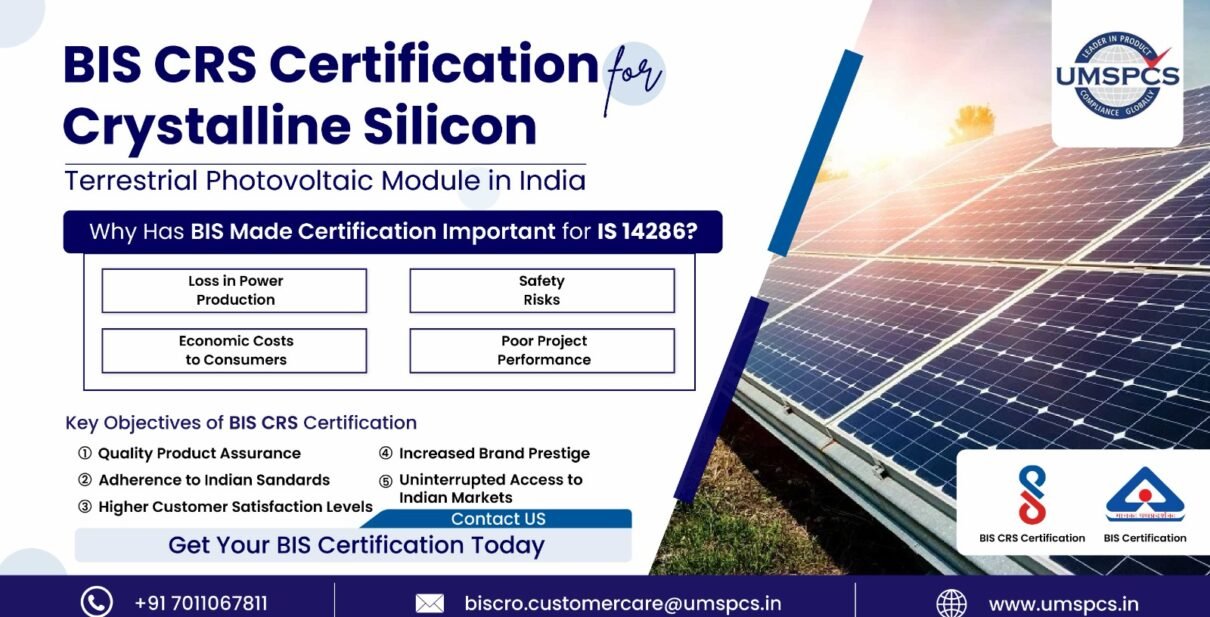
Why Has BIS Made Certification Important for IS 14286?
These modules are intended to function over several decades in severe outdoor environments. Poor-quality products could cause:
- Loss in power production
- Safety risks
- Early failures
- Economic costs to consumers
- Poor project performance
Thus, the BIS certification is a quality check procedure that safeguards not only the consumer but also the renewable energy system.
Products Covered Under IS 14286
This is normally issued for crystalline silicon photovoltaic modules used in:
- Domestic Sectors
- Commercial Applications
- Industrial Uses
- Utility Sectors
- Government Solar Schemes
Key Objectives of BIS CRS Certification for Crystalline Silicon Terrestrial Photovoltaic Module
Manufacturers that are able to obtain BIS certification get the following advantages:
- Quality product assurance
- Adherence to Indian standards
- Higher customer satisfaction levels
- Increased brand prestige
- Participation in government tender opportunities
- Avoidance of penalty fines from regulators
- Uninterrupted access to Indian markets
Eligibility Requirements for BIS CRS Registration
These include the following:
- Manufacturing facility operational
- Production process well-defined
- Conformity to IS 14286
- Technical documents available
- Testing capability for the product
- Quality control mechanisms
- Details of authorised signatories
- Labeling conformity
Foreign applicants must also obtain an Authorised Indian Representative (AIR) if applicable.
Key Technical Requirements Under IS 14286
This standard tests the ability of the module to operate in actual conditions.
The important criteria include:
- Mechanical Reliability: Testing structural strength and durability.
- Electrical Performance: Testing electrical generation features.
- Environmental Durability: Testing under different weather conditions.
- Thermal Stability: Testing performance under different temperatures.
- Safety Standard: Ensuring protection from electrical malfunctions and other hazards.
BIS Testing Requirements for Solar PV Modules
- Testing is considered to be one of the most important phases of the certification process.
The testing of the product must be carried out in a BIS-approved laboratory, as per the standards laid down in IS 14286.
Tests Performed
- Visual Examination Test
- Test for Maximum Power
- Thermal Cyclic Test
- Humidity Freeze Test
- Damp Heat Test
- Mechanical Stress Test
- Hot Spot Endurance Test
- Outdoors Test
- Insulation Test
- Wet Leakage Current Test
Successful completion of these tests is necessary before proceeding with BIS registration.
BIS CRS Registration Process for Crystalline Silicon Terrestrial Photovoltaic Module
Step 1: Product Profiling & IS Standard Identification
We analyse the product specifications and determine the relevant Indian Standard under BIS CRS. Accurate determination of standards will help avoid:
- Misclassification of the product
- Testing delay
- Application rejection
Step 2: Product Testing and Laboratory Coordination
UMSPCS works on testing coordination with BIS-recognised laboratories and facilitates:
- Testing scheduling
- Laboratory coordination
- Conformity assessment
- Test report collection
Step 3: Documentation and Application Preparation
We prepare and scrutinise all necessary documentation, which includes:
- Technical specifications
- Product manuals
- Manufacturing and Quality Assurance documents
- Affidavits and declarations
- AIR for foreign manufacturers
Step 4: Application Filing and BIS Coordination
The application is filed online through the BIS CRS portal, and we coordinate with BIS for any queries throughout the review process.
Step 5: BIS Registration and R-Number Allocation
Following the successful registration process, BIS will issue:
- CRS Registration Certificate
- BIS R-Number
This will ensure legal sale, import and distribution of your product in India.
Step 6: Marking and Labelling Compliance
We advise on proper:
- Usage of the BIS Standard Mark
- R-number placement
- Product Labeling
- Package compliance
Step 7: Registration Renewal and Compliance Assistance
UMSPCS assists with:
- Renewal of registration
- Inclusion of new models
- BIS Surveillance
- Regulatory Update Management
Documents Required for BIS CRS Certification
Several documents need to be submitted by the manufacturers while filing the application.
- Business Registration Certificate: Evidence of company registration/legal entity
- Product Details and Specifications: Technical data sheet regarding the product
- Test Reports: Generated from labs recognised by BIS
- Trademark Certificate: If the product is under trademark
- Letter of Authorisation: For signing authority/representative
- AIR Forms: Necessary for foreign manufacturers appointing an AIR in India
Proper documentation eliminates the chances of getting a query from BIS.
Benefits of BIS Certification for Crystalline Silicon Terrestrial Photovoltaic Module
- Access to Indian Markets: Certification is mandatory for selling and distributing products in India.
- Increased Business Prospects: Certified products are more favoured by distributors, EPC firms, and project developers.
- Increased Confidence in Consumers: BIS certification is an indicator of product quality and reliability.
- Reputation Building: Certification helps to build brand reputation.
- Eligibility to Bidding Process: Many government tendering projects demand that products must be certified under the BIS scheme.
- Risk Management: Certification reduces the likelihood of regulatory interventions and market limitations.
Estimated Cost of BIS CRS Certification for Electronic Products
The overall cost for certification will depend on the following criteria:
- Product Classification
- Quantity of Models
- Testing Cost
- Fees for BIS Registration
- Documentation Requirements
| Category | Total Cost (Excluding GST) |
| Indian Manufacturer | ₹55,000 + GST |
| Overseas Client | ₹90,000 + GST |
As each case is different, manufacturers should seek individualised assessment prior to commencing the process of certification.
The duration of the entire process will vary depending on the readiness of products and testing. Average duration: 20-30 working days.
Common Challenges Faced by Manufacturers
Many applicants encounter difficulties during the certification process.
- Identifying the Correct Standard: Incorrect classification can result in application rejection.
- Test Failures: Non-compliance with IS 14286 requirements may require product modifications and retesting.
- Documentation Errors: Incomplete documentation often triggers BIS queries.
- Delayed Responses: Slow response to regulatory observations can extend approval timelines.
- AIR-Related Issues: Foreign manufacturers frequently face challenges regarding Authorised Indian Representative requirements.
- Labelling Non-Compliance: Incorrect marking requirements may delay certification approval.
Why UMSPCS is the Preferred BIS CRS Consultant in India
BIS certification requires in-depth knowledge of procedures, processes, and regulations. Working with an expert consultant makes this process much easier.
The following services are provided by UMSPCS:
- Standard Identification: Identifying the right Indian standard for the concerned product.
- Documentation: Document preparation and validation of documentation.
- Laboratory Help: Guidance for testing of the product and its samples.
- Application Filing: Effective filing of BIS applications in order to avoid rejections.
- Management of Observations: Expert management of BIS observations and queries raised by the BIS.
- BIS Assistance to Foreign Manufacturers: Complete assistance to foreign manufacturers seeking BIS certification, including their AIR certification.
- Full Service Compliance: UMSPCS will manage the complete life cycle of your BIS certification.
With many years of experience in BIS CRS Certification for electronics, UMSPCS is able to assist manufacturers in obtaining certifications faster.
Why the Future of Solar Manufacturing Depends on Compliance
As the renewable energy industry in India keeps growing, regulatory compliance has become an important factor differentiating between manufacturers.
Certified products have a number of advantages, including:
- Increased market acceptability
- Improved purchasing options
- Increased distributor confidence
- Enhanced customer trust
- Business sustainability
Manufacturers that comply with regulations are more likely to benefit from the booming Indian solar energy industry.
Final Thoughts
The Indian solar energy market is an excellent choice for investments, but compliance is a very important thing in case of market entry into such a market. If your company has been granted a BIS Certification for Crystalline Silicon Terrestrial Photovoltaic Module in accordance with IS 14286, that means the quality and safety of the module have been ensured, along with full compliance.
There are a number of stages in the certification process, from tests and documentation to applying for the certificate and obtaining it.
In case you require qualified help concerning BIS Certification of Crystalline Silicon Terrestrial Photovoltaic Module, BIS CRS Certification for electronic products, as well as BIS Certification for foreign manufacturers, UMSPCS is the company you should contact.
Do you want to launch your Solar PV Modules in India?
Contact UMSPCS right now in order to receive end-to-end BIS CRS registration services.
Read more also: BIS ISI Certification for Aerial Bunched Cables for Voltages 1100
FAQs
- Is it necessary for the Solar PV Module to have BIS certification in India?
Yes, indeed, it is a requirement that the Solar PV Modules under the BIS Regulations be certified before marketing.
- What is the standard adopted by the Government of India for the testing of Solar PV Modules?
Testing of crystalline silicon terrestrial photovoltaic modules should conform to IS 14286 standards.
- Can any foreign company/group avail itself of BIS Certification for Crystalline Silicon Terrestrial Photovoltaic Module?
Yes, the foreign companies may be eligible to obtain BIS certification through AIR.
- What is the average time to get BIS CRS Certification of Solar PV Modules?
Approximately, it takes around 20 – 30 days to obtain BIS CRS Certification for Solar PV Modules.
- What are the major tests involved in the IS 14286 standard?
These are usually: thermal cycling test, damp heat test, humidity freeze test, mechanical load test, insulation resistance test, hot spot endurance test and electrical test.
❓ Ask a Question
Have any doubts? Fill the form below and our team will respond shortly.