It is undeniable that computers and digital devices are integral to the day-to-day life of many people, and keyboards are among the most common input devices in offices, schools, banks, homes and commercial establishments. These could be wired keyboards, wireless keyboards, or gaming keyboards, which are connected to electrical and information technology equipment and should meet safety requirements.
The Government of India has made several electronic and IT products subject to the Compulsory Registration Scheme (CRS) of the Bureau of Indian Standards (BIS) to ensure the safety and quality of the electronic products sold in India.
This blog highlights the BIS CRS registration procedure, eligibility criteria, documentation, cost involved, compliance issues, and how UMSPCS can support companies in getting BIS CRS Registration for keyboards. It is mandatory to be able to manufacture, import, or sell the keyboard in India.
What is the BIS CRS Registration Keyboard?
BIS CRS Registration for the keyboard has been compulsory as per the Compulsory Registration Scheme by BIS. The registration provides confirmation of compliance of the keyboard with the safety requirements mentioned in IS 13252 (Part 1): 2010.
Once approved, the manufacturer will be given:
- BIS Registration Certificate
- Unique Registration (R) Number
- Permission to use the Standard Mark on the product
The registration helps ensure that only safe and compliant products are introduced into the Indian market.
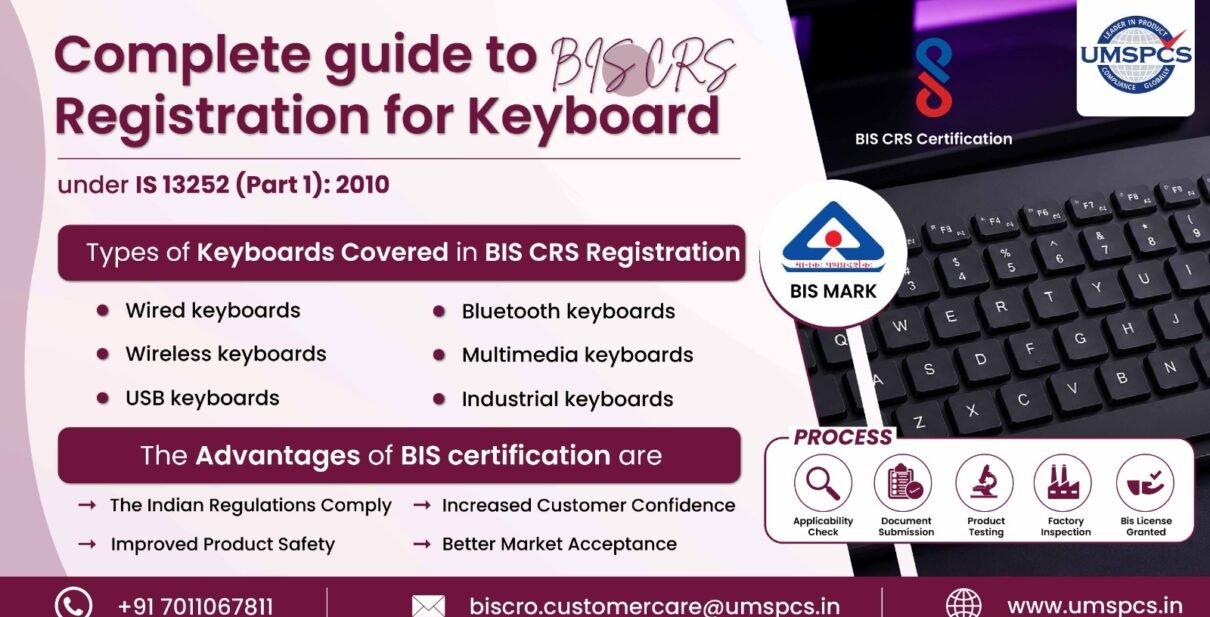
Types of Keyboards Covered in BIS CRS Registration for Keyboards
The following may be subject to a registration requirement:
- Wired keyboards
- Wireless keyboards
- USB keyboards
- Bluetooth keyboards
- Multimedia keyboards
- Gaming keyboards
- Industrial keyboards
Before applying for registration, manufacturers should check whether their products are suitable for the application.
UMSPCS provides an advisory service to manufacturers to identify if their product meets the criteria for inclusion in the BIS CRS scheme and what the criteria are.
What is the significance of BIS CRS Registration for keyboards?
The advantages of BIS registration include:
- Legal permission to sell products in India
- Ensuring compliance with Indian Standards
- Improved product credibility
- Better market acceptance
- Increased consumer confidence
- Reduced regulatory risks
In India, products subject to a mandatory certification scheme are not allowed to be sold without BIS registration.
Product Testing Requirements for BIS CRS Registration
Samples of the product have to be tested in a laboratory recognized by BIS before you apply for registration.
Common tests include:
- Electric shock protection test
- Temperature rise test
- Leakage current test
- Electric strength test
- Mechanical strength test
- Stability test
- Fire hazard test
- Marking and labelling: checking for verification
Only when the product has passed the relevant requirements is it registered by BIS.
List of Documents Required for BIS CRS Registration
For BIS CRS registration, the following documents are required. The required documents for BIS CRS registration are given below:
- Certificate of Business Registration
- Details of Manufacturing Unit
- Factory Address Proof
- Technical Specification of Product
- Images of Product
- User Guide
- Test report from a laboratory recognized by BIS.
- Trademark Certificate (if available)
- Letter of Authorization
- AIR Documents (for foreign manufacturers)
The proper and complete preparation of documents for the BIS CRS certification consultant for Keyboard is one of the most important components of the registration process. Good documentation will reduce delays, limit BIS enquiries and increase the chance of an approval in the time frame.
Know Process of BIS CRS Registration for Keyboard
UMSPCS offers full support during every step of the registration procedure, ensuring manufacturers don’t suffer needless delays.
Step 1: Product Profiling & IS Standards Identification
The first step is to correctly identify the product category & Indian Standard under the BIS CRS scheme. At UMSPCS, we do a thorough product profiling process to verify the applicability of CRS and to identify the right IS for your product.
This helps avoid:
- This is when the product is classified incorrectly and fails to meet the requirements for application.
- Improper selection of the standard leads to failure in testing
- Delays at the BIS portal (misidentification)
Step 2: Product Testing & Laboratory Coordination
Upon identification of the applicable standard, the product should be tested by a BIS-recognized and NABL-accredited laboratory. UMSPCS will directly coordinate with approved laboratories for smooth sample submission and the timely generation of the test report.
This stage covers:
- The product samples are sent to the BIS-recognised lab.
- Coordinate and follow up on the laboratory work.
- Automatic generation of a test report containing all the parameters of the relevant IS standard
Step 3: Factory Inspection by BIS
The manufacturing plant will be inspected to see if the requirements for certification are met.
The following areas will be taken into account for the inspection:
- Manufacturing process
- Production setup
- Quality assurance system
- In-house testing facility
- Management of materials and production.
Product samples might be taken during the inspection for verification purposes.
Step 4: Independent Sample Testing and Assessment
Product samples are tested in the approved laboratories to meet the IS 4990 requirement.
During this step:
- Independent Testing is performed
- Laboratory test reports (LTRs) are prepared
- Laboratory reports submitted for assessment by BIS
Step 5: Non-Conformity Closure
Any non-conformity or deviation identified as a result of testing and inspection should be addressed.
These might include:
- Working with observations about quality
- Making improvements to the manufacturing process
- Resubmission of documents
- Evidence of the provision of closure
- All non-conformities need to be properly closed.
Step 6: License & marking fees are to be paid to BIS
In case of successful completion of the above-mentioned process, the company has to pay the appropriate fees of BIS.
They can be as follows:
- Annual license fee
- ISI Marking Fee
- An appropriate fee as per the BIS regulation.
Step 7: Granting of ISI License
If the tests, inspections, document validations, and the payment of fees are successful, the manufacturer will be granted the ISI license.
The manufacturer is then allowed to affix the CRS mark on its production of plywood and put it into the market according to BIS norms.
Challenges Faced by Manufacturers for BIS CRS Registration
Many producers struggle to be certified.
- Incorrect Identification of Standards: The wrong standard could lead to an approval delay.
- Lack of Documentation: Insufficient documents will cause BIS queries.
- Non-Conformance Testing: In some cases, the products must not meet the technical requirements in testing.
- Factory Inspection Problems: In some cases, the quality management system is not enough to ensure successful certification.
- Delayed Response to Queries: This can result in an unnecessary delay in getting approval.
- FMCS Certification: This involves certain steps that need to be adhered to.
Cost and Timeline of BIS CRS Registration for Keyboard
The registration fee varies according to:
- Product category
- Number of models
- Testing charges
- Documentation requirements
- Consultancy support required
| Category | Total Cost (Excluding GST) |
| Indian Manufacturer | ₹55,000 + GST |
| Overseas Client | ₹90,000 + GST |
Actual cost will depend on product scope and testing requirements.
Estimated Timeline
- Documentation Preparation: 5-7 Days
- Product Testing: 10-15 Days
- BIS Review & Approval: 7-10 Days
Registration normally takes 20-30 days, depending on success during testing and documentation.
Why opt for UMSPCS for BIS CRS Registration for Keyboard?
To get the BIS CRS registration for a keyboard, you need to have extensive knowledge about Indian standards, requirements for testing, documentation, and procedures for BIS registration. Even a minor mistake in testing or documentation might cause delays in the approval process.
UMSPCS has been operating for 6 years in the field of BIS certification consultancy, and we have been helping many manufacturers in getting the certifications for over 600+ BIS-certified products. With our experience, we can help you understand the practical issues involved in the process and provide you with the solutions that will streamline the whole process of certification.
We can help you with:
- Assessing the applicability of the product
- Identifying the appropriate Indian Standard
- Preparing and checking the documentation
- Coordination with the BIS-recognized laboratories
- Filing BIS CRS application
- Responding to the BIS queries
- Post-registration compliance services
From the start till the end of the certification process, UMSPCS will work with you as a compliance partner and help you get the BIS CRS Registration for the keyboard.
Conclusion
Manufacturers who wish to manufacture/import/market keyboards in India must ensure compliance with the requirements of IS 13252 (Part 1): 2010 and obtain BIS CRS Registration for keyboards, wherever applicable. Compliance with BIS requirements is necessary to access the market legally and prove that the product is safe and good.
Registration includes the product testing, documentation and BIS approval, which needs the right planning and technical knowledge.
Planning to obtain BIS CRS Registration for keyboard?
Contact our experts at UMSPCS today to get the help you need with product testing, documentation, BIS product filing and full compliance support.
Read more about: BIS Certification for Natural Cheese (Hard Variety) – IS 2785
FAQs
1. Is BIS CRS Registration mandatory for keyboards?
Yes, if the notified keyboard is part of the BIS CRS scheme, then it is mandatory for keyboards.
- Which of the following is not the standard for keyboards?
The standard for keyboards is IS 13252 (Part 1): 2010.
- Who is eligible for registration for the BIS CRS Registration for a keyboard?
BIS CRS Registration for Indian manufacturers and foreign manufacturers via Authorised Indian Representatives (AIRs).
- What is the time taken for BIS CRS Registration for a keyboard??
For BIS CRS Registration for a keyboard, typically, 20-30 working days.
- Do products need to be tested for BIS CRS Registration for a keyboard??
Yes, it is mandatory to get the testing done in a BIS-recognised lab for BIS CRS Registration for a keyboard.
- What can UMSPCS do for BIS CRS Registration for a keyboard?
UMSPCS offers full testing and documentation services, BIS filing, and compliance requirements.
❓ Ask a Question
Have any doubts? Fill the form below and our team will respond shortly.