The dairy industry of India is witnessing a huge boom, and the consumer preference for high-quality cheese products is at its peak. But before launching any one of the above-listed cheese products in India, it is crucial to adhere to the Indian Standard for the same.
The foremost regulation that needs to be complied with is that of the BIS Certification for Natural Cheese based on IS 2785, which makes sure that the cheese products comply with certain quality, safety, composition, packaging and labelling criteria laid down by the Bureau of Indian Standards (BIS).
Whether you are an Indian dairy company or an international company intending to export your cheese products to India, it is very important to have an insight into the BIS certification process.
This guide gives you all the necessary information related to BIS certification of India – its applicability, product scope, eligibility conditions, testing criteria, documentation, certification process and much more.
What is BIS Certification for Natural Cheese under IS 2785?
IS 2785 is the Indian Standard that defines the quality standards for the following:
- Natural Cheese (Hard Variety)
- Processed Cheese
- Processed Cheese Spread
- Soft Cheese
Companies manufacturing the above-mentioned products need to meet the quality and safety standards laid down in this Indian Standard before securing the BIS license and ISI Mark.
It certifies that the product meets the Indian quality standards and can be sold in India.
Products Covered Under IS 2785
The standards apply to the following varieties of cheeses:
- Natural Cheese (Hard Varieties): The manufacturing process involves coagulation and ripening of the cheese with defined compositions and quality specifications.
- Processed Cheese: The manufacture involves blending the natural cheese with emulsifying salts and other ingredients.
- Processed Cheese Spread: The spreads contain cheese blended with moisture and fat specifications.
- Soft Cheeses: The cheeses have higher moisture contents with softer textures.
For the producers of these cheese types, it is mandatory to get the BIS Certification for Natural Cheese.
Why IS 2785 Compliance Matters for Manufacturers
Apart from being a regulation, gaining certification offers significant commercial advantages.
Advantages Offered
- Increases the credibility of the products
- Shows adherence to Indian quality standards
- Gains customer confidence
- Makes entry into the market easier
- Improves corporate image
- Minimises regulatory risks
- Helps in business expansion
- Use of the ISI mark becomes legally valid
- Competitive edge in the dairy sector
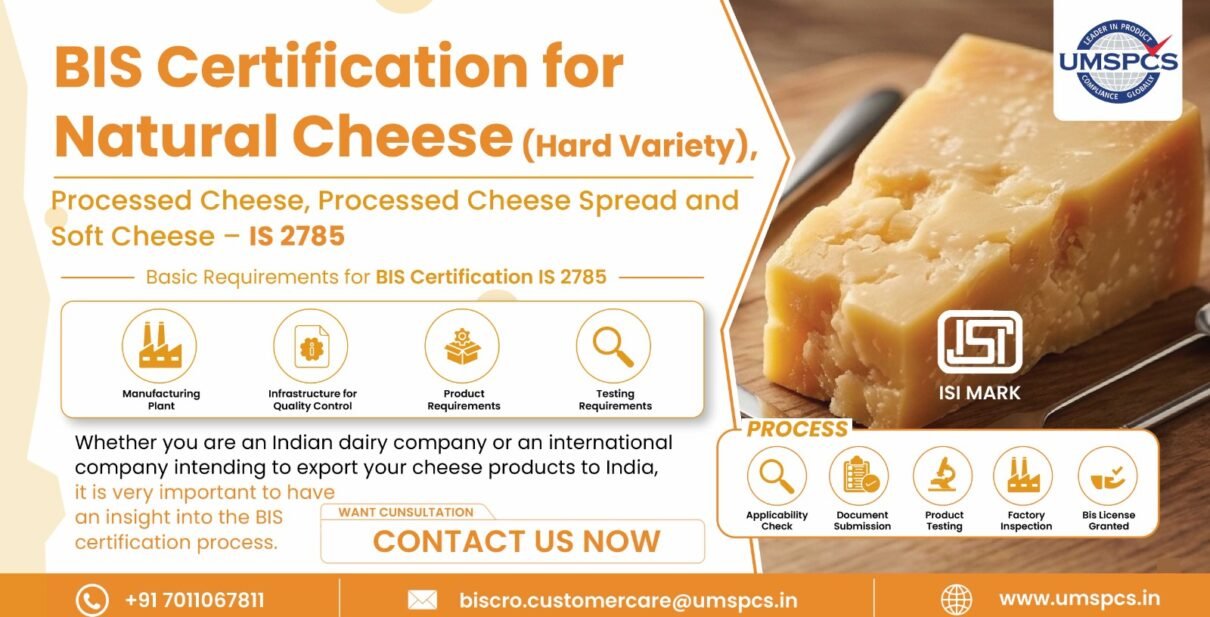
Basic Requirements for BIS Certification IS 2785
The manufacturers should meet the following criteria:
- Manufacturing Plant: The applicant must possess a manufacturing plant that is able to manufacture products meeting the requirements of IS 2785.
- Infrastructure for Quality Control: The plant must have quality control procedures and testing facilities.
- Product Requirements: Products must meet the requirements in terms of composition, hygiene, microbiology and quality as laid down in the standard.
- Testing Requirements: Product samples must pass the testing requirements.
- Documentation Requirements: Full documentation must be submitted to BIS for evaluation.
Applicable Tests for Cheese Products Under IS 2785
Product samples are put under tests for compliance with Indian Standards.
- Chemical Tests
- Microbiological Tests
- Organoleptic Tests
- Packaging Tests
The actual tests to be conducted depend upon the type of cheese being certified.
Step-by-Step BIS Certification Process for Natural Cheese
Step 1: Identify the Applicable Indian Standard (IS 2785)
The process of certification starts with identifying the appropriate Indian Standard relating to the product. For Natural Cheese (Hard variety), Processed Cheese, Processed Cheese Spread, and Soft Cheese, the manufacturer should comply with IS 2785.
At this step, manufacturers should:
- Have knowledge about the requirements given under IS 2785
- Assess their products as per BIS standards
- Ensure manufacturing processes are as per quality requirements
- Upgrade the manufacturing process if necessary
Step 2: Testing of Products and Documentation
Before submitting the application for certification, it is essential to test the products in a BIS-recognised and NABL-accredited laboratory to check compliance with the standard.
The step involves:
- Testing the products as per the requirements of IS 2785
- Documentation preparation
- Collection of manufacturing processes and factory details
- Quality Control Records
- Completion of BIS Application Forms
Step 3: Submission of BIS Application
As soon as testing and documentation are done, the BIS application should be submitted following the procedures.
Generally, the BIS application consists of:
- BIS application form duly filled
- Test Reports
- Information about Manufacturing Unit
- Information about Quality Control
- Fees and Documents as per government norms
After submission, BIS will scrutinise the application and related documents.
Step 4: BIS Factory Inspection
BIS officials come to the manufacturing plant to determine if the manufacturing unit is able to produce products according to IS 2785 standards.
During the inspection, BIS examines:
- Manufacturing procedures
- Production facility
- Quality control systems
- Testing facilities
- Records of raw materials and production
Samples can also be taken from the manufacturer during the inspection for testing.
Step 5: Testing of Samples and Evaluation
The samples collected during the inspection are tested in laboratories authorised by the BIS in order to ascertain their conformity to the standard prescribed.
This step involves:
- Laboratory testing of the product samples
- Ascertaining their quality and safety
- Submission of laboratory test reports directly to BIS
- Evaluation of laboratory test reports by BIS officials
Step 6: Closure of Observations and Non-Conformities
In case there are any observations or non-conformities observed during the inspection or testing, then BIS may observe the same, which would require corrective action.
Manufacturers may have to do:
- Take corrective action
- Submit revised documents/records
- Solve quality-related concerns
- Show conformity to BIS requirements
Step 7: Payment of License and Marking Fees
Once the candidate successfully passes the process of assessment and approval, he/she should make all the required payments for the fees.
They include:
- Annual license fee
- Marking fee
- Applicable BIS fees
Payment confirmation is required before issuing the license.
Step 8: Grant of BIS ISI License
The ISI license will be issued by the BIS after the completion of the testing, inspection, compliance, and fee payment.
Once the license is obtained, the manufacturers will be able to:
- Apply the ISI mark on the licensed goods
- Market their goods as BIS licensed
- Comply with the Indian quality standards
- Sell their goods in the Indian market
Documents Required for BIS Certification for Natural Cheese
General documents consist of:
- Basic information about the manufacturing unit and product line
- Evidence of manufacturing unit’s location (ownership/lease deed, utility bill, etc.)
- Trademark registration document (when there is any registration of the brand name)
- Manufacturing license / statutory clearances (when applicable – like pollution control and industry-specific clearances)
- Drawings/design of product
- Total manufacturing capacity
- List of materials along with their specification
- Information on the manufacturing machinery and equipment
- Layout of the factory, including manufacturing & testing facilities and storage facilities
- A detailed manufacturing process flow is provided here
- Testing equipment available within the factory premises, along with calibration details
- Quality control staff information
- Organisational structure of the factory
Common Challenges Faced by Manufacturers
Most applicants are subjected to certification delays because of:
- Inadequate Documentation: Lacking documentation usually results in questions from the BIS.
- Failing Tests: Failure in meeting required standards demands remedial action.
- Lack of Quality Control: Poor quality control measures may hamper the approval process.
- Difficulty in Interpreting the Regulations: It becomes difficult for most people to understand the technical requirements.
Professional assistance greatly helps avoid such problems.
Cost of BIS Certification for Cheese Products
The total cost for certification might vary according to the following factors:
- Product category
- Testing process
- Size of the factory
- Number of product variations
- BIS costs
- Laboratory costs
- Professional consultant services
Certification cost must be calculated by taking into account the portfolio of products of each manufacturing company.
Expected Timeline for BIS Certification IS 2785
Time taken for certification usually depends on the following:
- Documentation Process: Applications that are well documented save time.
- Testing of Products: Testing time period varies from laboratory to laboratory.
- BIS Certification: The time period taken for review and inspections is dependent on the difficulty level of the application.
Usually, certification takes several weeks to a couple of months. Read more about: BIS Certification Consultant in Nepal
Why Cheese Manufacturers Choose UMSPCS
Getting BIS Certification for Natural Cheese requires technical know-how, regulatory awareness, and effective project management skills.
UMSPCS has been recognised as a reliable certification partner for manufacturing firms in India and around the world.
Our expertise consists of:
- Complete assistance in obtaining BIS certification
- Evaluation of product suitability
- Preparation of documentation
- Coordination with testing activities
- Preparation of BIS application
- Handling of queries
- Factory audit assistance
- Assistance in BIS certification for foreign manufacturers
- Assistance after BIS certification
Why UMSPCS?
- Experience in BIS certification
- Certification experts
- Knowledge of the industry
- Quick project completion
- Effective process management
- Assistance to both Indian and foreign manufacturers
Be it BIS ISI Certification for Indian Manufacturers or BIS Certification for Foreign Manufacturers, we have got your back covered!
Conclusion
If your products fall under the category of Natural Cheese (Hard Variety), Processed Cheese, Processed Cheese Spread, or Soft Cheese, then getting the BIS Certification for your company in India according to IS 2785 standard is one of the important things you need to do.
UMSPCS helps in all aspects of getting the BIS Certification – from finding out whether your products are applicable to getting certification, to documentation, testing arrangements, application for BIS, and approval of the certification.
Getting BIS Certification for your Cheese Products?
Contact UMSPCS about BIS Certification for Natural Cheese, BIS ISI Certification for Indian Manufacturers, and BIS Certification for Foreign Manufacturers now!
Read more about: BIS Certification Consultant in Hungary
FAQs
- What is BIS Certification for Natural Cheese?
This certification is issued by BIS and demonstrates compliance of Natural Cheese and associated products with IS 2785.
- Which varieties of cheese are included in IS 2785?
The following types of cheeses are included in the standard:
- Natural Cheese (Hard Variety)
- Processed Cheese
- Processed Cheese Spread
- and Soft Cheese
- Do all cheese manufacturers need to have BIS certification?
Cheese manufacturers should ensure that they comply with the latest regulations regarding their products.
- Can foreign manufacturers receive BIS certification?
Yes, foreign manufacturers can obtain BIS Certification for Foreign Manufacturers according to the relevant BIS certification procedure.
- What type of tests are conducted as per IS 2785?
The tests are normally carried out for chemical, microbiological, organoleptic, and packaging tests.
- What is the duration of the BIS certification process?
The time frame is based on the preparation of documentation, testing, inspection, and BIS procedures.
- What documentation is needed for BIS certification?
Applicants usually need to provide company, product, manufacturing, quality control, and testing documentation.
❓ Ask a Question
Have any doubts? Fill the form below and our team will respond shortly.