Common salt quality not only impacts the taste of food but is also of vital importance to the health of consumers. Raw salt could be adulterated or not meet the required quality specifications, which is an important point to consider for the salt producers/manufacturers.
The Bureau of Indian Standards (BIS) has laid down quality specifications as per IS 253, Specification for Common Salt, which are applicable throughout to ensure uniformity of quality and consumer protection. UMSPCS ensures that manufacturers get BIS ISI certification easily with help throughout the certification process.
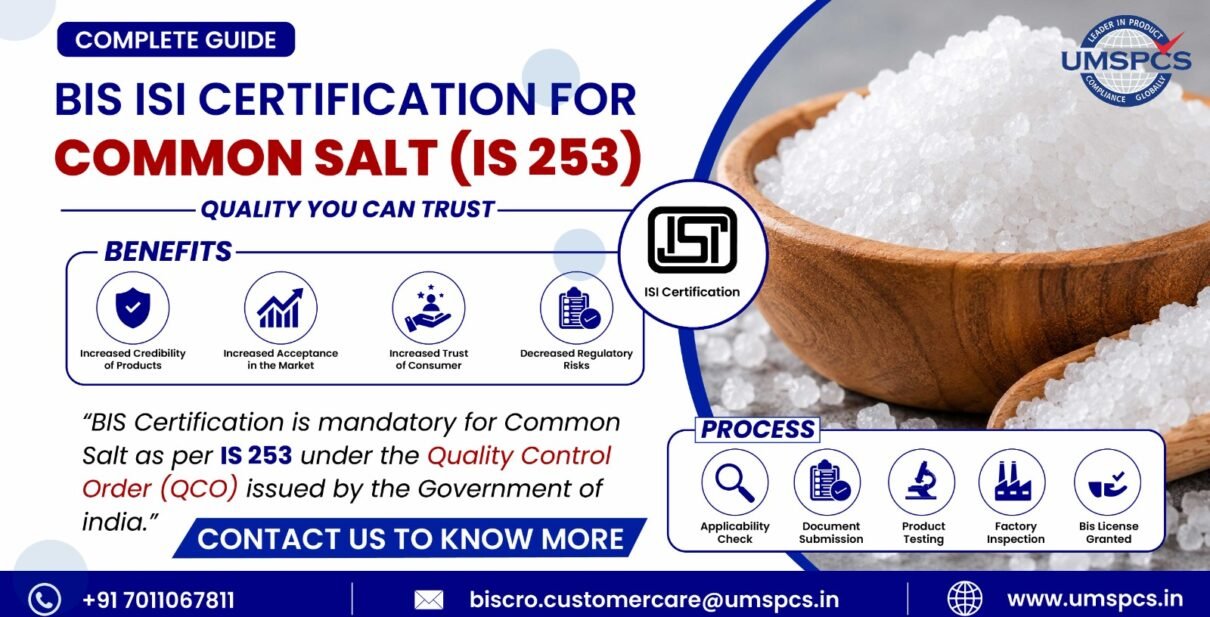
BIS ISI Certification for Common Salt is mandatory for all manufacturers who manufacture the common salt, which is covered under the relevant Quality Control Order (QCO) before manufacturing, selling or distributing the same in India. Such products can’t be legally sold in the country without a valid BIS licence.
What is the BIS ISI Certificate for Common Salt?
BIS ISI Certification is a product certification issued by the Bureau of Indian Standards in Scheme I. The certification ensures that the common salt has met the requirements as mentioned in IS 253.
Before issuing the licence, the BIS assesses the following:
- Product quality
- Manufacturing process
- Quality control systems
- Testing facilities
- The ability to meet the requirements of the applicable standards.
Once approved by the testing body, manufacturers are allowed to affix the ISI Mark to the products that are certified as conforming to the Indian standards.
Why is Common Salt needed to be BIS Certified?
BIS certification’s main purpose is to ensure that products available in the Indian market are of quality and safety standards as prescribed.
Certification for common salt can be used to guarantee the following:
- Meeting Indian Quality requirements
- Consistent product purity
- Consumer safety
- Standardised manufacturing practices
- Better product reliability
- Improved consumer confidence
Manufacturers who fall under the mandatory certification criteria can’t sell their products without a BIS licence in their name.
What is IS 253?
IS 253 is the Indian Standard that gives the specification for common salt for general use and recommended uses.
The standard sets out standards on:
- Product composition
- Purity levels
- Physical characteristics
- Chemical requirements
- Sampling methods
- Testing procedures
- Packing requirements
- Requirements for marking and labelling.
By adhering to IS 253, manufacturers can ensure that their products meet the required standards and remain compliant with regulations throughout the manufacturing process.
Key Quality Requirements Under IS 253
The standard contains multiple quality parameters that manufacturers are required to meet.
Some important requirements are:
- Sodium chloride content
- Moisture content limits
- Matter insoluble in water
- The level of calcium and magnesium in the soil.
- Sulphate content requirements
- Product purity requirements
- Food should be packed and marked with the proper labels.
In order to be certified, the products have to pass the tests listed above.
BIS ISI Certification Process for Common Salt
Usually, a BIS ISI certification for common salt takes about 30 to 45 working days without any delays in the testing or factory inspection process. For the BIS ISI certificate for Indian manufacturers, if there are
Step 1: Choose the Appropriate Indian Standard
Locate the product’s Indian Standard (IS) code first.
Manufacturers need to:
- Recognise the needs of the product
- Produce goods in compliance with BIS standards.
- Increase production methods if needed.
- Increase production methods if needed.
Step 2: Test the Product & Document
The product shall be tested in a BIS-recognised and NABL-accredited laboratory.
Samples of the product are screened for this at this stage.
- Technical documents are made.
- Data is collected on factories and manufacturing.
- Done. Application forms and manufacturing.
Step 3: Submit Application
The BIS requires an online application that includes a copy of the DHS grant letter, a BIS form, and an application letter.
- Documents needed: Test report
- Details about Plants
- There are applicable government fees.
- The BIS authority processes the application after it is submitted.
Step 4: BIS Factory Inspection
The BIS officials visit the manufacturing plant to verify
- Production process
- Production Environment
- Quality control scheme
- Testing capacity
During the inspection, samples of the product may also be taken for independent analysis.
Step 5: Testing Products and Uploading Lab Reports
Samples collected are sent for analysis to approved laboratories. The Lab Test Report (LTR) is then sent directly to the BIS for evaluation by the lab.
Step 6: Closure of Non-Conformities (if any)
Corrective action must be taken if BIS discovers any problems during its testing or inspection.
- New documents must be provided.
- Any non-compliance must be addressed.
Step 7: Payment of Licence & Marking Fees
Once BIS has completed the certification process, the manufacturer must pay the following:
- Annual licence fee
- ISI marking fee
Step 8: Granting of ISI Licence
The BIS issues an ISI licence after the testing, inspection and payment procedures are completed. This allows the manufacturer to use the ISI mark of certified products.
Read more about BIS Certification Consultant in UAE.
Documents Required for BIS ISI Certification for Common Salt
Typically, the following documents are needed for manufacturers:
- Basic data product segment and manufacturing unit
- The manufacturing facility’s proof of address certificate
- Certificate of Trade Mark Registration
- Manufacturing licence and statutory approvals
- Design schematics and product drawings.
- Production Capacity Installed
- Material List and Specification
- Details of machinery and equipment for manufacture
- The layout plan of the factory shows production and testing areas, and storage areas
- A thorough explanation of the manufacturing process flow is provided.
- Internal testing equipment and calibration data
- Personnel Information for Quality Control
- Organisational chart for a factory
When the documentation is accurate and comprehensive, the certification process minimises delays and objections.
Cost & Timeline of BIS Certification for Common Salt
The fee for BIS ISI certification for Common Salt varies according to the following:
- Product category
- Testing requirements
- Factory size
- Documentation complexity
Estimated Timeline
Actual timing may be different based on product complexity and BIS processing.
- Estimated length of time: 30 – 40 working days
- AIF Products: As long as 180 days in some cases
Benefits of BIS ISI Certification for Common Salt
There are various benefits for manufacturers in obtaining BIS certification.
These are some of the advantages provided:
- Permission from the law to sell regulated products.
- The compliance with the Indian standards.
- Improved product quality
- Enhanced consumer trust
- Better market acceptance
- Stronger brand reputation
- Reduced compliance risks
- Increased business opportunities
Certification is a way of showing a manufacturer that he or she cares about quality and conforms to regulations. Also can get more information about BIS Certification Consultant in Japan.
Common Challenges Faced by Manufacturers
Manufacturers could experience a delay because of:
- Incorrect product classification
- Incomplete documentation
- Product testing failures
- Factory inspection observations
- Failure to meet quality criteria
- Slow answers to BIS queries
Proper planning and technical guidance can help minimise these challenges.
Why Choose UMSPCS for BIS ISI Certification for Common Salt?
With more than 6 years of experience in providing BIS certification consultancy services, we have successfully helped manufacturers with their BIS certification in more than 600 categories of products.
We help businesses understand and comply with BIS guidelines in an effortless manner. We offer complete assistance right from product applicability, documentation, testing, application filing, and compliance with BIS standards.
UMSPCS can help manufacturers with:
- Product applicability assessment
- Identification of the relevant standards
- Documentation preparation
- The work is coordinated with the BIS-recognised laboratories.
- BIS application filing
- Factory inspection support
- BIS query handling
- Post-certification compliance assistance
Conclusion
Common salt is a critical product that is used in all households, food businesses, and industries. Compliance with IS 253 assists manufacturers in maintaining product quality, complying with regulatory requirements and fostering consumer trust.
Manufacturers wishing to produce and/or sell in India should take care to ensure compliance with the relevant BIS requirements and get BIS ISI certification for Common Salt wherever required. Being a vital commodity, Common Salt has been certified as approved by BIS ISI.
If you are planning to get your Common Salt (IS 253) product certified by BIS ISI, then you should know that the rates for the same are as follows.
Call UMSPCS today to get full support in documenting, testing products, filing for BIS, factory inspection and compliance management.
Read more also: BIS CRS Registration for Power Converters Used in Photovoltaic
FAQs
- Is BIS ISI certification mandatory for common salt?
Yes, for any place where BIS ISI certification regulations require it.
- Which standard applies to common salt?
The standard that applies to common salt is covered under IS 253.
- Who can be a certified BIS for Common Salt?
Applicants who are Indian manufacturers, foreign manufacturers or eligible brand owners may apply.
- Is factory inspection required for common salt?
Yes, in general, BIS inspects the factory before issuing the licence for common salt.
- What is the time taken for BIS certification for common salt?
The time taken for BIS certification for common salt is about 30-40 working days.
- How can UMSPCS help with BIS ISI certification for common salt?
From testing to documentation, UMSPCS offers complete support for BIS approval and compliance.
❓ Ask a Question
Have any doubts? Fill the form below and our team will respond shortly.