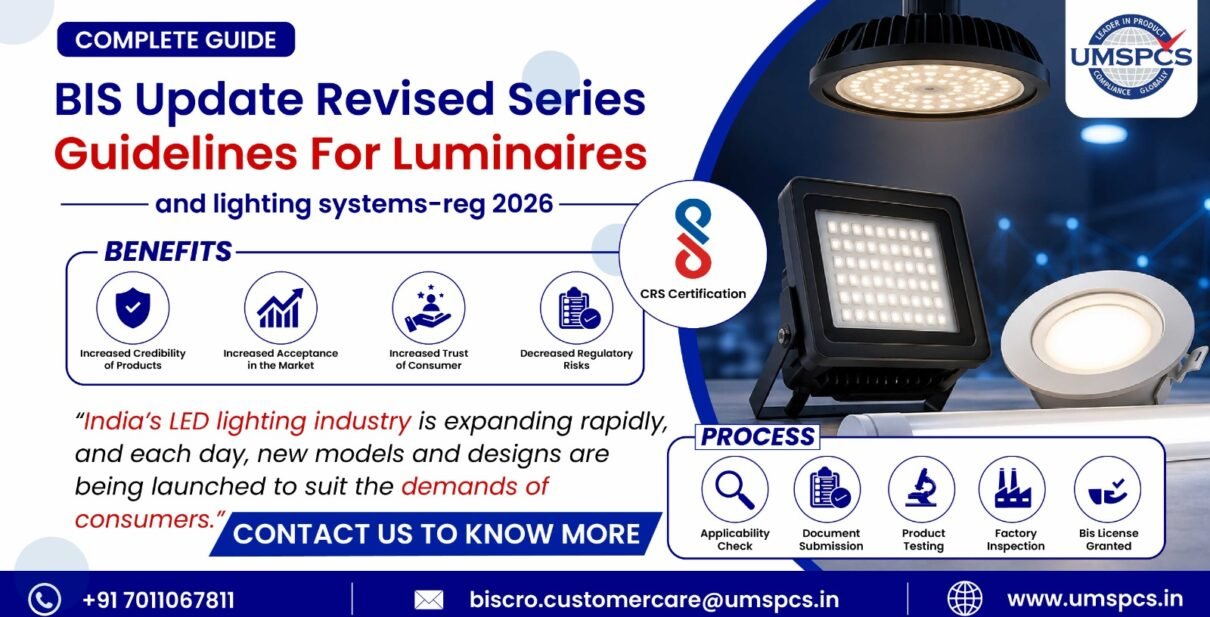
India’s LED lighting industry is expanding rapidly, and each day, new models and designs are being launched to suit the demands of consumers. But as the innovations come, so do the regulations. The Ministry of Electronics and Information Technology (MeitY) has issued new and revised series guidelines for BIS certification of lighting products through its circular dated 3 June 2026 in order to increase transparency and uniformity in the BIS certification process.
These revised guidelines are issued according to the revised standards, namely IS 16102 (Part 1):2026 and IS 10322:2026, which also involve new guidelines on product family, model grouping and representative sampling as per the BIS Compulsory Registration Scheme (CRS).
It is important for the manufacturers and importers of LED lamps, luminaires, emergency lights, chandeliers and decorative lights to know about these changes before applying for BIS registration and license extension.
At UMSPCS, we make the latest regulatory changes simple and assist manufacturers to become BIS compliant smoothly and efficiently.
Why Has MeitY Revised the BIS Series Guidelines for LED Lighting Products?
There are many different versions of a product made by manufacturers, some with varying wattage, drivers, batteries, PCB designs or layouts. There was a great deal of confusion about:
- What models might be allowed to be registered under a single BIS?
- What is the maximum number of models that could make up one product series?
- What are the different variations of the product that need to be certified separately?
- How to select good samples?
The updated guidelines have been brought in to eliminate this ambiguity and provide a standard procedure on how to group products together and how to test them.
The aim is to develop the BIS certification process to be more transparent and to keep all products up to date with the current safety standard.
Why Manufacturers and Importers Should Pay Attention to These Changes
These new requirements will apply to lighting product manufacturers and importers. This might mean that companies need to review their existing product range and revise any plans on certification.
The new requirements may affect:
- Current series of products with BIS certification.
- Scope extension applications.
- Product testing requirements.
- Product development & design decisions.
- Future BIS registration applications will be based on this data.
Mislabelling or incorrect grouping of products can result in delayed applications, extra testing, or application rejection.
What is a Product Family Under the Revised BIS Guidelines?
The new guidance defines a product family as a set of products that have the same highest order of components and sub-assemblies.
If a product has the following characteristics, it can be considered to be a part of the same product family:
- Similar construction
- Common design
- Same safety-critical components
- Standard assemblies that have to do with compliance
Such a definition would help the manufacturers decide if various models can be registered together for a single BIS registration.
Maximum Number of Models Allowed in a Single Product Series
Also updated in the new guidelines are the number of models accepted for a series.
- The maximum number of models allowed for each of most types of lighting products is 10.
- Some notified products can have up to 20 models.
- Up to 50 models can be found in fancy lights and chandeliers.
- These limits will offer more clarity and assist the manufacturer in avoiding registration errors.
Revised Series Guidelines for Self-Ballasted LED Lamps Under IS 16102 (Part 1):2026
The revised guidelines apply to the self-ballasted LED lamps for general lighting services as per the IS 16102 (Part 1):2026.
Products can only be grouped into one series if they have some characteristics in common, such as the following:
- The same rated input voltage is to be used.
- The same LED driver or ballast size rating.
- The same PCB design and layout is used.
- Same lamp cap design
- Same IP rating
- Same battery chemistry
- Same charging and protection circuit design
Different battery capacities may be allowed, but it should be a representative sample of the highest battery capacity.
New BIS Requirements for Luminaires Under IS 10322:2026
Common conditions for grouping luminaire products into one series have been introduced in the revised guidelines in IS 10322:2026.
Manufacturers should carefully review:
- Class of construction
- Input voltage
- Enclosure material
- Connection mechanism
- Insulation class
- Energy storage technology
- Battery chemistry
- Charging PCB design
- Nominal battery voltage
Products of different battery technologies cannot be connected in series with each other, nor can differently types of luminaires.
Special Provisions for Fancy Lights and Chandeliers
There has been some relief for the manufacturers of decorative lighting as well.
The circular allows:
- As many as 50 models per series.
- Submission of three representative samples.
- Decorative elements – use of pictorial submissions in some instances.
The following are typical examples of representative samples:
- Highest rated model
- Middle-rated model
- Lowest rated model
The changes should simplify the compliance process for manufacturers who are required to meet often changing decorative design requirements.
Which Manufacturers Will Be Most Affected by the New BIS Guidelines?
It becomes important with the revised guidelines for
- LED lamp manufacturers
- Luminaire manufacturers
- Emergency lighting manufacturers
- Decorative lighting manufacturers
- This includes importers of lighting products.
- Any existing BIS licence holders who wish to apply for scope extension.
It is recommended that any company that deals with BIS CRS certification for lighting products check the revised requirements.
What Should Manufacturers Do to Comply with the Revised Series Guidelines?
To prevent future compliance problems, manufacturers need to:
- Evaluate existing BIS-approved product series.
- Ensure correct grouping and family formation.
- Discuss PCB designs, battery layouts and driver designs.
- Know which products might need separate registrations.
- Be sure to take representative samples.
- Review future product development strategies.
- Always seek advice from compliance authorities before new BIS applications.
Preparation work can make a huge difference in limiting time to certification and additional costs.
Common Mistakes Manufacturers Should Avoid During BIS Registration
Common errors that can result in certification problems are:
- Combining items that use different battery types.
- Using a combination of various luminaire types in a single series.
- Selection of a wrong representative sample.
- Neglecting the difference in insulation class.
- Continuing to use old grouping methods.
By avoiding these mistakes, the registration process for BIS may run much more smoothly.
What Happens If Manufacturers Do Not Follow the Revised BIS Guidelines?
If this does not happen, then a failure to meet the new requirements can lead to the following:
- Late registration of BIS.
- Denial of applications for scope extension.
- Additional product testing.
- Increased certification costs.
- Delayed product launches.
Hence, manufacturers need to urgently assess their product portfolios and certification policies.
How UMSPCS Helps Manufacturers with BIS Certification for Lighting Products
We have over 6 years of experience with regulatory compliance and have been supporting manufacturers on over 600+ product certificates at UMSPCS.
Our services include:
- Product applicability assessment
- The formation of product families and product series.
- Documentation preparation
- Laboratory testing coordination
- The filing of BIS CRS applications is required.
- Scope extension support
- Technical compliance review
- End-to-end certification assistance
Our experienced team works closely with manufacturers and importers to ensure smooth and hassle-free BIS approvals.
Conclusion
The updated series guidelines provided by MeitY, under IS 16102 (Part 1):2026 and IS 10322:2026, are a significant advancement in enhancing transparency and uniformity in the BIS certification of lighting products.
These changes aren’t just another regulatory update for manufacturers and importers to deal with. The new requirements may have implications for the grouping of products, testing requirements, and future BIS registrations directly.
All businesses that produce LED lamps, LED luminaires, emergency lighting products or decorative lighting products should update their product portfolios in line with the updated guidelines as soon as possible.
From understanding the new series guidelines to handling BIS CRS certification, UMSPCS can guide you through the entire process and ensure that your product is fully compliant with the revised MeitY guidelines.
Want professional help on BIS certification of lighting products?
Talk to UMSPCS now for full guidance and full compliance support.
Read more about News: BIS Releases Revised Standards for Led Luminaires 2026
FAQs
- Why did MeitY change the series guidelines?
The new rules make it easier to understand the rules for grouping products and make BIS certification easier.
- What are the standards that are addressed by the updated guidelines?
The guidelines apply to IS 16102 (Part 1):2026 and IS 10322:2026.
- How many models are there normally in a series?
There can be up to 10 models in a single series of most lighting products.
- Are products of different battery chemistries compatible?
Products with different battery chemistry should not be series connected.
- Can fancy lights have a higher number of models in one series?
Yes. For some decorative lighting products, up to 50 models are possible.
- What is UMSPCS doing to assist manufacturers?
UMSPCS offers complete assistance ranging from product evaluation, documentation, testing coordination, and support with BIS certification.
❓ Ask a Question
Have any doubts? Fill the form below and our team will respond shortly.