There are many things that need to be regulated and coordinated during the product certification process in India, from determining the applicable Indian Standard to arranging for tests and preparing the required documentation, to replying to the queries raised by the BIS.
Manufacturers and importers in Delhi NCR can benefit a lot by working with the right consultants, as the process can get really tedious when applying for BIS CRS certification for electronic products, BIS ISI certification for electronic products, and other such certifications. A good consultant can help a manufacturer or importer achieve the said certifications and avoid wasting time in the process.
The question is: Which consultants are actually helping in procuring BIS certification in Delhi NCR? What services should be expected? What parameters define expertise in the field and help recognize a consultant as suitable for a given product?
This blog addresses the above questions and describes different types of BIS consultants, their responsibilities, the process and documentation, costs and time taken, and finally, how UMSPCS helps.
Which Consultants help in Procuring BIS Certification in Delhi NCR?
Businesses should look for consultants with practical experience in product certification, Indian Standards, laboratory coordination, and regulatory documentation.
Consultants can be classified as:
| Consultant type | Key responsibilities | Suitable for |
| BIS CRS consultants | CRS registration, product testing and portal applications | Electronic and IT products |
| BIS ISI consultants | ISI licensing, factory readiness and inspection coordination | Products covered under Scheme-I |
| Foreign manufacturer consultants | FMCS applications, AIR documentation and international coordination | Overseas manufacturers |
| WPC and regulatory consultants | Wireless approvals and related regulatory requirements | Wi-Fi, Bluetooth and RF-enabled products |
| Product compliance consultants | Standard identification, QCO assessment and regulatory planning | Manufacturers and importers |
Understanding the Three Major BIS Certification Routes
It is crucial for companies to evaluate which certification scheme is applicable to their products before engaging a consultant. Selecting the wrong certification scheme means expenses and time delays in the process.
A. BIS ISI Certification for Indian Manufacturers
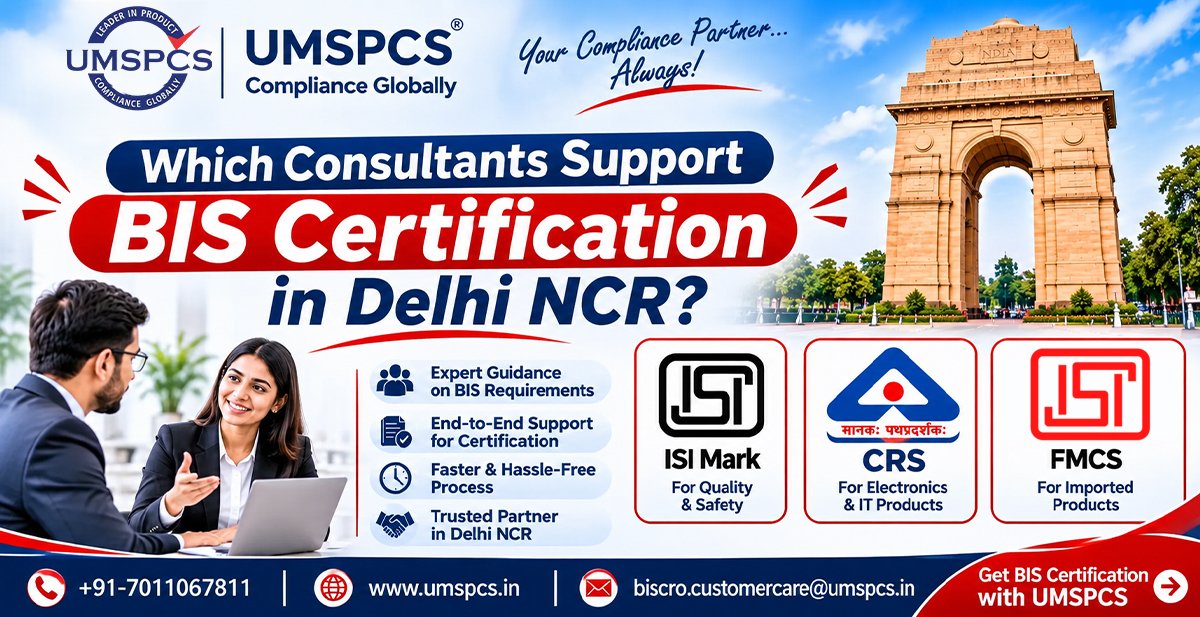
Indian manufacturers producing products covered under mandatory QCOs must obtain BIS ISI Certification for Indian manufacturers under Scheme-I of the BIS (Conformity Assessment) Regulations, 2018.
The process involves compliance with the applicable Indian Standard, product testing, factory inspection, and verification of manufacturing and quality-control facilities.
Professional BIS certification assists manufacturers with standard identification, documentation, laboratory coordination, application filing, and factory inspection preparation.
B. BIS CRS Certification for Electronic Products
Manufacturers of electronic and IT products covered under the Compulsory Registration Scheme (CRS) must obtain BIS registration before selling their products in India.
The process includes identifying the applicable Indian Standard, product testing through a BIS-recognised laboratory, document preparation, and application submission through the BIS CRS portal.
BIS CRS certification for electronic products involves technical documentation, laboratory testing, and registration formalities. A professional CRS consultant can assist with these requirements.
C. BIS Certification for Foreign Manufacturers
The Indian market is open to all, including foreign manufacturers. Accordingly, if a foreign manufacturer makes a product that is covered in the Indian Standards and is a critical product that is imported, they too can apply for BIS certification.
In general, the BIS certification of foreign manufacturing facilities is done through the FMCS scheme, under which BIS issues a certification license to manufacturing facilities of eligible foreign firms.
This scheme is aimed at foreign electronics brands, component manufacturers, other industrial equipment manufacturers, and foreign businesses who export to India.
Complete Process for BIS Certification is in New Delhi
Step 1: Determination of Applicable Indian Standard
Identify the applicable Indian Standard and understand the requirements. Get the product and process aligned with the BIS requirements.
Step 2: Product Testing and Documentation
Get product samples tested by a BIS-recognized laboratory. Get specifications, manufacturing details, quality records, and factory records in order.
Step 3: Filling out and Submitting BIS Application
Furnish an online application to BIS through the particular portal, and submit the test report, documents, and prescribed government fee.
Step 4: Inspection by BIS
BIS officials visit the facility and assess the production capability, QC and in-house testing, and other facilities.
Step 5: Laboratory Testing and Report Submission
When needed, a BIS-authorized laboratory tests the product sample and issues the Laboratory Test Report (LTR) to BIS.
Step 6: Closure of Non-Conformities
Achieve closure of non-conformities by implementing corrective actions/submitting revised documents/requesting additional tests.
Step 7: Payment of Licence and Marking Fees
Pay the BIS charges, which include the annual licence fee, marking fees, and other fees, as applicable.
Step 8: Grant of BIS ISI Licence
Upon successful completion of the requirements, BIS issues an ISI licence to the manufacturer to affix the ISI Mark on the concerned product, as per the provisions of the scheme.
Documents Required for BIS Certification
One of the most crucial phases in the certification process is the preparation of documents. Inconsistent or missing documents may raise objections in the application.
Although the exact checklist varies by scheme and product, the following documents are generally required.
- Manufacturing Unit
- Address Proof of Factory
- Trademark Certificate/Registration
- Manufacturing License/Approval
- Product Drawings/Specifications
- Installed Production Capacity
- Raw Material Details
- Machinery/Equipment Details
- Factory Layout Plan
- Manufacturing Process
- Quality Control
- Test and Calibration
- Factory Organization
How Long is the BIS Certification Process in Delhi NCR?
The duration of BIS certification is dependent on a number of factors like complexity of product and scheme, assessment, and laboratory capacity.
The following are some planning estimates and not guaranteed BIS processing times:
| Certification category | Estimated timeline |
| BIS CRS registration | 20 – 30 working days |
| BIS ISI certification | 30 – 40 working days or longer |
| BIS FMCS certification | 5 – 6 months or longer |
Scheme-I – Average timelines published by BIS state different things for the two application options. For both applications, actual timelines will depend on inspection scheduling, sample testing, and application completeness and responses to queries.
As noted above, a consultant can help address issues that result in avoidable delays with respect to documentation, sample testing, inspections, and responses to queries. However, the approval time at BIS is beyond the control of the consultant.
What Challenges Can a BIS Consultant Help You Avoid?
Manufacturers can run into several obstacles such as:
- Failure to identify the appropriate standard
- Product testing failures
- Discrepancies in documents
- Factory inspections
- Issues related to AIR (Additional Information Required)
- Regulatory changes
An experienced BIS Consultant in Delhi NCR can help you identify all the issues stated above before application submission and formulate an appropriate compliance strategy.
How UMSPCS Supports BIS Certification in Delhi NCR
UMSPCS provides Product Certification and Regulatory Consulting services to manufacturers, importers, and other businesses located in India and outside India, in the area of market access to India.
UMSPCS has over 6 years of experience and exposure to about 600 product compliance requirements across a wide range of industries and product segments.
We understand that each product is unique and therefore formulate solutions accordingly, as opposed to following a one-size-fits-all approach.
Our services include:
- BIS CRS Certification
- BIS ISI Certification
- BIS FMCS Certification
- QCO Assessment
- Technical Documentation
- Post-Certification Support
How to Select the Best BIS Certification Consultant?
The most important factor while selecting a consultant is evaluating their experience in managing requirements similar to yours.
You should look into:
- Industry expertise
- Scheme experience
- Technical understanding
- Documentation support
- Foreign manufacturer’s support
- Post-certification assistance
- Transparency
You should not choose a consultant just because they offer low service fees or guarantee approval. Go with the one who has the right expertise and experience.
Conclusion
In India, according to the law, it is mandatory for manufacturers to obtain BIS certification to legally sell their products. Before certification, it is necessary to check the BIS scheme applicable to your product. Depending on your product, you may need to obtain BIS CRS Certification, BIS ISI Certification, or BIS certification for foreign manufacturers.
In the process of obtaining BIS certification, having the right consultant can ease your job and make the process error-free. At UMSPCS, we offer a range of services, from product-specific assistance to technical documentation to laboratory services and application support.
Need help getting BIS certification for your products? Book your free consultation here.
Read more also: What Are the BIS Requirements for Press Tool-Punches in India
FAQs
- Who are the BIS Certification consultants in Delhi NCR?
There are several product compliance and Regulatory consultancy firms in Delhi NCR. UMSPCS in Delhi NCR has experience in handling CRS, ISI, and FMCS certifications.
- How to identify the right BIS certification consultant in Delhi NCR?
You need to find a consultant who has the right product experience, is familiar with Indian Standards, can manage coordination with laboratories, and has experience with the BIS documentation and application process.
- Is BIS CRS certification mandatory for all electronic products?
No, CRS is mandatory only for those electronic and IT products which are notified by the central/state government. The applicable product category and Indian Standard need to be verified.
- What is the difference between BIS CRS and BIS ISI certification?
In case of CRS, product certification is done based on testing carried out under the applicable scheme, whereas ISI certification under Scheme-I is done by assessment of the manufacturing facility, quality control system, and product testing.
- Can BIS consultants help foreign manufacturers to get certification in India?
Yes, BIS consultants can assist foreign manufacturers with FMCS, AIR documentation and laboratory coordination, preparation for factory inspections, and communication with relevant authorities.
- Can an Indian importer apply for BIS certification under FMCS?
No, under FMCS, it is the foreign manufacturer who is required to apply for a license and appoint an eligible Authorised Indian Representative as stipulated by BIS.
❓ Ask a Question
Have any doubts? Fill the form below and our team will respond shortly.