Here is something that you cannot afford to ignore: BIS Certification for Cotton bales is now a legal necessity when you’re a cotton producer, gin owner, or trader in India. The Bureau of Indian Standards made it compulsory for cotton bales to align with IS 12171:2019 under a Quality Control Order (QCO). manufacturers and businesses in the cotton supply chain to work fast in accordance with the compliance deadline set for 27 August 2026.
India is one of the world’s largest cotton producers, which confirms that quality at the baling stage is essential for farmers, mills, exporters, and the whole textile ecosystem. The IS 12171:2019 certification confirms trust in Indian cotton among local and global markets.
Non-compliance after the deadline can result in legal fines, product denials, and business disruption. Start your certification procedure today.
What Is BIS Certification for Cotton Bales (IS 12171:2019)?
BIS Certification for cotton bales means your cotton bales are tested, verified, and certified to align with Indian Standard IS 12171:2019, which is a specification imposed by the Bureau of Indian Standards for the packing and quality of cotton bales produced or sold in India.
The Bureau of Indian Standards (BIS) is India’s national standard body under the Ministry of Consumer Affairs. It has standards for hundreds of products and issues certification to confirm that such products are safe, reliable, and consistent in quality.
IS 12171:2019 covers aspects like the following:
- Bale weight and dimensions
- Packing material and binding requirements
- Marking and labelling standards
- Quality of cotton (staple length, trash content, moisture)
In simple terms, you are not able to sell legally in India after the deadline of 27 August 2026, when your cotton bales do not have the BIS ISI mark as per IS 12171:2019.
Why Is This Certification Important?
Here is why BIS cotton bale certification matters for your business:
Legal compliance: This certification is compulsory under the Quality Control Order (QCO). Selling cotton bales without certification is a punishable offence under the BIS Act 2016.
Market access: Certified cotton bales are accepted through spinning mills, textile factories, and export buyers without having any questions. Non-certified bales face rejection.
Buyer confidence: The ISI mark on your bales tells buyers that the cotton aligns with standardised quality to improve your brand reputation and market value.
Fair trade: Standardised bale weights and packing avoid disputes between gin owners and mills, which is a major difficulty in the cotton trade.
Export advantage: Indian cotton certified under BIS standards is more competitive in foreign markets.
Penalty avoidance: Failing to comply can attract penalties, product ban and even factory closure.
Applying early offers gives you time to solve any non-conformances prior to the inspection in accordance with the 27 August 2026 deadline.
Procedure for BIS Certification for Cotton Bales
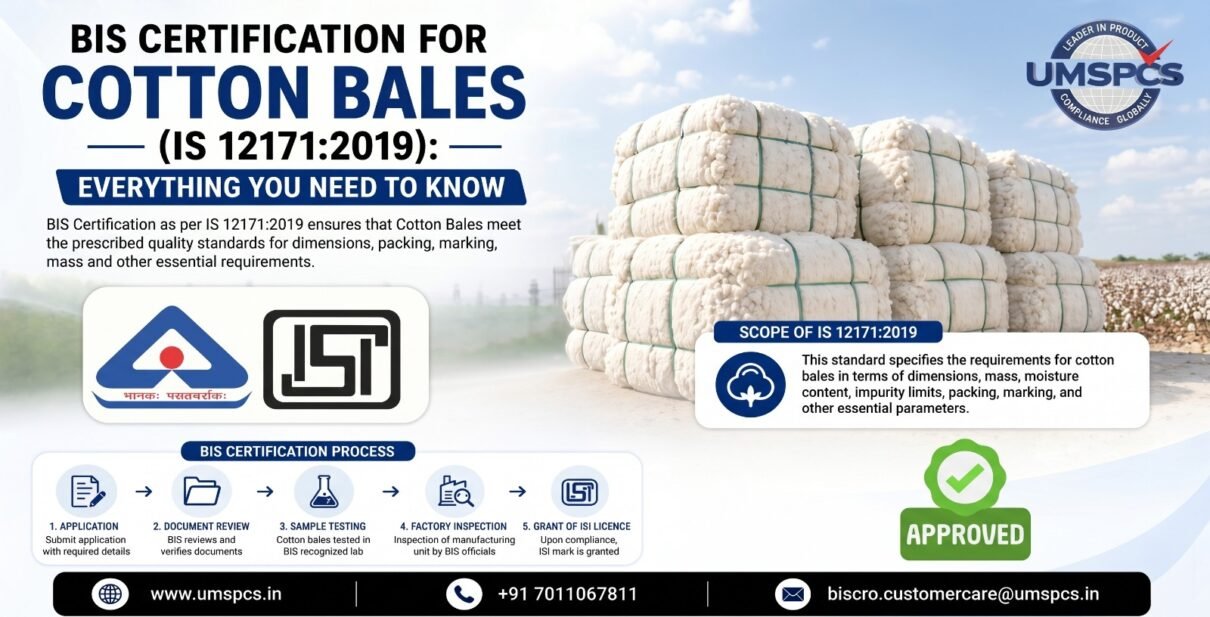
The procedure to obtain IS 12171:2019 certification consists of various clear steps. Here is a simple breakdown, which is as follows:
- Identify the correct licence type
Find out whether you require a BIS ISI license or registration. Cotton gin owners and baling units are usually manufactured under this QCO.
- Prepare documentation
Collect every required business, technical, and factory paperwork. Inaccurate or incomplete paperwork is the biggest reason for postponements.
- Apply on the BIS portal
Upload your application online at the official BIS portal and pay the applicable charges. Select the right product category and standard number.
- Product testing at a BIS-approved lab
Cotton bale samples are delivered to the lab and approved by BIS. Tests consist of moisture content, bale weight, staple characteristics, trash content, and packing conformity.
- Factory/unit inspection
A BIS officer visits your ginning and pressing unit to review your baling procedure, quality control practices, and facility standards prior to granting a license.
- Grant of BIS licence & ISI marking
BIS issues your license after the test and audit are cleared. You can then utilise the ISI mark on your cotton bales and legally sell all across India.
On average, the IS certification procedure requires 3 to 6 months. You should get your application as soon as possible to prevent last-minute rushes, as per the deadline of 27 August 2026.
Documents Required for IS 12171:2019 Certification
Here is a list of required documents that you need to apply for during BIS Certification for cotton bales:
- Business registration certificate
- GST registration certificate
- PAN card of the company/proprietor
- Factory/unit address proof
- Layout plan of the manufacturing unit
- List of machinery/equipment
- Product details & technical specifications
- Sample test reports from the approved lab
- Quality control process document
- Authorised signatory ID & details
- Trademark/brand registration (if any)
- Previous BIS licence (for renewals)
Note: BIS might demand further documents, which depend on the factory inspection. A consultant can assist you in preparing a complete and mistake-free document.
How UMSPCS Can Help You Get Certified Faster
Obtaining BIS Certification for cotton bales can feel overwhelming in accordance with paperwork, lab interaction, portal filing and BIS audits. This is where UMSPCS steps in as your trustworthy compliance partner.
UMSPCS with 600+ experience offers complete BIS certification guidance for manufacturers, ginners, and cotton traders across India. Our experienced consultant manages each step from consultation to final permit, so you can concentrate on your business growth.
- Document preparation
- Complete docket assistance
- Lab coordination
- Tie-ups with BIS labs
- Portal filing
- Error-free applications
- Audit support
- Factory inspection readiness
- Faster approval
- Reduced back-and-forth
- Post-certification
- Renewal & surveillance help
You don’t have to trace BIS regulations alone in accordance with USMPCS. Our workforce knows the procedure inside out and confirms your application has the greatest chance of first-time approval. Read more also: BIS ISI Certification for Infant Milk Substitutes IS 14433
Conclusion
The BIS certification for cotton bales under IS 12171:2019 is not only a regulatory formality, but it is a mark of quality that safeguards your business, buyers, and India’s cotton reputation. Each cotton gin owner, presser, and trader should act now in accordance with the 27 August 2026 compliance deadline drawing closer.
The procedure consists of testing, documentation, factory audits and BIS approval, each of which consumes time. Starting early means getting low risks, better preparation, and a seamless certification journey.
Read more also: BIS CRS Certification for Smartwatches: Indian Need to Know
Frequently Asked Questions (FAQs)
- Is BIS Certification for cotton bales mandatory in India?
Yes, BIS Certification for cotton bales is mandatory under the Quality Control Order (QCO). After 27 August 2026, selling or distributing non-certified cotton bales in India will be illegal and can result in penalties.
- Who needs to apply for BIS Certification for cotton bales?
Cotton ginning and pressing units, manufacturers, and businesses involved in producing or selling cotton bales in India should get BIS certification as per IS 12171:2019.
- What is the deadline for compliance with IS 12171:2019?
The compliance deadline for BIS Certification for cotton bales is 27 August 2026. Businesses should apply well in advance to prevent delays and last-minute issues.
- What happens if I do not get BIS Certification before the deadline?
Non-compliance can result in heavy fines, product seizure, cancellation of business operations, and legal action under the BIS Act, 2016.
- How long does it take to get BIS Certification for cotton bales?
The certification process usually requires 3 to 6 months, which is based on documentation, product testing, and factory inspection readiness.
- What tests are conducted for cotton bale certification?
Cotton bales are tested for parameters such as moisture content, staple length, trash content, bale weight, and packing quality as per IS 12171:2019 standards.
- Can I apply for BIS Certification online?
Yes, you can apply online through the official BIS portal by uploading required documents, selecting the correct standard, and paying the applicable fees.
- How can UMSPCS help with BIS Certification for cotton bales?
UMSPCS provides complete assistance, which consists of documentation, lab coordination, application filing, and audit preparation to ensure faster and hassle-free certification approval.
❓ Ask a Question
Have any doubts? Fill the form below and our team will respond shortly.