Manufacturers apply for BIS certification simultaneously and get certified on time in one case. The second faces many queries regarding documentations, extra testing and compliance and gets delayed for months due to this reason.
This is not because of poor quality of their product but due to their preparation before the BIS Certification.
No matter whether you are an already established manufacturer in Rajasthan, starting a new product or a foreign company coming to the Indian market, getting BIS Certification in Rajasthan involves more than applying for it. You have to understand the correct certification scheme, Indian Standard, documentation process and latest BIS Guidelines to avoid any unnecessary delays and extra costs.
In this blog, we will tell you everything you need to know regarding BIS Certification in Rajasthan such as eligibility criteria, legal requirements, documentation, process of certification, timeframe, challenges and some tips to make it easier for you. We will also share with you how UMSPCS assists you to get BIS ISI Certification for Indian Manufacturer, BIS CRS Certification for electronic products and BIS Certification for foreign manufacturers.
What is BIS Certification?
Bureau of Indian Standards (BIS) is the national standards body in India according to the Bureau of Indian Standards Act, 2016. This body sets the standards for Indian Standards (IS). It also ensures that the products available in the Indian market are of requisite quality and performance levels.
As per the type of product, BIS provides the following types of certifications:
- BIS ISI Certification for Indian Manufacturers
- BIS CRS Certification for Electronic Products
- BIS Certification for Foreign Manufacturers (FMCS)
- Hallmarking
- Laboratory Recognition
Several products come under the purview of various Quality Control Orders (QCOs) from the Government of India and require BIS certification to be manufactured, imported, and sold.
Why is BIS Certification in Rajasthan Becoming More Important?
Rajasthan has established itself as an important industrial hub that includes industries located at:
- Jaipur
- Udaipur
- Kota
- Alwar
- Bhiwadi
- Neemrana
- Jodhpur
- Bhilwara
Industries like electronics, cement, chemicals, engineering goods, electrical appliances, steel products, automotive parts, and consumer goods often need to be BIS certified before getting into the Indian market.
BIS certification in Rajasthan helps organizations to:
- Sell their products legally
- Gain consumer trust
- Bid in government tenders
- Increase their presence in India
- Face no legal action for non-compliance
Which Businesses Need BIS Certification?
BIS certification may be needed by:
- Indian manufacturer
- Foreign manufacturer exporting to India
- Brand owner
- Importer
- OEM manufacturer
- Electronics manufacturer
- Electrical equipment manufacturer
- Cement manufacturer
- Steel manufacturer
Types of BIS Certification You Should Know
1. BIS ISI Certification for Indian Manufacturers
The ISI mark Scheme is mainly meant for the products produced in India.
Usually, it covers 74 products among which are:
- Cement
- Pressure Cooker
- Steel products
- Electrical appliances
- Gas cylinders
- Packaged drinking water
- Household products
- And many more
Permission to use the ISI mark is granted following evaluation, product testing, and factory inspection.
2. BIS CRS Certification for Electronic Products
Compulsory Registration Scheme (CRS) applies to electronic products and IT products notified by the Ministry of Electronics & Information Technology (MeitY).
These include:
- LED lights
- Power Adapters
- Mobile Phone
- Smart watches
- Electronic Clocks
- UPS Systems
- TV Receivers
- Laptops
- Monitors
- Amplifiers
- And 700+ others
Product testing should be done in a laboratory accredited by BIS before registering.
3. BIS Certification for Foreign Manufacturers
Certification under the FMCS or CRS scheme should be obtained by foreign manufacturers exporting regulated products in India, based on the category of products applicable.
They should also appoint the authorized Indian representative where applicable.
Legal Framework Governing BIS Certification
The BIS certification process is regulated by:
- Bureau of Indian Standards Act, 2016
- Bureau of Indian Standards Rules, 2018
- Bureau of Indian Standards Regulations, 2018
- Indian Standards (IS) relevant to the product
- Quality Control Orders (QCOs) from the Government of India
- Guidelines of BIS for ISI, CRS and FMCS schemes
These rules specify the criteria for eligibility, standards, testing, factory inspection, certification, and surveillance.
Basic Requirements Before Applying
Before making the application, the manufacturer must be assured of having:
- Manufacturing unit
- Indian Standard relevant to the product (IS code)
- Quality assurance system
- Testing facility for the product
- Manufacturing process information
- Specifications
- Product label design
- Factory information
- Authorized signatory
- Appropriate business registration
Foreign manufacturers must also nominate an Authorized Indian Representative, where applicable.
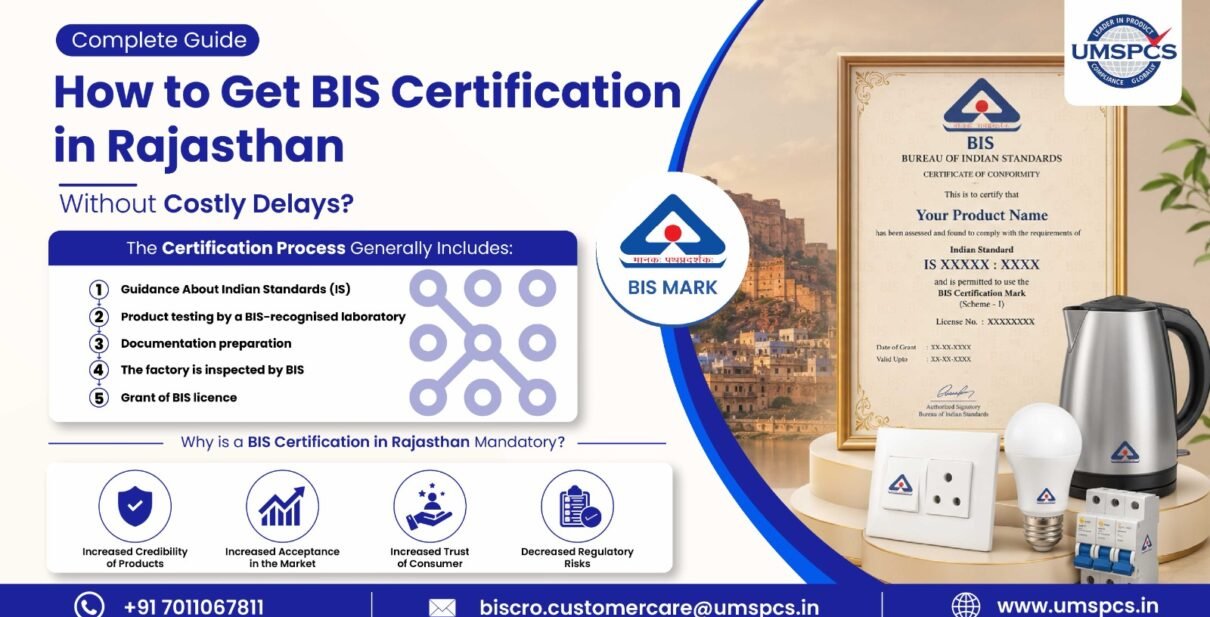
Complete Procedure to Obtain BIS Certification in Rajasthan
Step 1: Identify the Applicable Indian Standard (IS Code)
Identify the IS code that is applicable for the particular product. The manufacturer should:
- Know the requirements of the product
- Manufacture the product according to the standard laid down by BIS
- Improve the process of manufacturing, if necessary
Step 2: Product Testing and Documentation
Test the product in a BIS-recognized and NABL-accredited laboratory. During this phase:
- Product samples are tested
- Technical documents are made
- Factory and manufacturing documents are made
- BIS applications are filled
Step 3: Application Submission
BIS application can be submitted through online mode along with the necessary documentation and applicable fee. Generally, a BIS application consists of:
- Test reports
- Factory details
- Government fees
- Documents for BIS
Step 4: BIS Factory inspection
Inspect the manufacturing facility by a BIS official to ensure that the factory is following the manufacturing process by inspecting the following:
- Manufacturing process
- Manufacturing setup
- Quality assurance system
- Testing setup
- Product samples (if needed)
Step 5: Laboratory Evaluation
Samples collected are tested in the approved laboratories, and the LTR is submitted directly to the BIS.
Step 6: Closure of Non-conformities
If BI finds any non-conformity in the documents submitted by the manufacturer, then he/she has to:
- Take action
- Submit the revised documents
- Close the observations
Step 7: Payment of License & Marking Fees
After the evaluation process, payment is to be made for:
- Annual license fee
- ISI marking fee
Step 8: Awarding of BIS ISI License
When all conditions are met, then BIS issues the ISI Mark License. This will enable the company to put the ISI Mark on its products.
Documents Required for BIS Certification in Rajasthan
The documentation varies based on the certification program but typically consists of:
- Business registration certificate
- GST and PAN information
- Product specification
- Manufacturing process
- Test report
- Quality control information
- Letter of authorization (for products from foreign suppliers)
Costing of BIS Certification In Rajasthan
| Particulars | Estimated Cost (INR) |
| Application Fees (BIS) | ₹1,000 |
| Testing Charges (Lab Fees) | ₹15000 – ₹2,50,000 |
| Factory Inspection Charges | ₹7000 |
| Annual License Fees | ₹1,000 |
| Marking Fees (ISI Mark Usage) | As per BIS norms (based on production) |
| Consultancy Charges (UMSPCS) | ₹ 50000 |
How Long Does BIS Certification Take?
Certification timeline is contingent upon:
- Type of product
- Duration of testing
- Factory inspection
- Review by BIS
- Document accuracy
Typically:
| Certification Scheme | Approximate Timeline |
| BIS CRS Registration | 3 – 6 weeks |
| BIS ISI Certification | 2 – 6 months |
| BIS FMCS Certification | 4 – 8 months |
Timelines can differ based on product complexity and BIS guidelines.
Common Reasons Behind Costly Delays
Common reasons for delays include:
- Misrepresentation of the IS code
- Missing information
- Non-conformity with the design of the product
- Discrepancies in the test report
- Failure in laboratory testing
- Incorrect application information
- Delayed responses to BIS inquiries
- Unpreparedness of the factory
- Changing notifications by the government
Proper planning can minimize these problems.
Tips to Avoid Certification Delays
- Identify the right certification scheme prior to application
- Perform document assessment before submitting
- Test your products in BIS-accredited laboratories only
- Make sure your product labeling meets BIS specifications
- Act quickly on any observations made by BIS
- Update your manufacturing and quality documentation
- Be aware of any changes in relevant QCOs and BIS guidelines
- Engage with compliance professionals with experience
Benefits of BIS Certification in Rajasthan
Some of the advantages that arise from being BIS certified are:
- Compliance with Indian law
- Increased product credibility
- Greater consumer confidence
- Improved market access within India
- Greater acceptance within government procurement
- Less risk of regulatory issues
- Market competitiveness
- Product quality consistency
- Brand reputation improvement
- Business growth
Read more: ISI Certification Consultant in Rajasthan
Why Choose UMSPCS for BIS Certification?
Following BIS regulations may prove to be difficult due to changing standards and paperwork required. But at UMSPCS, the whole certification procedure is made easy with end-to-end assistance under regulatory procedures for manufacturers in Rajasthan as well as India.
Why Do Businesses Trust UMSPCS?
- 6+ years of experience in regulatory compliance
- 600+ completed projects in product compliance
- Specialized assistance in ISI, CRS, and FMCS certification procedures
- We are always there to help businesses avoid any delay during certification
With us, you can focus on production as we take care of regulatory issues.
Conclusion
BIS certification for Rajasthan will mean more than complying with the legal necessities; it would be an intelligent decision regarding the quality of the products, consumer satisfaction, and future business growth. Whether one is looking for BIS ISI Certification for Indian Manufacturers, BIS CRS Certification for Electronic Products, or BIS Certificate for Foreign Manufacturers, being aware of the process will help avoid any unnecessary delays.
Work with a compliance consultant who will make the process of documentation, testing, and applying for certification easy and efficient.
Ready to Get BIS Certified With No Delays?
UMSPCS assists you in obtaining BIS Certification in Rajasthan, as well as in all regions of India, regardless of whether you run a startup, an MSME, or a large manufacturing company or import goods into India.
Contact us now for your free consultation!
Read more: BIS FMCS Certification Consultant in Rajasthan
FAQs
- Is BIS Certification Mandatory in Rajasthan?
Yes, if your product is notified under a mandatory Quality Control Order (QCO), then BIS certification is mandatory before manufacturing, importing,g or marketing your product in Rajasthan or India.
- Who can apply for BIS ISI Certification for Indian Manufacturers?
Indian Manufacturers manufacturing goods falling within the scope of the ISI Certification Scheme can apply if they comply with the Indian Standard of that product.
- Which Products Require BIS CRS Certification for Electronic Products?
LED Lighting, Laptops, Mobile Phones, Televisions, Power Adapters, Monitors, a nd many other Electronic and IT products notified under the Compulsory Registration Scheme require BIS CRS Certification.
- Do foreign companies qualify for BIS certification?
Yes, Foreign Manufacturers exporting regulated products to India may apply under FMCS or CRS depending on the type of product.
- Validity of BIS Certification?
Validity varies according to the certification scheme. The certificate may be renewed when there is compliance with BIS requirements.
- How long does it take for BIS Certification?
It varies according to the category of product, testing, and BIS approval process. CRS registration usually takes less time than ISI Certification.
- Which documents should be submitted for BIS certification?
The relevant documents include company registration, factory information, product details, test reports, quality control reports, manufacturing process information, and authorization documents, if any.
- What steps can be taken by manufacturers to minimize delay in BIS certification?
Selecting the appropriate IS standard, having all necessary documentation, conducting tests at BIS-approved laboratories, and quick response to BIS queries can minimize delays.
❓ Ask a Question
Have any doubts? Fill the form below and our team will respond shortly.