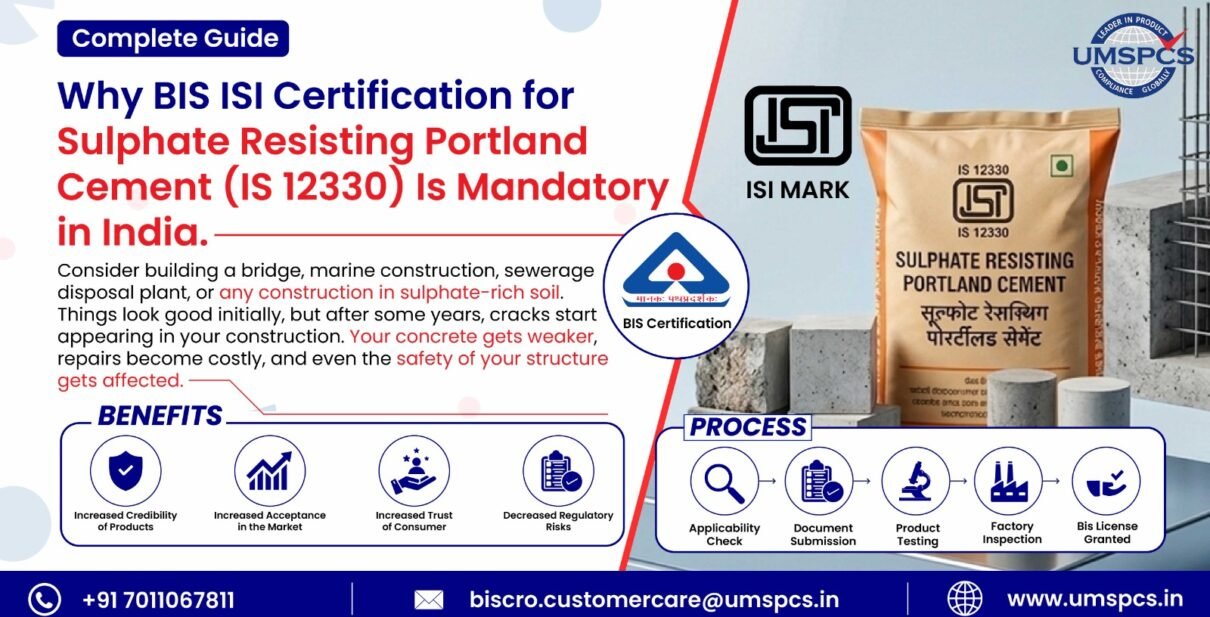
Consider building a bridge, marine construction, sewerage disposal plant, or any construction in sulphate-rich soil. Things look good initially, but after some years, cracks start appearing in your construction. Your concrete gets weaker, repairs become costly, and even the safety of your structure gets affected.
One of the major reasons for such damage is called sulphate attack. In order to avoid it, India has laid down stringent quality requirements for Sulphate Resisting Portland Cement (SRPC) as per IS 12330, thus assuring that only quality cement reaches the markets.
Here comes into picture the need for BIS Certification for Sulphate Resisting Portland Cement. BIS requires adherence to IS 12330 for getting an ISI mark on the product. Whether you are a manufacturer in India or a foreign company intending to supply in the Indian market, getting BIS certification in India will show that your product meets the quality and safety standards required in the country.
In this blog, UMSPCS helps you understand everything about BIS certification of sulphate resisting portland cement.
Understanding about Sulphate Resistant Portland Cement (SRPC)
Sulphate Resistant Portland Cement (SRPC) is a type of cement that does not react with sulphates which are abundant in places where the soil and water contain large amounts of sulphates.
Unlike OPC, SRPC contains a small amount of Tricalcium Aluminate (C₃A).
This is commonly used in:
- Marine constructions
- Coastal constructions
- Sewage treatment plants
- Underground construction
- Structures retaining water
- Bridges
- Dams
- Industrial establishments
- Chemical industry
Foundations subjected to sulphate bearing soil
Why is BIS Certification Mandatory?
Regulation of Cement Products in India by BIS takes place under the provisions of BIS Act, 2016 by the Product Certification Scheme.
The ISI mark cannot be affixed on the cement products unless and until the BIS license is obtained after complying with IS 12330.
Certification provides the assurance that:
- The cement is of prescribed quality.
- The manufacturing process remains constant.
- The testing of the product is conducted regularly.
- Safe and durable construction material is provided to consumers.
- Poor quality cement is kept away from the Indian market.
For Indian manufacturers, this certification is provided under BIS Product Certification Scheme. For foreign manufacturers exporting SRPC to India, certification under FMCS is required.
Products Covered Under IS 12330
The standard applies to:
- Sulphate Resisting Portland Cement manufactured for construction applications
- Cement intended for structures exposed to sulphate-bearing environments
- Cement used in marine construction
- Cement supplied for sewage and drainage infrastructure
- Cement for foundations in aggressive soil conditions
Basic Requirements for BIS Certification IS 12330
Manufacturers must establish a manufacturing facility capable of consistently producing cement conforming to IS 12330.
Basic requirements include:
- Manufacturing unit
- Quality Control Laboratory
- Qualified technical personnel
- Testing equipment
- Documented quality management system
- Manufacturing process controls
- Raw material quality control
- Factory Testing Laboratory
Eligibility Requirements for BIS certification of Sulphate Resisting Portland Cement
1. For Indian Manufacturers
The manufacturers have to satisfy:
- Own a manufacturing plant
- Manufacture cement according to IS 12330
- Have their own testing laboratory
- Adhere to Scheme of Inspection and Testing (SIT)
- Be open for BIS factory inspection
2. For Foreign Manufacturers
Under the BIS Certification for Foreign Manufacturers scheme, the manufacturers have to:
- Own the manufacturing plant
- Appoint an Authorised Indian Representative (AIR)
- Provide necessary technical information
- Undergo BIS factory inspection
- Be compliant with IS 12330
Applicable Tests Under IS 12330
Prior to issuing the certification, BIS ensures the quality of the cement by conducting lab tests. The main tests are:
Physical Tests
- Fineness
- Setting Time
- Soundness
- Compressive Strength
- Heat of Hydration
Chemical Tests
- Insoluble Residue
- Loss on Ignition
- Magnesium Oxide
- Sulphuric Anhydride
- Chloride Content
- Tricalcium Aluminate (C₃A)
- Lime Saturation Factor
The test shows that the cement meets the required quality standards according to IS
Step-by-Step BIS Certification Process for Sulphate Resisting Portland Cement
Step 1: Identify the Applicable Indian Standard (IS 12330)
The first step in the certification procedure starts with identification of the correct Indian Standard for the product. In case of Sulphate Resisting Portland Cement, the manufacturers have to follow IS 12330.
In this stage, the manufacturers have to:
- Familiarize themselves with the technical requirements of IS 12330.
- Ensure that the product is designed and manufactured as per the BIS Standards.
- Improve the process or quality controls if necessary to meet the prescribed standards.
Step 2: Testing and Document Preparation
The product should undergo testing in a laboratory approved by the BIS and accredited by NABL as per IS 12330.
During this stage:
- Testing of product samples as per the relevant standard takes place.
- Preparation of technical and quality related documents.
- Collection of manufacturing and factory details.
Completion of the BIS application along with other documents.
Step 3: Submission of BIS Application
Upon completion of testing and documentation, the manufacturer applies to BIS through its official portal.
A typical BIS application comprises of the following:
- BIS application form
- Test reports of the product
- Factory and manufacturing details
- Relevant declarations and documents
- Government Fees (as applicable)
The BIS reviews the application after which the next stage starts.
Step 4: BIS Factory Inspection
After going through the application, the BIS officials inspect the manufacturing factory to check for adherence to IS 12330.
While inspecting, they verify:
- Manufacturing process
- Production infrastructure
- Quality control process
- In-house testing laboratories
- Adherence to BIS requirements
Samples of products may also be collected for independent lab tests, if necessary.
Step 5: Testing of Samples of Products in Laboratory
Testing of samples of products collected is done in the approved laboratory to ensure that the product satisfies all quality and performance requirements specified under IS 12330.
Lab Test Report (LTR) is submitted to BIS by the laboratory for technical evaluation.
Step 6: Rectification of Defects, If Any
If any defects have been found out by the BIS during inspections and sample testing, then the manufacturer has to rectify those defects before certification is granted.
It could involve:
- Implementation of corrective measures
- Updating of manufacturing or quality control process
- Submission of revised documentation or other information
- Satisfying the BIS requirements
Step 7: Payment of Licence and Marking Fees
Once the product and manufacturing plant pass all the BIS requirements, the manufacturer is supposed to pay the following fees:
- Annual licence fee
- ISI marking fee
- Other BIS fees, if any
Step 8: Grant of BIS ISI Licence
On successful completion of the testing, inspection, compliance check, and payment of fee, BIS provides the ISI licence.
The manufacturer is thus enabled to place an ISI mark on Sulphate Resisting Portland Cement produced in conformity with IS 12330.
Documents Required for BIS Certification for Sulphate Resisting Portland Cement
The manufacturing company usually requires:
- Basic data of the manufacturing plant and product line
- Evidence of manufacturing plant address (ownership/lease document, utility bill, etc.)
- Trademark registration certificate (in case if the brand name has been registered)
- Manufacturing license/other statutory clearances (if required, for example, pollution control clearance and industry specific clearances)
- Design of product line and other drawings/description
- Production capacity installed
- Material list along with its specification
- Manufacturing machinery and equipment details
- Layout plan of the manufacturing plant (production & test area and storage area)
- Detailed manufacturing process flow is available.
- In-house test facility and calibration details
- Quality control staff details
- Organisation Chart of the factory
Benefits of BIS ISI Certification IS 12330
Benefits of BIS ISI Certification for Indian Producers are:
- Market Credibility: Customers can be assured that the ISI mark denotes quality as per national standards.
- Legal Authorization: Helps in legal manufacturing and sale of relevant cement products.
- Increased Customer Confidence: Contractors, builders and even government bodies prefer BIS certified products.
- Access to Markets: BIS certified cement is mandatory in many infrastructure works.
- Market Competitive Edge: Certified producers enjoy more market visibility.
- Product Quality Improvements: Surveillance ensures uniformity in the manufacturing process.
Common Challenges Faced by Manufacturers IS 12330
Delays in many cases may be caused by:
- Incorrect documentation
- Laboratory problems
- Poor testing facilities
- Tests failing
- Factory observations
- Technical interpretation of BIS requirements
- Slow response to applications
Professional advice can prevent most of these problems and facilitate certification.
Costing and Timeline for BIS Certification of IS 12330
Cost of Certification is determined by a number of things, which include:
- Type of product
- Number of manufacturing sites
- Laboratory testing
- Government charges
- Inspection fees
- Consultancy services
| Particulars | Estimated Cost (INR) |
| Application Fees (BIS) | ₹1,000 |
| Testing Charges (Lab Fees) | 15000- ₹2,50,000 |
| Factory Inspection Charges | ₹7000 |
| Annual License Fees | ₹1,000 |
| Marking Fees (ISI Mark Usage) | As per BIS norms (based on production) |
| Consultancy Charges (UMSPCS) | ₹ 50000 |
Estimated Timeline:
| Manufacturer | Approximate Timeline |
| Indian Manufacturer | 30 – 40 Days |
| Foreign Manufacturer | 5 – 6 Months |
Timeframes can differ according to availability of documents, product testing, BIS inspection schedules, and application completeness.
Read more also: BIS CRS Certification for Amplifiers with Input Power 2000W Above
Why Choose UMSPCS for BIS Certification for Sulphate Resistant Portland Cement?
BIS Certification for Sulphate Resistant Portland Cement needs professional skills, accurate documentation, and constant coordination with the BIS officials.
In UMSPCS, we make your entire certification process easy for you as a manufacturer in India and abroad.
Our Expertise:
- More Than 6 Years of Regulatory Experience
- 600+ Successful Projects for Product Compliance
- Full Document Support
- Identification of Product Standards
- BIS Application Filing
- Laboratory Coordination
- Factory Inspection Support
- Compliance Gap Analysis
- Help for Foreign Manufacturers
- Post Certification Assistance
Our regulatory experts work hand-in-hand with the manufacturers for minimizing delays and improving documentation.
Conclusion
The requirement for building materials that last has been increasing in India. The BIS Certification for Sulphate Resistant Portland Cement based on IS 12330 assures quality construction material capable of handling aggressive sulphate conditions.
If you are an Indian manufacturer looking for BIS ISI Certification for Indian Manufacturers or an international company that needs BIS Certification for Foreign Manufacturers, then timely compliance will help you save time, money, and effort.
Looking for professional guidance in obtaining BIS Certification for Sulphate Resistant Portland Cement?
Contact UMSPCS professional today and make your BIS certification process simple.
Read more also: Drug Licence in Delhi NCR: Complete Guide for Manufacturers
FAQs
- Is BIS Certification for Sulphate Resisting Portland Cement Mandatory in India?
Yes, as it is mandatory for the manufacturers to have a BIS license according to IS 12330 for applying the ISI Mark for Sulphate Resisting Portland Cement.
- Are BIS certifications available for foreign manufacturers?
Yes, as foreign manufacturers can apply for BIS certification under BIS FMCS through the authorized Indian representative.
- How long does the BIS Certification Process take?
It usually takes 30 – 40 working days for Indian manufacturers and around 5-6 months for foreign manufacturers depending upon the testing and documentation process.
- What are the Major Tests performed under IS 12330?
BIS Certification process involves physical and chemical tests such as Compressive Strength, Fineness, Setting Time, Soundness, Heat of Hydration, Sulphuric Anhydride, Magnesium Oxide and Tricalcium Aluminate (C₃A).
- What are the necessary Documents for BIS Certification?
Necessary documents include company registration, Factory details, manufacturing process, Laboratory details, test report, Quality Control Documentation, Calibration certificates and statutory registrations.
- Why should manufacturers take the services of BIS Consultant?
Consultants will make sure that there are no mistakes in documentation and coordinate all activities involved in the BIS certification process.
❓ Ask a Question
Have any doubts? Fill the form below and our team will respond shortly.