Business organisations tend to believe that environmental rules and regulations are applicable to big manufacturing firms. Indeed, in case your business is engaged in manufacturing, importing, distributing or selling plastic packaging products and usage of plastic packing products, there are possibilities that you need to follow the Plastic Waste Management Rules and be required to obtain Plastic Waste Approval in Delhi NCR.
Otherwise, you will be subjected to regulatory action, financial penalties and your business process will be interrupted. However, adhering to these rules can enhance the brand reputation, meet sustainability goals and contribute to the smooth running of the business.
In this blog, UMSPCS brings for you an all-round guide on Plastic Waste Approval in Delhi NCR.
Understanding Plastic Waste Approval in Delhi NCR
Plastic Waste Approval in Delhi NCR is an approval requirement which will be provided under the provisions of Plastic Waste Management Rules, 2016, issued by MoEFCC via CPCB and respective SPCBs/PCCs.
This approval will help in making sure that all environmental standards and extended producer responsibility are fulfilled by companies dealing with plastic waste generation, manufacturing, importation, processing, recycling, and handling.
The primary purpose of the approval is to reduce the amount of plastic waste, to enable waste collection and to promote recycling.
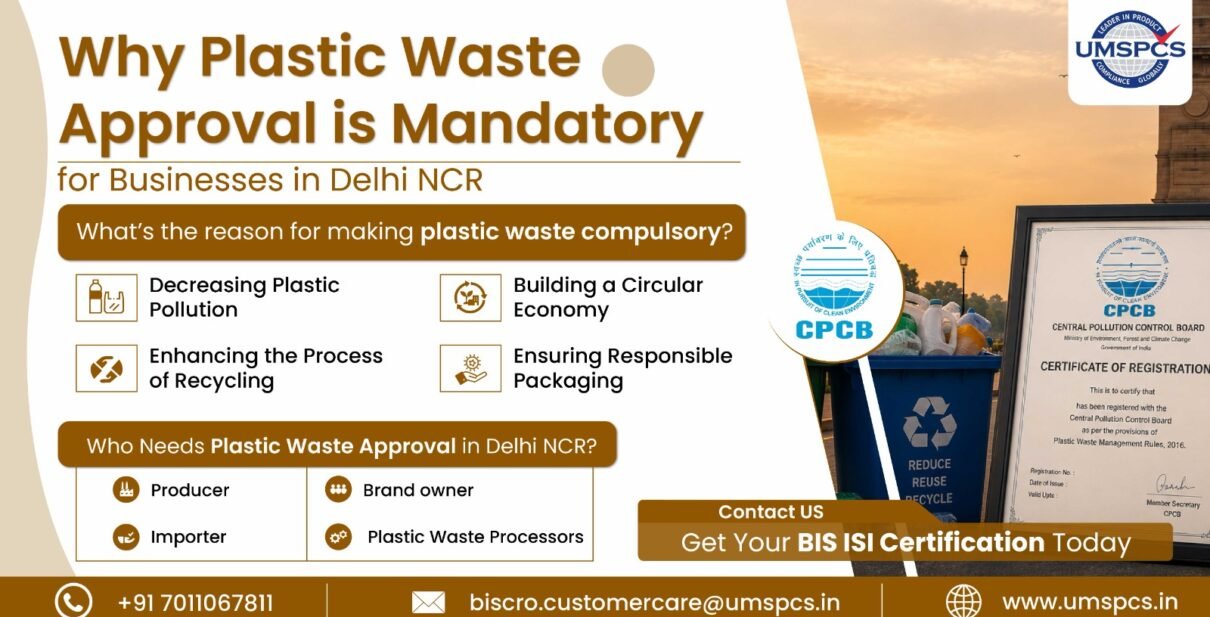
What’s the reason for making plastic waste compulsory?
India generates millions of tons of plastic waste each year. The Government of India has set certain compliances for its companies for better management of waste and recycling.
These include:
- Decreasing plastic pollution
- Enhancing the process of recycling
- Building a circular economy
- Ensuring responsible packaging
- Making manufacturers liable through EPR compliance
- Avoidance of illegal dumping of plastic waste
- Environmental sustainability
Companies failing to follow the guidelines could be penalized and deregistered.
Who Needs Plastic Waste Approval in Delhi NCR?
As per PWM Rules and EPR Guidelines. In case your organisation belongs to any one of the following categories, it becomes mandatory to get Plastic Waste Approval in Delhi NCR.
1. Producer
Producer is any entity that manufactures plastic packaging or products packaged in plastic. It is the responsibility of the producer to collect and manage the plastic packaging put into the market under the EPR guidelines.
2. Importer
An importer who brings plastic packaging or product in plastic packing material into India has to comply with the EPR requirements for imported packaging material.
3. Brand owner
Brand owners who market products under their brands (e-commerce portals, retailers, supermarkets, etc.) have to comply with the EPR obligation. However, micro and small enterprises (as per definition of MSME ministry) do not come under the Brand Owners category under EPR guidelines.
4. Plastic Waste Processors
Plastic Waste processors are vital in terms of sustainable waste management as they process collected plastic waste using approved processes which include,
- Plastic Recycling
- Waste to energy
- Waste to oil conversion
- Industrial Composting
The following will help to ensure that the plastic waste will not be buried in landfills but will instead be disposed of using environmentally friendly methods. Also get to know more about Battery Waste Certification.
What Does Extended Producer Responsibility Cover?
The problem of EPR is not just about collecting plastic waste but concerns the entire lifecycle of plastic packaging.
As per the EPR guidelines, the responsibilities of enterprises include:
- Reuse of plastic packaging
- Recycling of plastic waste
- Utilization of recycled plastic materials
- Environmental disposal at end of life
This will encourage the enterprises to adopt sustainable packaging with minimal pollution of the environment.
Types of Plastic Packaging Covered Under EPR
Not all types of plastic packaging belong to the same classification. The EPR Guidelines have grouped plastic packaging into four categories depending on their composition.
| Category | Type of Plastic Packaging |
| Category I | Rigid Plastic Packaging |
| Category II | Flexible plastic packaging (single-layer or multi-layer), plastic sheets, carry bags, plastic sachets, and pouches |
| Category III | Multi-layered plastic packaging containing both plastic and non-plastic materials |
| Category IV | Compostable plastic carry bags, plastic sheets, and similar packaging materials |
It is very important to know which category the packaging belongs to as each of them has different EPR obligations and recycling targets.
Legal Framework Governing Plastic Waste Approval
The approval will be in accordance with:
- Rules for Management of Plastic Waste, 2016
- Plastic Waste Management (Amendment) Rules
- EPR Guidelines
- CPCB Guidelines
- Requirement of State Pollution Control Board
- Environmental Protection Act, 1986
These rules define the role of producers, importers, brand owners, recyclers, and waste processors.
Applicable Tests and Compliance Requirements
Though Plastic Waste Approval for Delhi NCR is more of a regulatory approval rather than a product certification, there may be some tests or verifications to be done based on regulations and standards that would apply.
Tests or verifications can include the following:
- Identification Tests
- Recycled Content Tests
- Compostable Plastics Testing (If applicable)
- Thickness Tests (If applicable)
- Product Quality Test
- Lab Reports from accredited laboratories (If applicable)
- Compliance to BIS standards (Where applicable)
The exact testing requirements depend on the category of plastic product and applicable environmental regulations.
Step-by-Step Process of Registration for Plastic Waste Approval in Delhi NCR
Step 1: Create an Account on the Portal
The process of registration should begin with the creation of a user account using a valid email ID and generating a password in the dedicated portal.
Step 2: Login to the Portal
Login to the portal using your email ID and password to enter the online application portal page.
Step 3: Upload the Necessary Documents
Fill in the application form along with uploading the necessary documents and make sure that you have provided correct information in the application.
Step 4: Pay the Required Registration Fees
Proceed to pay the government fees for the registration as per the prescribed procedure.
Step 5: Complete Your Application
Make sure that you verify your application after paying the required government fees for the registration.
Documents Required for Plastic Waste Approval in Delhi NCR
The document requirement differs according to whether the person seeking registration is a Producer, Importer, or Brand Owner.
Documents required from Brand Owners and Importers
- Companies that seek to register as Brand Owners and Importers usually require:
- Company PAN
- Certificate of GST Registration
- Certificate of Incorporation (CIN), wherever necessary
- GST invoice of all States/UTs wherein business is being conducted
- PAN number and Aadhaar of the authorized signatory
- E-mail id and mobile number of the authorized signatory
- Description of products manufactured or marketed
- Pictures of products
- Certificate of Registration issued by DIC, MSME, or Udyam Registration
- Scan copy of signature of the authorized signatory
- Letterhead of Company
Additional Documents required from Producers
Apart from these documents, the following documents also need to be provided by producers:
- Diagram of manufacturing process flow
- Details of raw materials input and output products
- Information about waste generated in manufacturing process
- Information about captive power generation, if any
- Details of water consumption
Adequate documentation will prevent delays in the review of the applications.
Extended Producer Responsibility (EPR) Targets
As per the EPR Guidelines, enterprises have been required to attain progressively increasing targets for recovery and recycling of plastic packaging depending on their category.
| Plastic Packaging Category | 2024-25 | 2025-26 | 2026-27 | 2027-28 Onwards |
| Category I | 50% | 60% | 70% | 80% |
| Category II | 30% | 40% | 50% | 60% |
| Category III | 30% | 40% | 50% | 60% |
| Category IV | 50% | 60% | 70% | 80% |
The above targets represent the Government of India’s resolve to increase plastic waste recovery and recycling.
Why Understanding Your EPR Category Is Important
One of the main causes of delay in receiving Plastic Waste Approval in Delhi NCR region is choosing an incorrect applicant category or incorrectly classifying plastic packaging.
A proper evaluation assists in:
- Determining the proper EPR responsibilities
- Calculating proper recycling targets
- Providing proper documentation
- Ensuring that the application is not rejected
- Ensuring continued compliance with the regulations
In UMSPCS, we help you determine your category, prepare proper documentation and get the proper registration done to ensure easy compliance with the Plastic Waste Management Rules and EPR Certification.
Why Businesses Across Delhi NCR Trust UMSPCS
Obtaining permission for managing plastic waste approval in Delhi NCR needs knowledge and expertise in technical and regulatory aspects.
With over 600 successful product compliance projects and more than 6 years of experience in regulatory compliance consulting, UMSPCS ensures easy compliance for companies.
Some of the services we offer are:
- Business eligibility check
- Identification of plastic categories
- Document preparation
- Filing of applications
- CPCB/SPCB compliance assistance
- EPR registration assistance
- Questioning management
- Full-fledged approval management
- After registration compliance management
Be it Delhi, Noida, Gurgaon, Ghaziabad, Faridabad, Greater Noida, or the surrounding areas, our team makes the whole procedure of approval easier for you.
Conclusion
Environment compliance has emerged as an integral component of conducting business operations in India. Being a business entity manufacturing, importing, selling or utilizing plastic packaging material, having the Plastic Waste Approval in Delhi NCR becomes a must for conducting business responsibly and sustainably in the region.
Compliance with the Plastic Waste Management Rules not only helps avoid potential legal troubles but enhances the reputation of your brand from the point of environmental responsibility. And also know more about Oil Waste ERP Certification.
Do you require any assistance in obtaining Plastic Waste Approval in Delhi NCR?
At UMSPCS we offer comprehensive support from eligibility verification to document preparation and application submission. Get in touch with our experts today!
Read more also: Why You Need a BIS Certification Consultant in Sweden
FAQs
- Is Plastic Waste Approval necessary in Delhi NCR for all companies?
It is mandatory for those companies which manufacture, import, process, recycle or introduce plastic packaging into the market.
- Who is required to get Plastic Waste Management Approval?
Those companies who produce, import, recycle, process and certain manufacturers of plastic packaging are needed to obtain such authorization.
- What is the difference between Plastic Waste Approval and EPR Registration?
Plastic Waste Approval is related to authorization under applicable regulations whereas EPR Registration is concerned with Extended Producers Responsibility of plastic packaging.
- How long is the approval procedure?
It usually takes between 3 and 8 weeks, depending on documents preparedness and review by regulators.
- What documents are required for Plastic Waste Registration in Delhi NCR?
Typical documents are GST, PAN, business registration and manufacturing information etc.
- Can MSMEs get Plastic Waste Approval?
Yes. MSMEs producing, importing or recycling of plastic packaging products are eligible for application.
- What will be the consequences for the operation without such authorization?
There are various consequences like penalty, ecological compensation, litigation and restrictions on business activity.
❓ Ask a Question
Have any doubts? Fill the form below and our team will respond shortly.