- June 18, 2026
- by umspcs
- Blog, Latest Notifications, News & Updates
- 371 Views
- 0 Comments
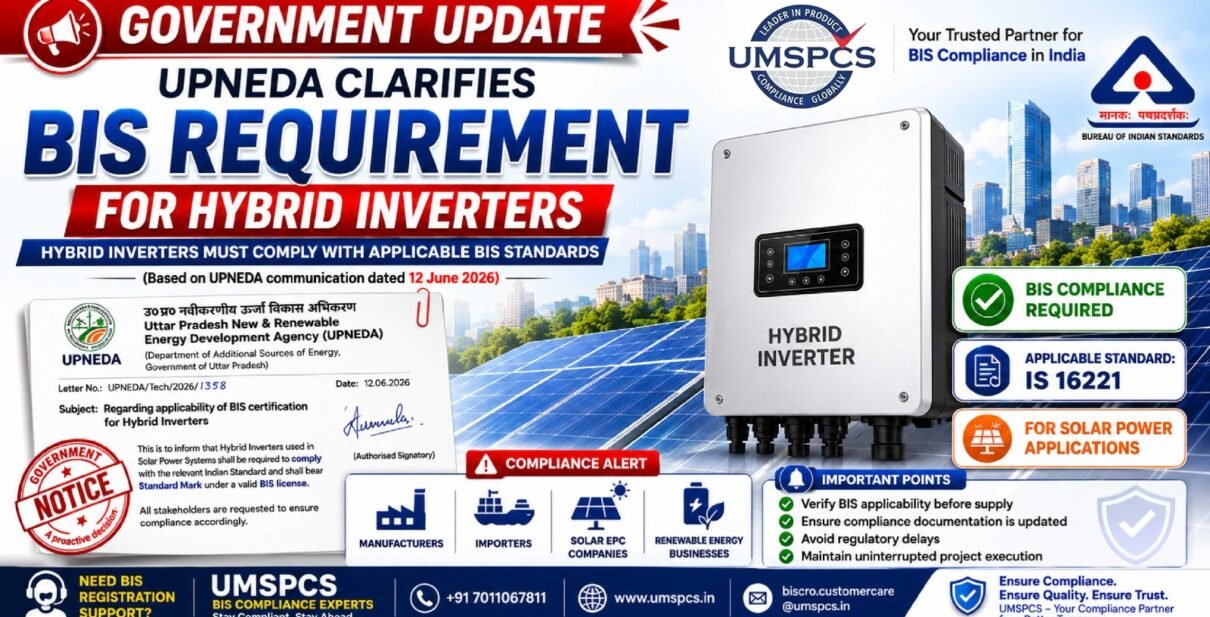
UPNEDA Issues Important Compliance Directive for Hybrid Inverters Under PM Surya Ghar Yojana
This notification will come into force from 12 June 2026 and acts as a warning for all vendors and other relevant entities regarding technical specifications, quality criteria, and testing of hybrid inverters for use in rooftop solar power plant systems as per the recommendations of the Ministry of New and Renewable Energy and the Government of India.
Such a measure is expected to enhance quality standards in the rapidly growing rooftop solar energy industry.
Understanding the Latest UPNEDA Order
The UPNEDA has brought attention to the specific clauses regarding Hybrid Inverters, and all the vendors engaged in the PM Surya Ghar Scheme have been asked to ensure strict adherence to these before installation.
The idea behind this is to ensure that the standard of products installed in solar rooftops is maintained at par with the international standards.
Key Compliance Requirements for Hybrid Inverters
1. Conformance to Quality Control Order (QCO) of Solar PV Inverter
2. Compliance with BIS & IEC StandardsCertification for Electronic Products
3. MPPT Requirement for Foreign Manufacturers (FMCS)
4. Environmental Testing Requirements
5. IP Protection Standards
Compliance with these requirements is essential for maintaining safety and durability throughout the equipment lifecycle
What Does This Mean for Vendors and Manufacturers?
- Manufacturers of solar inverters
- Suppliers of hybrid inverters
- EPCs for rooftop solar installations
- Registered firms under the PM Surya Ghar program
- Importers of solar inverter products
Non-compliance could result in delayed project completion, failure in inspections, or non-compliance with regulations.
Why Should There Be BIS Certification for Hybrid Inverters?
Advantages are:
- Product Qualification: It indicates that the product conforms to the Indian standard.
- Safety Level Increased: The test reports indicate that the products conform to the safety standards.
- Compliance with Rules: Product manufacturers can supply their products based on the rules of quality control orders.
- Better Reputation in the Market: This will give producers more reputation with regard to the government, EPC, and consumer communities.
- Eligibility for Government Projects: Some government projects require that products be in compliance with BIS standards and other governmental standards
Impact on the PM Surya Ghar: Muft Bijli Yojana
The UPNEDA notification ensures that the government's focus remains on:
● Quality solar setup
● Reliability of the system for its lifetime
● Consumer safety
● Energy efficiency
● Equipment standardization
The intention behind such stringent standards is that only those systems are installed that will provide dependable performance over the entire life of the solar panels.
Action Points for Manufacturers and Vendors
- Ensure adherence to all relevant BIS standards.cation: It indicates that the product conforms to the Indian standard.
- Comply with all provisions of Quality Control Order.
- Check for inclusion of MPPT technology in the inverter system.
- Verify environmental test results.
- Inspect the protection classification of enclosures (IP65/IP54).
- Verify technical data and certification documents.
- Before providing any product under the government-subsidised rooftop solar program.
How UMSPCS Can Help
- BIS Certification for Solar Photovoltaic Inverters
- BIS Registration and Regulatory Guidance Services
- BIS Registration and Regulatory Guidance Services
- BIS Registration and Regulatory Guidance Services
- QCO Compliance Assistance
- BIS Certification for Hybrid Inverters
- PM Surya Ghar Scheme Compliance Services
- Regulatory Liaison Services
Conclusion
Businesses need to make sure that they do not encounter any regulatory issues, ensuring the smooth execution of government-funded solar projects. Getting BIS Certification for Hybrid Inverters on time and complying with other standards will help businesses succeed in India’s burgeoning solar energy sector.
Get in touch with UMSPCS now, and our experts will assist you with the product requirements and BIS certification process.
Frequently Asked Questions (FAQs)
Yes, hybrid Inverters deployed under the PM Surya Ghar scheme Muft Bijli Yojana need to adhere to BIS Standards, QCOs and MNRE technical standards.
UPNEDA Notification includes standards such as IS 61683, IS 16221(Part 2), IS 16169 and Environmental testing according to IEC 60068-2.
The Maximum Power Point Tracker (MPPT) serves an important purpose in Hybrid Inverters for maximising solar energy generation through the extraction of maximum energy from solar PV panels.
IP65 should be the minimum IP Rating requirement for any Hybrid Inverter intended to be installed outdoors.
Yes, importation of Hybrid Inverters shall be done in compliance with applicable BIS Certification, QCOs and MNRE technical standards.
Not complying with the two entities could lead to project approval delays, installation refusals, regulatory actions, market entry problems, and inability to join government-sponsored solar projects.
One should first determine which standard the product needs to comply with, test the product in a certified laboratory, prepare all the required documents, apply for BIS certification, and finally get approval before releasing the product into the market in India.
❓ Ask a Question
Have any doubts? Fill the form below and our team will respond shortly.