In almost all fertiliser manufacturing plants, warehouses, or distributors, one will find tonnes of woven sacks carrying various fertilisers. These sacks carry vital agricultural products such as fertilisers that are crucial in crop production. The problem is that poorly constructed sacks can tear when handling or transporting them or can let in moisture when storing them. Thus, the use of high-quality HDPE & PP woven sacks for packing fertilisers is a necessity both in terms of packaging and regulations.
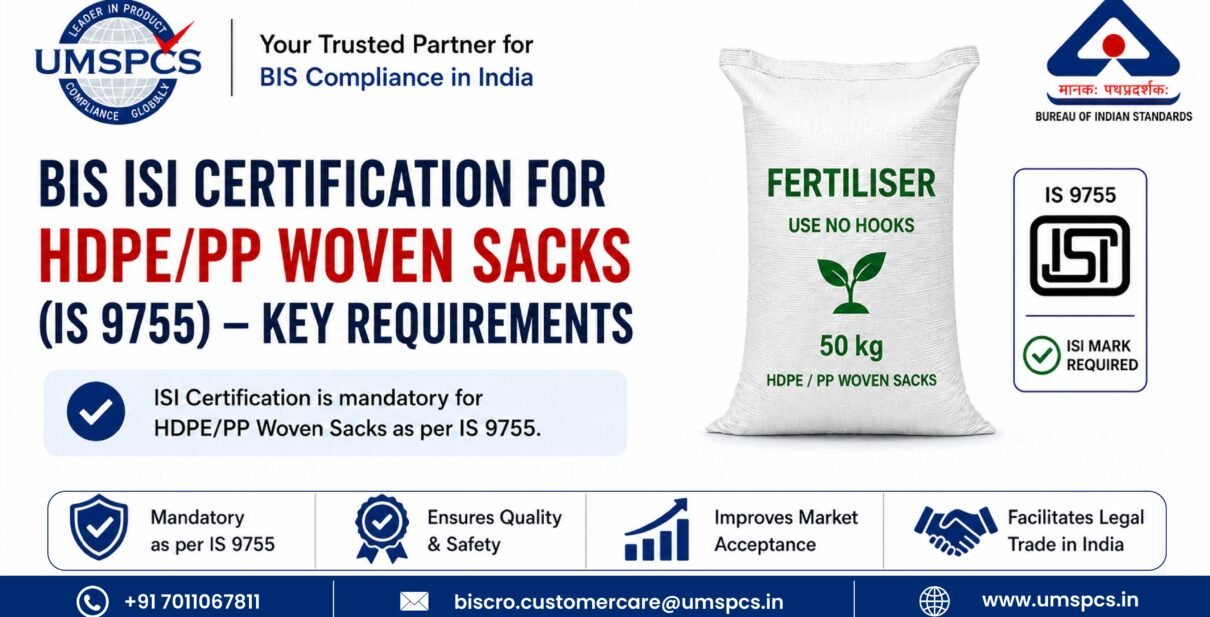
BIS ISI Certification for HDPE/PP Woven Sacks for Packing Fertilisers is mandatory under IS 9755. No manufacturer is allowed to produce, sell, distribute, or deliver the HDPE/PP woven sacks to fertiliser manufacturers without proper BIS ISI certification with the ISI mark.
The entire process of ISI certification includes product testing, inspection of the manufacturing facility and reviewing documentation in line with relevant Indian Standards. UMSPCS provides information to the manufacturers about BIS ISI Certification for HDPE/PP Woven Sacks for Packing Fertilisers (IS 9755). It covers details about eligibility.
What is BIS ISI Certification for HDPE/PP Woven Sacks (IS 9755)?
BIS ISI certification is a compulsory product certification as per the BIS Act, 2016. In case of HDPE and PP woven sacks for packing fertiliser, the scheme to be applied is the ISI Mark Scheme (Scheme I) under IS 9755.
In this BIS ISI certification for HDPE/PP woven sacks for packing fertilisers, manufacturers will need to be granted a BIS licence and affix the ISI mark to their products before they can lawfully sell sacks to the fertiliser companies. This certification is regulated and enforced by BIS. Manufacturers cannot sell these sacks for packing fertiliser in the Indian market without a BIS licence.
What do you mean by HDPE/PP Woven Sack?
Flexible packaging material composed of flat polymer tapes that are woven into fabric and seamed into bags of different shapes is called HDPE and PP woven sacks. They are commonly employed in the bulk packaging of fertilisers, food grains and chemicals.
- HDPE Woven Sacks
Excellent tensile strength and moisture resistance in high-load applications, made from high-density polyethene tapes.
- PP Woven Sacks
Produced with polypropylene tapes – lighter-weight but stronger than other tapes in use because they are the most economical to use to package fertilisers.
- Laminated Woven Sacks
Provide inner or outer lamination for increased moisture resistance, especially for hygroscopic fertilisers.
Why is BIS Certification Mandatory for HDPE/PP Woven Sacks?
- Agricultural safety: Fertiliser sacks must be able to resist stacking, transporting and rough handling without tearing.
- Quality assurance: Poor-quality sacks result in spillage, contamination and wastage throughout the supply chain.
- Consumer protection: Farmers must receive fertilisers in the correct quantity and condition
- Uniformity in supply: Mandatory certification means all suppliers have to have the same quality standard
- Preventing adulteration: Uncertified sacks create scope for repackaging and fertiliser adulteration.
Eligibility Requirements for BIS Certification
- Applicant is a legal entity (proprietorship, partnership or an LLP/company)
- Must have a working manufacturing plant equipped with appropriate manufacturing machinery
- The factory should have an internal or available quality-testing facility and equipment.
- The sourcing and production of raw material should be in accordance with IS 9755.
- The product shall be ready for testing before the filing of the application.
- Foreign manufacturers are required to make an Appointment of Authorised Indian Representative (AIR).
Applicable Tests Conducted Under IS 9755
- Mass per unit area of fabric
- Single fibre strength (warp and weft direction)
- Elongation at break
- The number of tapes per unit length.
- Weight of the sack
- Seam strength (bottom and side seams)
- Drop test (filled sack from specified height)
- Chemical modification (where applicable)
- Residual volume of the liner (when the liner is present)
BIS Certification Process for HDPE/PP Woven Sacks for Packing Fertilisers
Step 1: Identification of Applicable Standard
The first step in the procedure is to identify the Indian standard for the product. Manufacturers who are manufacturing fertiliser packing bags using HDPE/PP woven bags should adhere to IS 9755.
This step includes:
- Knowledge of the technical aspects of IS 9755.
- Analysis of the product specification and manufacturing process.
- Sample inspection and marking of products as per BIS standards. Product conformity as per BIS standards.
- Advances in product production and quality assurance processes
Step 2: Product Testing & Documentation Preparation
The product should be subjected to testing in a BIS-approved and NABL-recognised laboratory to ensure it meets the IS 9755 guidelines.
In this step:
- Compliance testing of samples from the product for all IS 9755 parameters
- Preparation of technical documents.
- Details about manufacturing and quality control.
- Factory and Production information
- BIS application forms
Step 3: Submission of BIS Application
After completing the necessary tests and preparations of documents, the BIS application is filed on the official site.
Typically, the document bundle consists of:
- Report from a BIS-recognised testing laboratory.
- Drawing up technical documents and product specifications
- Factory manufacturing details
- Application forms
- Government-prescribed fees
- When the application is completed, it is submitted to BIS.
Step 4: Factory Inspection by BIS
A factory inspection will be conducted to check the compliance with all the requirements for the factory certification.
- During the inspection, the following areas will be looked at:
- Every step of the manufacturing process and production setup.
- A quality assurance system and procedures.
- Testing facility and equipment available within the house.
- Responsibility for raw material storage and control.
- Production and material control records must be kept. Must keep production and material control records.
Product samples are allowed to be taken during the inspection to further verify.
5. Independent Sample Testing & Assessment
Samples of the product are sent to approved laboratories for testing to ensure conformance to IS 9755 standards.
During this step:
- Samples of the sacks are tested independently
- Laboratory Test Reports (LTRs) are completed:
- The report of strength, seam, drop test and other parameters is sent to BIS for assessment.
Step 6: Non-Conformity Closure
Corrective action should be taken when any non-conformance or deviation is identified by the testing & inspection process.
These might include:
- Listening to feedback on products’ and materials’ quality.
- The efficiency of the manufacturing or stitching operation was enhanced. The efficiency in the manufacturing or stitching process was improved.
- The documents will be submitted again for review.
- Any unfilled gaps in closure evidence reported to BIS. Any gaps in closure evidence are reported to BIS.
All non-conformities must be closed properly before issuing a licence.
Step 7: Payment of BIS Licence & Marking Fees
Once the above process is completed and passed, the manufacturer needs to pay the appropriate fees to BIS.
These can include:
- Annual licence fee
- ISI marking fee
- Any other fee as per BIS regulation, if applicable.
Step 8: Granting of ISI Licence
Once the tests, inspections, validation of documents and payment of the fee are done, BIS gives the ISI licence to the manufacturer.
The manufacturer can then use the ISI mark on HDPE/PP woven sacks and sell them as per the requirements of the BIS.
What are the documents needed for BIS ISI Certification?
Usually, manufacturers require:
- Data about the unit of manufacturing and the product category
- Have evidence of a manufacturing unit (deed, any type of utility bill, etc.).
- Marks: Certificate of trademark (in case the brand name is registered)
- Pollution Control: Manufacturing licence/statutory clearance (as per the requirements of pollution control)
- Drawings of the product design/schematic
- Capacity of manufacturing
- Material list used with their specifications
- Parts of Machines used in production
- Engineering drawing of the factory layout (Production area and storage area)
- Here, the detailed manufacturing process is mentioned.
- The list of equipment and internal test calibration information.
- Information on quality control staff members
- The manufacturing unit’s organisational structure is outlined in this document. This document details the manufacturing unit’s organisational structure.
- A sound documentation system is a key element to expedite approvals.
Cost and Timeline of BIS Certification
The typical costs of certification are:
| Particulars | Estimated Cost (INR) |
| Application Fees (BIS) | ₹ 1,000 |
| Testing Charges (Lab Fees) | ₹15,000 – ₹250,000 |
| Factory Inspection Charges | ₹ 7,000 |
| Annual Licence Fees | ₹ 1,000 |
| Marking Fees (ISI Mark Usage) | As per BIS norms (based on production) |
| Consultancy Charges (UMSPCS) | ₹ 50,000 |
The above charges vary according to the nature of the products being certified. Also can get information about BIS Certificate for Foreign Manufacture
Expected Timeline for BIS ISI Certification
Due to BIS processing and product readiness, products may take longer than stated to become available.
- Estimated length of time: 30 – 40 working days
- AIF Products: As long as 180 days in some cases
Why go with UMSPCS for BIS Certification?
UMSPCS is a dedicated BIS certification consultancy engaged with the woven sack manufacturers. Here are some of the things we can provide you:
- Assessment of product applicability is done as per IS 9755.
- Data exchange between the DAM and a standard ID/compliance mapping.
- Complete documentation preparation support
- Coordination of testing with the BIS-recognised laboratories.
- Correct filing of the application on the BIS portal
- Managing BIS questions and technical comments
- Preparing and supporting the factory inspections.
- AIR arrangement support for foreign manufacturers. Foreign manufacturers’ support of an air arrangement.
- The management of post-certification renewal and surveillance
Conclusion
The BIS ISI certification for HDPE/PP woven sacks for packing fertilisers with ISI is as per IS 9755. A quality promise to producers’ reliability in real-world applications means performance, every time, in every sack.
Certification is legally protecting your business, expanding markets and increasing buyer trust.
Getting a BIS ISI certification for HDPE/PP woven bags for fertiliser packing may not always be an easy task. However, with UMSPCS, you can get through this complex procedure easily. We can help you in every step of this process, right from preparing your application to getting your BIS licence. Get in touch with us for a streamlined process.
Read more also: BIS Certification for Sealed Secondary Cells – Portable Applications
FAQs
- Are all HDPE/PP woven sacks required to be BIS certified?
In IS 9755, BIS ISI certification is required for particular fertiliser-packing industry sacks. Other uses of sacks might be subject to other standards.
- Is it possible for small-scale manufacturers to certify their products under IS 9755?
Yes. There is no minimum production capacity requirement. To ensure the safety of the fertiliser packing sacks, irrespective of the size of the business, any manufacturer is required to get BIS certification.
- What lab to use for IS 9755 testing?
Testing needs to be done at a BIS-recognised laboratory. UMSPCS can assist you in determining which laboratory is suitable for your needs, based on the different types of products and where you live.
- What is the duration of the BIS ISI licence?
A BIS ISI licence is generally valid for one year and could be renewed if fulfilled, along with the payment of renewal fees, if the company keeps on complying with the terms and conditions.
- Do laminated HDPE/PP sacks need to be certified as BIS?
Yes. Variants used for packing fertiliser that have been laminated are included in the scope of IS 9755 and must be certified.
- What will be the implications of providing uncertificated sacks?
Failure to provide non-BIS-certified sacks may lead to seizure of product, penalty under the BIS Act, 2016, and even exclusion from the government procurement programme.
❓ Ask a Question
Have any doubts? Fill the form below and our team will respond shortly.