You might be curious about how a blood glucose meter works. Helps people with diabetes every day.
A blood glucose metre tells people what their blood sugar levels are doing. Diabetics need to monitor their blood glucose levels, as small alterations in it can affect the treatment they receive.
That is why blood glucose metre systems have to be very good and safe before people can buy them. Blood glucose metre systems need to meet standards for quality and performance. This is so people with diabetes can get the help they need from a blood glucose metre to control their diabetes.
Blood glucose monitoring system manufacturers in India might have to follow the Indian Standard IS/ISO 15197 for the use of self-testing blood glucose monitoring systems in the management of diabetes mellitus. The BIS ISI Certification for In Vitro Diagnostic Test Systems process helps to make sure that products are supplied to consumers after having attained certain quality standards and performance specifications.
UMSPCS supports manufacturers with any aspect of the certification process, such as documentation, testing management, application support and regulatory guidance.
What are the In Vitro Diagnostic Test Systems?
In Vitro Diagnostic (IVD) Test Systems are medical devices that are used to analyze samples like blood, urine or tissue, but outside the human body. They play a role in the diagnosis, monitoring, and management of various health conditions by healthcare professionals and individuals.
One of the most used In Vitro Diagnostic Test Systems is blood glucose monitoring system. They are particularly developed to be used for self-testing by people with diabetes mellitus and are important for daily diabetes care.
What is IS/ISO 15197?
IS/ISO 15197 is the Indian standard for adoption of ISO 15197 standard. It defines the standards for blood glucose monitoring devices that are designed to be used by people with diabetes mellitus for self-testing.
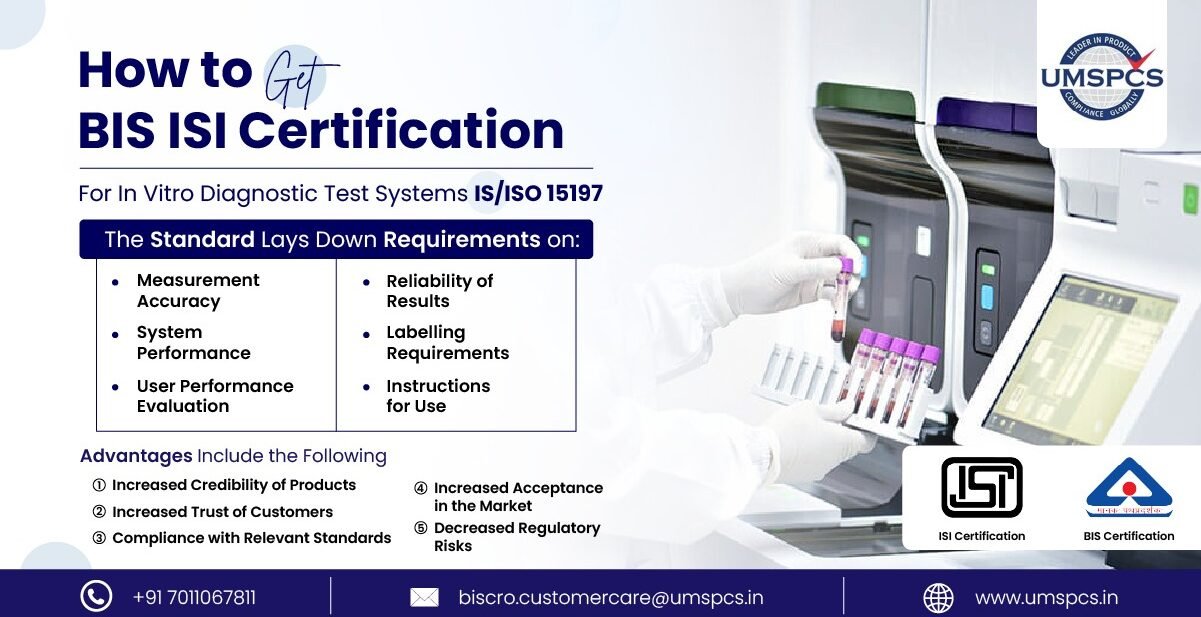
The standard lays down requirements on:
- Measurement accuracy
- System performance
- User performance evaluation
- Reliability of results
- Labelling requirements
- Instructions for use
The purpose of IS/ISO 15197 is to assure that blood glucose monitoring systems give dependable and reliable results that enable effective diabetes management.
Importance of BIS Certification for In Vitro Diagnostic Test Systems
Blood glucose monitoring system. A blood glucose monitoring system is a medical device used to monitor your blood glucose from time to time if you have diabetes.
These devices are very important for healthcare decisions, and therefore, accuracy and reliability become very important. The wrong readings from a device could lead to poor diabetes control and possibly harmful health consequences.
The BIS ISI certification for the blood glucose monitoring system supports confidence in the quality and performance of this device by proving that its manufacturer adheres to the requirements of the relevant Indian Standard.
Advantages include:
- Increased credibility of products
- Increased trust of customers
- Compliance with relevant standards
- Increased acceptance in the market
- Decreased regulatory risks
Product Categories Included in IS/ISO 15197
Products that may fall under this standard include:
- Blood glucose monitoring systems
- Blood glucose meters
- Self-testing glucose monitoring devices
- Diabetes monitoring devices
- Blood glucose testing systems for personal use
The applicability of certification should always be confirmed based on the product’s intended use and technical specifications.
Who Needs BIS Certification for In Vitro Diagnostic Test Systems?
1. Indian Manufacturers
The requirement of BIS ISI Certification for In Vitro Diagnostic Test Systems is important for those manufacturers who manufacture blood glucose testing device systems in India.
Key responsibilities include:
- Product testing
- Documentation preparation
- Application submission
- Quality control maintenance
2. Foreign Manufacturers
Manufacturers from other countries who want to export their products in India should be guided by the BIS standards.
Key responsibilities are as follows:
- Product compliance
- Technical documentation
- Testing support
- Regulatory coordination
3. Importers
Importers should verify that imported products meet applicable certification requirements.
Key responsibilities:
- Certification verification
- Compliance record maintenance
- Proper product labelling
- Brand Owners
Businesses offering products under their brand should make sure that their products are compliant with relevant standards.
4. Primary Responsibilities
- Compliance verification
- Brand management
- Documentation support
- Supplier coordination
Why Accuracy is Important inIn Vitro Diagnostic Test Systems
People with diabetes use a blood glucose monitoring system on a daily basis to monitor and manage their diabetes. The accuracy of readings allows people to make informed decisions about medication, diet and lifestyle.
Therefore, IS/ISO 15197 emphasizes the accuracy of measurement, performance evaluation and system reliability. Meeting the standard gives manufacturers confidence that their products will perform reliably under typical circumstances.
Step-by-Step BIS Certification Process for In Vitro Diagnostic Test Systems
The BIS ISI Certification for In Vitro Diagnostic Test Systems process is simple and systematic if all the requirements are satisfied. Knowing the process beforehand will help manufacturers to avoid delays and make the process smoother for approval.
Step 1: Identify the Applicable Indian Standard
The first one is to ascertain the correct Indian Standard (IS) for the product.
Manufacturers should:
- Be aware of the technical specifications of the product.
- Make sure the product is based and created according to the BIS.
- If appropriate, make needed changes to the manufacturing process.
Step 2: Product Testing and Documentation
The product must be sent to a BIS-recognised laboratory and be accredited by NABL.
At this stage:
- Samples of products are sent for testing.
- Technical documents are prepared
- Data on manufacturing and factory-related information is gathered
- Application forms and supporting documents are filled in
Step 3: Application Submission
After the testing and documentation, the BIS application is submitted with the necessary supporting documents.
Typical documents that are needed are:
- Test reports
- Details of the factory and manufacturing.
- A form and a declaration for applications.
- Government fees and records supporting fees (if applicable).
Once an application is submitted, BIS reviews it and the accompanying documents.
Step 4: BIS Factory Inspection
Inspection is done at the manufacturing unit by the officials of BIS for checking the product and the manufacturing.
At the inspection BIS can evaluate:
- Manufacturing process
- Production environment
- Quality control system
- In-house testing facilities
Samples of the product may also be taken for independent verification tests.
Step 5: Laboratory Report Submission and Product Evaluation
Samples collected are sent to the approved laboratory for testing.
After testing:
- The laboratory is responsible for preparing the lab test report (LTR).
- The report is sent straight to BIS for evaluation.
- BIS checks against the relevant BIS standard requirements
Step 6: Closure of Non-Conformities
Where non-conformities are detected during inspection and/or testing, corrective action needs to be implemented.
This may include:
- Submit other documents for review.
- Process improvements
- Product changes as necessary,
- The closure of all the observations raised by the BIS.
Corrective action as soon as possible to avoid delays in Certification.
Step 7: Payment of Licence & Marking fees
Once the applicant passes the evaluation, the next step is to pay the necessary BIS fees, which include:
- Annual licence fee
- ISI marking fee
Step 8 is the grant of ISI licence
After completion of testing, inspection, documentation and payment of fees, BIS issues an ISI licence.
The manufacturer can then affix the ISI Mark certified products following the guidelines given by BIS.
Documents Required for BIS Certification In Vitro Diagnostic Test Systems
Having proper, accurate and complete documentation is crucial in avoiding unnecessary delays for BIS certification.
Well done is created by well-prepared documents, which will help to minimize queries and allow for a smooth certification procedure.
Commonly Required Documents
- The basic information about the manufacturing unit and product category.
- Factory address proof.
- Trademark registration certificate.
- Obtaining manufacturing license and relevant statutory approvals.
- Product drawings, designs, technical specifications
- This will provide information on installed manufacturing capacity.
- List and specifications of raw materials used
- Knowledge of the manufacturing processes for machinery and equipment.
- Manufacturing layout includes production space, test area and storage space.
- CF, Manufacturing process flow chart
- CSA records and calibration are kept on site.
- The details of the personnel with responsibility for quality control.
If the documentation is well organised, it helps reduce the number of objections and streamlines the application process.
Cost and Timeline of BIS Certification In Vitro Diagnostic Test Systems
The price of a BIS ISI certificate depends on the item and certification requirements.
Certification costs can be influenced by the following :
- Product category
- Testing requirements
- Size of factory and amount of production.
- Complexity of documentation
- Application fees and licensing fees for BIS.
- The cost of inspecting and marking students’ work. Cost of marking and inspection.
- Consultancy support from a professional (if needed)
Each product may have its own compliance requirements, so the total certification cost depends on the product.
Estimated Timeline
| Activity | Estimated Timeline |
| The Normal ISI Certification Procedure | 30-40 working days |
| AIF Products (if applicable) | 180 Days (sometimes) |
Actual timelines are subject to product complexity, testing requirements and BIS processing time.
Certification Process Obstacles That Manufacturers Face
Most manufacturing companies face difficulties because of some avoidable problems.
Incomplete Documentation
Missing or incorrect documents often result in additional queries.
Testing Non-Conformities
In case the product is not compliant, some corrections have to be made and tests repeated.
Incorrect Product Classification
Selecting the wrong standard or category can delay approvals.
Factory Inspection Observations
Non-compliance during inspections may require corrective measures.
Labelling Errors
Incorrect markings or labelling of products may cause non-compliance problems.
Planning will help reduce all of these obstacles.
Advantages of the BIS ISI Certification for Blood Glucose Monitoring System
Obtaining BIS Certification for In Vitro Diagnostic Test Systems offers several advantages:
- Shows adherence to the IS/ISO 15197 criteria
- Increases product confidence
- Builds trust with health care providers and distributors
- Accepts returns in controlled markets
- Reduces compliance-related risks
- Strengthens brand reputation
- Develops a buy-in from end users and healthcare professionals
The benefits for the manufacturer include sustainable business growth.
Why Partner With UMSPCS for BIS ISI Certification?
BIS Certification requirements are difficult to manage, especially with technical specifications, testing requirements, and documentation.
Our Support Includes:
- Product applicability assessment
- Documentation preparation
- Testing coordination
- BIS application assistance
- Regulatory guidance
- Compliance management support
- Renewal assistance
UMSPCS assists manufacturers throughout the certification process and helps simplify regulatory compliance requirements. Read more also: How Foreign Manufacturers Can Obtain BIS Certification in India
Conclusion
The Blood Glucose Monitoring System (BGMS) manufacturers providing self-testing diabetes management devices to the Indian market must comply with an important requirement BIS ISI Certification for In Vitro Diagnostic Test Systems. Compliance with IS/ISO 15197 ensures that products perform up to a specified level of performance, accuracy and safety.
The certification process will be done more efficiently when manufacturers plan it properly, document it accurately, and test it in time. UMSPCS will offer businesses the support they need to understand the certification requirements and get ready for successful market entry.
Do you need any help with the BIS ISI certification?
UMSPCS also offers professional assistance with the preparation of documentation, testing coordination, application filing, and regulatory guidance.
Contact our team about your certification needs now!. And get to know more about BIS Certification Consultant in Spain
Frequently Asked Questions
- For which BIS Certification for In Vitro Diagnostic Test Systems is required?
Certification may be required for manufacturers, importers, foreign manufacturers, and brand owners of products that are subject to the requirements.
- Do you have to test the products?
Product testing, as a component of the certification process, can be helpful in verifying compliance with applicable standards.
- Is it possible to have foreign manufacturers certified?
Yes. Foreign manufacturers can apply for certification using the relevant certification procedure and may need an authorised representative.
- What are some of the usual documents that are needed in BIS Certification for In Vitro Diagnostic Test Systems?
Typically, it is requested to have business registration papers, product specifications, test reports, factory information, quality control records, and trademark documents.
- What are the usual causes for certification delays?
Important reasons for delays include documentation errors, testing problems, wrong product classification, labelling problems, and delayed response.
- How can UMSPCS help in BIS Certification for In Vitro Diagnostic Test Systems?
UMSPCS can support you in the preparation of documentation, test coordination, application management and compliance guidance.
❓ Ask a Question
Have any doubts? Fill the form below and our team will respond shortly.