Which is that one silent ingredient which determines whether the bridge stands stable for years to come or will develop cracks after a few years?
It is the cement. Although it is a silent element, the quality of cement plays a crucial role in determining the structural stability, durability, and security of all structures. Compromise with quality can lead to structural failures, losses, threats to lives, and legal actions against them.
To avoid such threats, the Government of India has made BIS ISI Certification for Portland Slag Cement (IS 455) mandatory for all the manufacturers based on the relevant Quality Control Orders (QCOs).
For every manufacturer in India and even foreign exporters, it becomes crucial to get the BIS ISI Certification for Portland Slag Cement (IS 455).
In this blog post, UMSPCS tells everything about IS 455 Certification, from its applicability, process of getting the certification, documentation, requirements, and applicable QCOs.
Why is BIS ISI Certification for Portland Slag Cement (IS 455) Mandatory in India?
BIS ISI Certification for Portland Slag Cement is a certification granted to products by the Bureau of Indian Standards under Scheme-I of Schedule-II of BIS (Conformity Assessment) Regulations, 2018.
The certification gives manufacturers the right to put an ISI Mark on Portland Slag Cement which meets Indian Standard IS 455: Portland Slag Cement – Specification.
An ISI Mark signifies that the cement has been produced by manufacturing using standardized raw materials and production process, and also passed through the required laboratory tests.
Without BIS ISI Certification, the manufacturing, storing, importing, distribution, and sale of Portland Slag Cement in the Indian market will not be legally permitted when a Quality Control Order is applicable to it.
What is Portland Slag Cement (PSC)? Applications and Key Benefits
Portland Slag Cement (PSC) is produced by the grinding process of Portland Cement Clinker, Granulated Blast Furnace Slag, and Gypsum. When compared to OPC, PSC provides:
- More durability
- More resistance to Sulphates and Chlorides
- Lower Heat of Hydration
- Good Strength Development Properties
- Excellent Marine Performance
- Environment-friendly due to the utilization of waste from industries
Due to the above properties, Portland Slag Cement finds application in marine works, dams, bridges, industrial foundations, high rise buildings, sewage works, and coastal constructions.
Why Has the Government Made BIS ISI Certification for IS 455 Mandatory?
India’s Government has made it necessary for various cement products to obtain BIS ISI Certification in India in order to safeguard consumer interest and to maintain quality through infrastructure construction.
This helps in:
- Ensuring structural safety
- Maintaining uniformity in quality of product
- Preventing poor quality cement in the market
- Increasing consumer trust
- Building quality infrastructure
- Adhering to quality manufacturing practice
Only manufacturers that have a valid license from BIS are allowed to use ISI Mark in Portland Slag Cement.
Who Can Apply for BIS ISI Certification for Portland Slag Cement (IS 455)?
For getting certified, the manufacturers need to have:
- A manufacturing unit
- A quality control lab
- Technical staff
- Production process conforming to IS 455
- Facility for product testing
- Quality management at factory level
- Testing instruments
- Manufacturing procedures
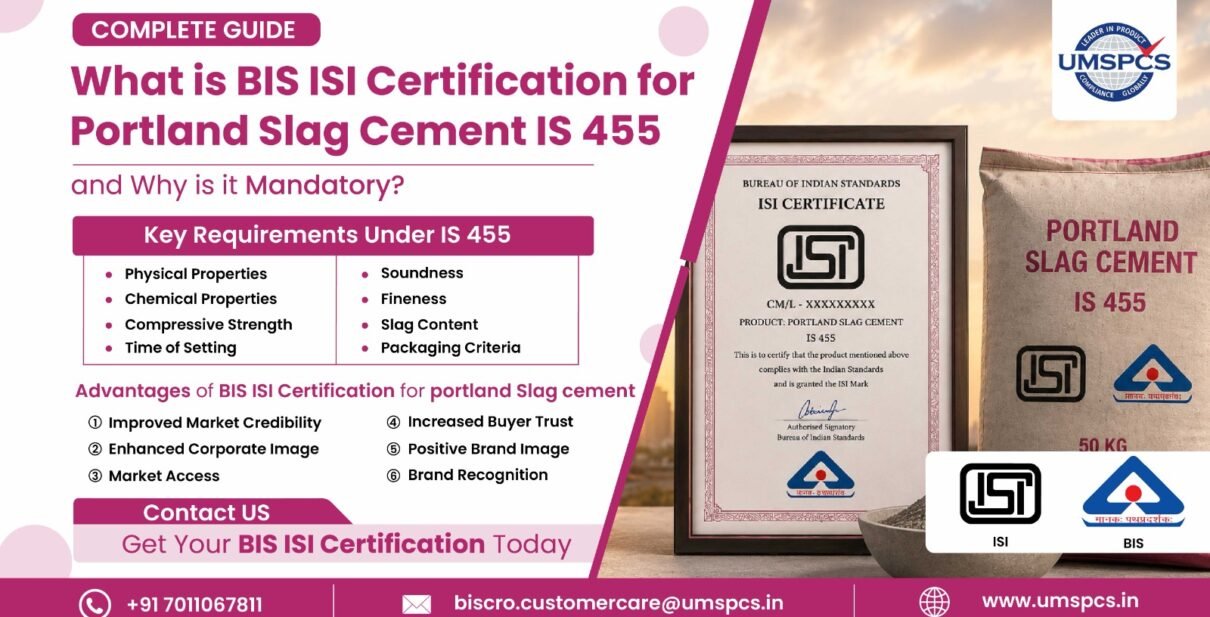
Key Quality Requirements Under IS 455 Standard
The manufacturers have to abide by a range of quality criteria that are stipulated in the standard, such as:
- Physical properties
- Chemical properties
- Compressive strength
- Time of setting
- Soundness
- Fineness
- Slag content
- Control of quality during manufacturing process
- Packaging and labeling criteria
All product samples should meet the test requirements before certification.
Documents Required for BIS ISI Certification for Portland Slag Cement
Usually, the manufacturer should have:
- Data of the manufacturing plant and of the product line
- Proof of the manufacturing plant address (proof of ownership/lease agreement, utility bill, etc.)
- Trademarks (in case the brand name is registered)
- Manufacturing license/other statutory approvals (where applicable – pollution control approvals, etc.)
- Technical drawings/diagram of the product
- Capacity of the manufacturing facility
- Description of materials used and specifications
- Description of the machinery/equipment used in manufacturing
- Factory layout plan including the manufacturing facility, test facilities, and storage facilities
- Flow of the manufacturing process is provided in detail
- Test facility and calibration data within the manufacturing facility
- Information regarding the quality control staff
- Organizational chart of the factory
BIS may ask for other documents as per requirement.
How to Obtain BIS ISI Certification for Portland Slag Cement (IS 455): Step-by-Step Process
Step 1: Identify the Applicable Indian Standard
For Portland Slag Cement, the manufacturers have to comply with IS 455.
At this point, the manufacturer should:
- Understand the requirements of IS 455
- Manufacture the product according to BIS specifications
- Improve the production process, if needed, to meet the requirement
Step 2: Product Testing and Documentation
The product needs to be tested in a BIS-approved and NABL-accredited laboratory.
At this point:
- The product is tested according to IS 455
- Technical documents are prepared
- Information about factories and manufacturing is collected
- BIS application forms are filled
Step 3: Application Submission
The manufacturer makes an application to BIS for certification, including all necessary documentation.
Application usually contains the following documents:
- Test reports of the product
- Information about the factory and manufacturing
- Government fees prescribed in the application form
After this, BIS scrutinizes the application and supporting documents.
Step 4: Inspection by BIS
BIS inspects the manufacturing unit for:
- Process of manufacturing
- Manufacturing facilities
- Quality control system
- Testing facilities in the factory
During the inspection, samples can be taken for independent testing.
Step 5: Product Testing & Lab Report Submission
The samples are sent to a laboratory authorized by BIS for testing. After the testing is complete, the Lab Test Report (LTR) is sent directly to BIS for evaluation.
Step 6: Closure of Non-Conformities (If Any)
Where there are non-conformities found in the course of inspection/testing, the manufacturer has to:
- Take the necessary corrective action
- Submit modified documents where required
- Remove all issues of compliance before starting the process of certification
Step 7: Payment of Licence & Marking Fees
Following the successful evaluation, the manufacturer has to pay:
- Annual license fee
- ISI marking fee
as prescribed by BIS.
Step 8: Grant of ISI License
Once the inspection, testing, documentation and fee payment are successfully done, BIS will grant ISI License. The manufacturer will have the right to use the ISI mark in respect of the certified Portland Slag Cement.
How Long Does BIS ISI Certification for IS 455 Take?
Factors influencing the timeline include:
- Readiness of documentation
- Laboratory testing
- Factory readiness
- Inspection scheduling
- Review process at BIS
In general, the entire process for certification can be completed in 30 – 40 days; however, this is dependent on how complex the application is.
Common Challenges While Obtaining BIS ISI Certification
Manufacturers face challenges like:
- Inaccurate documentation
- Laboratory testing delays
- Quality record problems
- Non-conformity to IS 455 standards
- Plant preparedness problems
- BIS queries response delays
- Testing equipment calibration mistakes
Professional advice can help avoid such delays.
Top Benefits of BIS ISI Certification for Portland Slag Cement (IS 455)
The following benefits will accrue from the BIS ISI Certification of Portland Slag Cement:
- Legal permission to trade in India
- Increased customer trust
- Improved credibility of product
- Market competitiveness
- Compliance with government rules
- Increased acceptability in infrastructural projects
- Minimization of chances of regulatory measures
- Better brand image
- Quality management systems
What is the Validity of BIS ISI Certification for Portland Slag Cement?
The BIS license continues to be valid according to the terms and conditions laid down by BIS and is subject to timely renewal and continued adherence to all relevant requirements.
Manufacturers need to continue maintaining:
- Quality of products
- Quality Control in factories
- Test reports
- Compliance requirements
Failure to adhere could lead to suspension or revocation of the license.
Why Choose UMSPCS for BIS ISI Certification for Portland Slag Cement?
BIS Certification in India requires proper documentation, product testing, factory inspections, and constant coordination with BIS. Any error in documentation will delay the process.
UMSPCS offers full end-to-end solutions for both domestic and foreign companies.
With an experience of 6 years and having completed more than 600 product compliance projects, we have helped various firms in multiple sectors to receive regulatory approvals efficiently.
Our services include:
- Product standard identification
- IS code identification
- Documentation
- Laboratory testing
- Application
- Factory inspections
- Compliance
- Queries management
- Licence grant assistance
- Post certification compliance support
Why Does the ISI Mark Matter for Portland Slag Cement Manufacturers?
The ISI Mark is not just a mandatory certification mark. The ISI Mark means quality, safety, and compliance with certain standards. In the rapidly evolving infrastructure industry, the certified cement plays an important role in providing durable and safe construction of various buildings, roads, bridges, dams and other industrial objects.
For manufacturers, the BIS ISI Certification of Portland Slag Cement means not only compliance with certain regulations but also establishment of long term trust with the customer and government buyers.
Conclusion
With the rapid development of India’s infrastructure industry, the importance of compliance with the standards of quality is increasing. BIS ISI Certification for Portland Slag Cement (IS 455) allows manufacturers to make sure that the product complies with all the safety and performance standards set and can be legally marketed in India.
Whether you need BIS ISI Certification for Indian Manufacturers or BIS Certification for Foreign Manufacturers, it is important to know the specifics of the procedure.
UMSPCS is here to assist you with BIS Certification services through all phases of the process, from determining the relevant standard to getting the BIS license and compliance support.
Contact us at UMSPCS right away and start your journey towards BIS ISI Certification for Portland Slag Cement.
Read more also: How Can Manufacturers get BIS Certification for Masonry Cement
FAQs
- Is BIS ISI Certification compulsory for Portland Slag Cement?
Yes, Portland Slag Cement governed by the Quality Control Order should have BIS ISI Certification before being manufactured, sold or imported into India.
- What Indian Standard is applicable for Portland Slag Cement?
Portland Slag Cement is governed by IS 455 – Portland Slag Cement Specification.
- Can foreign manufacturers obtain BIS Certification?
Yes, Exporters of Portland Slag Cement to India should have BIS Certification for Foreign Manufacturers according to the FMCS scheme.
- What is the time taken for the BIS Certification process?
It generally takes about 30-40 days depending on documentation, testing, factory inspection and BIS approval.
- What are the required documents for BIS ISI Certification?
Some of the common documents are factory registration, manufacturing details, laboratory details, product test report, quality manual, machine details, calibration certificate, etc.
- What will happen if Portland Slag Cement is not certified?
Manufacturing, importing or selling of cement products governed by the applicable laws and Quality Control Orders without BIS ISI Certification might result in regulatory action.
- Why should manufactures engage a BIS consultant?
Consultant services can help to minimize the risk of mistakes in the documentation process, manage technical compliance, facilitate testing and inspection, and ensure quick approval.
❓ Ask a Question
Have any doubts? Fill the form below and our team will respond shortly.