For instance, if you plug your mobile phone charger, sparks may be observed flying out of it; therefore, it can be deduced that such plugs and sockets are of poor quality and hence unsafe to use. The gadgets are used in the above-mentioned places on a regular basis; hence, any fault would lead to accidents.
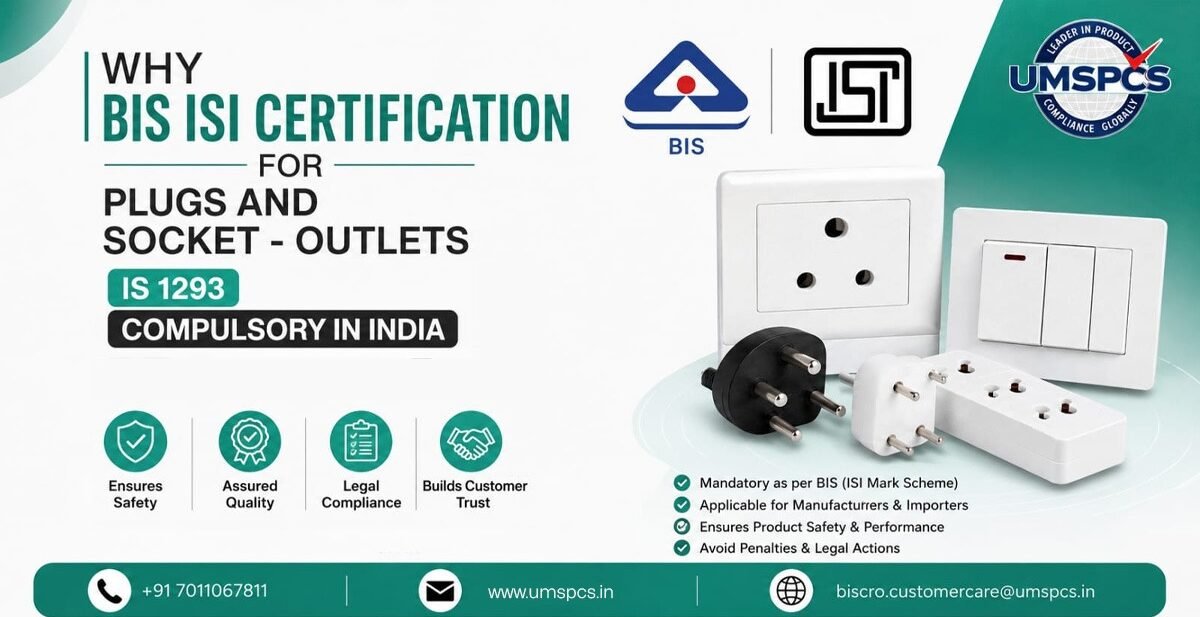
The Government of India has issued the mandatory ISI standard IS 1293 to ensure that consumers are safe from electrical hazards when it comes to BIS ISI certification for plug and socket outlets. This certification assures products are safe and of high quality prior to entering the market.
The certification for the manufacturers is not only about compliance but much more because it builds trust and safety in products and provides new opportunities for growth in India.
In today’s blog, we will explore the importance of this certificate, the BIS ISI process, requirements, fees, advantages, and how UMSPCS can help you obtain it easily.
Understanding BIS ISI Certification for Plugs and Socket-Outlets IS 1293
ISI stands for the Bureau of Indian Standards. The organisation oversees the process of regulating the safety standards of the products manufactured in the country. In order to market their plugs and sockets in India, companies need to comply with the IS 1293:2005 standards.
The following are the items that fall under this standard:
- Plugs
- Socket-outlets
- Adaptors
- Switched socket-outlets
- Extension accessories
If the product meets all requirements, BIS allows the use of ISI on the product. ISI mark is a guarantee of safety and quality of the product, which has passed the tests.
Why Has BIS Certification Become Mandatory in India?
Consumer safety is directly related to electrical products. Unsafe plugs and socket-outlets can cause:
- Electric shocks
- Fire accidents
- Short circuits
- Damage to appliances
- Power failures
The Indian government has ordered manufacturers to certify that they have removed these risks.
Mandatory certification helps:
- Ensure consumer safety
- Maintain product quality
- Remove low-quality products from the market
- Enhance the confidence of electrical products
Regulated products may not be sold in India without BIS approval.
Key Requirements to Obtain a BIS License
There are various technical requirements and compliance criteria that manufacturers must meet before they can apply for certification.
All manufacturers need to have in order to receive a BIS license:
- An adequate manufacturing plant
- In-house testing equipment
- Quality control systems
- Technical personnel and testers
- Products that are made as per IS 1293
In addition, manufacturing companies are required to make their products undergo lab tests.
Special Requirements for Foreign Manufacturers
Foreign companies are also eligible for certification under the Foreign Manufacturers Certification Scheme (FMCS).
According to this scheme, a foreign manufacturer should obtain a BIS Certificate under the following conditions:
- An appointment of an Authorised Indian Representative (AIR)
- These are inspected by the BIS officials during a factory inspection
- Testing of products in accordance with the Indian Standards
- Full compliance with BIS standards
This enables foreign brands to legally sell Certified products in India.
Products Covered Under IS 1293:2005
The standards apply to various types of electrical accessories for domestic and similar applications.
- Two-pin plugs
- Three-pin plugs
- Socket-outlets
- Switched socket-outlets
- Adaptors
- Extension sockets
Step-by-Step Process for BIS ISI Certification for plugs and socket outlets
The process of obtaining ISI certification for plugs and socket outlets involves several steps to ensure the products comply with the Indian safety and quality requirements laid down in the Indian Standard IS 1293:2005.
Step 1: Identify the Applicable Indian Standard
The initial step is to determine the right Indian Standard of the product. In the case of plugs and the socket-outlets, they will have to adhere to IS 1293.
In this stage, manufacturers should:
- Know the safety and technical specifications of products
- Make products as per BIS standards
- Improve production/quality system if necessary
The right choice of standard is crucial to smooth certification approval.
Step 2: Product Testing and Documentation Preparation
The product needs to be tested at a BIS-recognised and NABL-accredited lab.
During this stage:
- Testing of Product samples is done in accordance with IS 1293:2005
- The preparation of technical documents is carried out
- Data is gathered on manufacturing and factory-related data
- Application forms for BIS were filled out
This step is useful to ensure that the product fulfils all the safety and quality requirements.
Step 3: Submission of BIS Application
Once it has been tested and the documentation prepared, the manufacturer submits the BIS application online.
Typically, the application comprises:
- BIS application form
- Application letter
- Supporting documents
Some of the documents required:
- Product test reports
- Factory details
- Manufacturing information
- Applicable government fees
The BIS authority reviews the application and documents once they’re submitted.
Step 4: BIS Factory Inspection
The officials of BIS undertake a visit to the manufacturing plant to view the entire production and quality management system.
At the inspection, BIS verifies:
- Manufacturing process
- Production setup
- Quality control procedures
- In-house testing capabilities
Samples of products may also be taken during the inspection for independent testing.
Step 5: Product Sample Testing and Lab Report Submission
Product samples have been received and tested in the approved laboratories.
Following the testing:
- The Lab Test Report (LTR) will be prepared in the lab
- A direct assessment through the lab report will be made to the BIS
BIS will evaluate the product through LTR and will ascertain if the product meets the IS 1293 requirements.
Step 6: Closure of Non-Conformities (If Any)
In case any non-conformance is found by the BIS inspectors at any stage of inspection/testing, the manufacturer needs to rectify the same.
It could involve:
- Necessary improvement
- Revised technical documentation
- Quality improvement
- Revise all documents
Non-conformances must be sorted out before the product gets approval for certification.
Step 7: Payment of License and Marking Fees
Once the certification process succeeds, the manufacturer must make the payment to BIS.
Payment involves:
- License fee
- ISI marking fee
The payment should be made before the license is issued.
Step 8: Grant of ISI License
The ISI License will be given after the successful process of testing, inspection, document submission and payment of the fee.
The manufacturer will get permission from BIS to mark the ISI label on the certified plug and socket outlet.
Important Documents Required for BIS ISI Certification
Documentation is a critical component of the approval process.
- Basic data of the manufacturing unit and the product segment
- Document to verify that the unit is manufactured at a valid address (deed to ownership/lease, utility bill, etc.)
- Trademark registration certificate (where the brand name is used and registered)
- Controlled materials are required for appropriate land-use planning.
- Control/approval
- Technical drawings/designs
- Manufacturing capacity installed
- Details regarding the material specifications
- Information about the manufacturing of machines and equipment
- The factory layout plan includes details such as the layout of the production and test area, and also the storage layout area.
- Process flow for manufacturing
- In-house testing equipment and calibration data
- Details on the quality control personnel
- Organisational structure of the factory
Documentation is vital for avoiding delays and improving chances of approval.
BIS ISI Certification Cost and Expected Timeline
There are several factors that determine the certification cost.
- Product category
- Application Fees (BIS)
- Testing Charges (Lab Fees)
- Factory Inspection Charges
- Annual License Fees
- Marking Fees (ISI Mark Usage)
- Consultancy Charges (UMSPCS)
The period of time listed is a general estimate and can change depending on the use and testing procedure.
- Length of time: 30 – 40 working days
- AIF Products: Up to 180 days (in some cases).
Major Benefits of BIS ISI Certification for Manufacturers
There are a number of benefits to certification, both business and legal.
- Legal Authorisation to Sell Products: Manufacturers are not allowed to sell regulated products without BIS approval.
- Consumer Trust: People like to buy products that have the ISI mark as they are assured of the certified quality and safety.
- Enhanced Brand Reputation: Certification enhances the image and credibility of the market.
- Lowered Product Safety Hazards: Testing makes sure that products are safe to use by consumers, and lowers electrical accident risks.
- Better Market Opportunities: Certified products have better chances to be available with distributors, retailers and Government Projects.
- Competitive Advantage in the market: BIS-certified products are competitive with uncertified products.
Common Challenges Faced During BIS Certification
Completing the certification process can be challenging for manufacturers.
- Complex Documentation Process: Delays or rejection may occur if errors occur in the documentation process.
- Failure of Product Testing: Products can fail the technical test.
- Ignorance regarding the BIS: Many organisations are ignorant of the BIS requirements.
- Issues in preparing for inspection: Some manufacturers may fail to maintain appropriate testing equipment and quality management systems.
- Delay in Coordination: Communication is stuck with the laboratories and authorities.
Manufacturers can address these issues more effectively with professional consultancy support.
How UMSPCS Simplifies the BIS Certification Process
UMSPCS offers comprehensive assistance to manufacturers to obtain BIS ISI certification for Indian manufacturers and to foreign companies in India to get their products certified in India.
Why Do Manufacturers Choose UMSPCS?
- Experienced BIS professionals
- Quick and efficient process
- Dedicated customer support
- Strong regulatory expertise
- Assistance for Indian and foreign manufacturers
Our team helps businesses complete certification smoothly with minimal delays.
Final Thoughts
Despite seeming like simple electric products, plugs and socket outlets hold a very crucial place when it comes to ensuring electrical safety. The IS 1293:2005 certification is compulsory and ensures that consumers do not buy products that are potentially harmful and of poor quality.
From the perspective of manufacturers, BIS ISI certification in India is essential for ensuring compliance with legal standards and for producing high-quality products.
However, if the certification process is not technology-oriented, it becomes lengthy. Here, professional help from UMSPCS can be beneficial.
If you’re searching for an Expert BIS Certification Support, you have come to the correct place. UMSPCS helps companies in India and globally with hassle-free BIS certification services with reliable support.
We have experts at your disposal to guide you through all stages of documentation, testing, factory inspection, and BIS Certification for a foreign manufacturer or not.
Call UMSPCS today and make the BIS certification process easy.
Read more also: Trusted BIS Consultant in India for Foreign Manufacturers 2026
FAQs
- Do plugs and socket outlets need to be certified by BIS in India?
Yes, since plugs and socket outlets fall under IS 1293, it becomes essential that they be BIS certified.
- What do we understand by ISI certification?
ISI marking makes sure that the product is safe and of good quality according to the BIS standards.
- Can foreign manufacturers obtain a BIS certificate?
Yes, foreign manufacturers can obtain a BIS certification through FMCS schemes through an Authorised Indian Representative.
- What is the duration taken to get a BIS certificate?
Usually, Indian producers require between 30 and 90 days, while foreign producers require above 90 days.
- What would happen if products are marketed without a BIS certificate?
There would be serious consequences, including sanctions and other actions against the manufacturer.
- Why would manufacturers need to have a BIS consultant?
A BIS consultant assists with the documentation, testing, application and approval process.
❓ Ask a Question
Have any doubts? Fill the form below and our team will respond shortly.