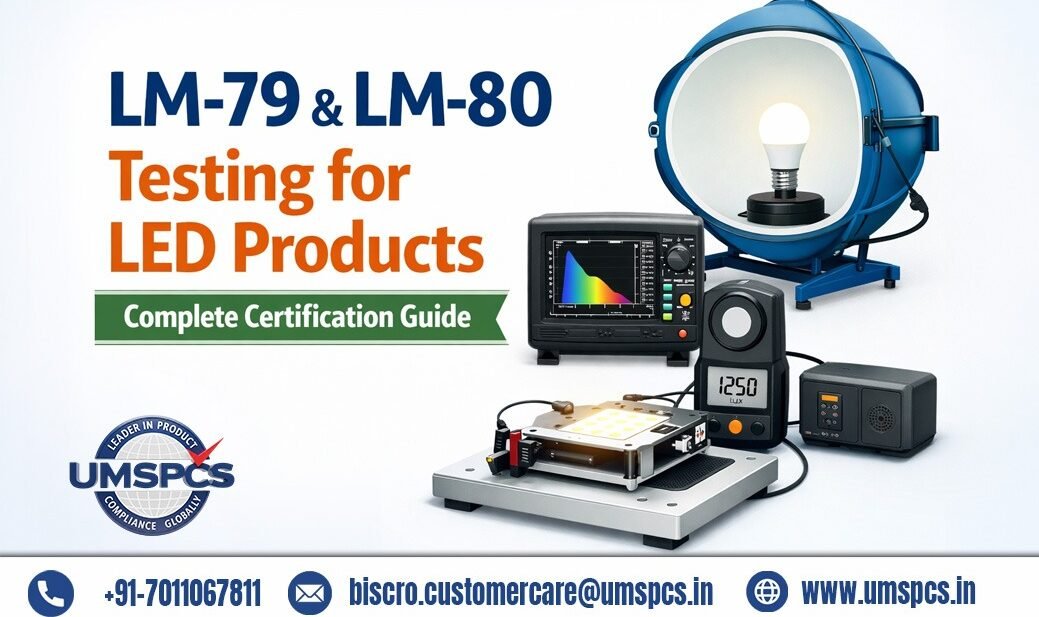
The LED lightning industry has rapidly grown because of its energy efficiency, long lifespan and environmental benefits. However, to confirm product quality, safety, and performance, standardised testing is necessary. Two of the most essential global standards for LED testing are LM-79 & LM-80.
Such standards are developed by the illuminating engineering society (IES) which assist manufacturers, importers, and regulators to examine LED products correctly. Knowing such testing methods is essential when you are aiming to sell LED products in India or globally.
What is LM-79 Testing?
LM-70 is a testing standard which is used to measure the electrical and photometric performance of LED luminaires and lamps.
It examines how an LED light functions at a given point in time under controlled laboratory conditions.
Key Parameters Tested in LM-79
LM-79 concentrates on two major aspects which are as follows:
1. Electrical Measurements
- Power consumption
- Voltage and current
- Power factor
- Total harmonic distortion
2. Optical Measurements
- Luminous flux (brightness in lumens)
- Luminous efficacy (lumens per watt)
- Color temperature (CCT)
- Color Rendering Index (CRI)
- Light distribution
Such parameters assist manufacturers to know how efficient and effective their LED product is.
Why LM-79 is Important
- Provides accurate performance data
- Helps compare products across brands
- Required for certifications like BIS, BEE, Energy Star
- Builds trust with buyers and regulators
One important point: LM-79 only measures functionality at a certain time and does not show how the LED light will behave as the time passes.
What is LM-80 Testing?
LM-80 examines the long term reliability of LED components while LM-79 concentrates on first performance.
It measures how the LED light output reduces over time which is also known as lumen depreciation.
Primary Aspects of LM-80 Testing are as Follows:
- Lumen maintenance over time
- Color shift (chromaticity change)
- Performance under different temperatures
- Long-duration testing (6,000 to 10,000 hours or more)
Why is LM-80 Important?
- Predicts LED lifespan (L70, L80, etc.)
- Ensures long-term performance
- Helps manufacturers choose quality components
- Supports warranty claims
LM-80 works on LED chips, modules, or arrays which are not complete fixtures unlike LM-79.
LM-79 vs LM-80: Key Differences
| Feature | LM-79 Testing | LM-80 Testing |
| Purpose | Measures performance | Measures lifespan |
| Applies to | LED lamps & luminaires | LED components |
| Duration | Short-term test | Long-term test (thousands of hours) |
| Output | Photometric & electrical data | Lumen maintenance data |
| Use | Product certification | Lifetime prediction |
As coming together both tests offer a complete picture of LED quality regarding performance and durability.
Why LM-79 & LM-80 Testing is Mandatory
LM-79 and LM-80 testing has become essential in accordance with creasing regulatory requirements in India and globally which is as follows:
1. Regulatory Compliance
Several fo certification demands for LM-79 reports which are:
- BIS CRS Certification
- BEE Star Rating
- International approvals (CE, UL)
2. Product Quality Assurance
Such tests confirm the followings:
- Consistent brightness
- Energy efficiency
- Stable color output
3. Market Acceptance
Buyers and distributors prefer tested and approved products due to followings reasons:
- Data is standardized
- Performance claims are verified
4. Export Requirements
LM-79 and LM-80 outcomes are necessary when you want to export LED products.
LM-79 Testing Process (Step-by-Step)
Here’s how LM-70 test is usually performed as follows:
- Sample Submission
Manufacturers uploads LED fixture or lamp - Lab Setup
Testing is performed under controlled environment - Electrical Testing
Power, voltage, and current are measured - Photometric Testing
Using integrating sphere or goniophotometer - Data Analysis
Results are recorded and verified - Test Report Generation
Certified LM-79 report is issued
LM-80 Testing Process (Step-by-Step)
LM-80 testing consist of long-term evaluation which are as follow:
- Component Selection
LED packages/modules are selected - Test Setup
Variety of temperature conditions are applied - Continuous Operation
LEDs run for 6,000–10,000+ hours - Periodic Measurement
Lumen output measured over time - Data Recording
Lumen depreciation curve generated - Lifetime Prediction
Used with TM-21 method for lifespan estimation
Common Challenges in LM Testing
Several of manufacturers face complications during LM-79 and LM-80 testing which consist of the followings:
- Incorrect sample preparation
- Inconsistent test conditions
- Lack of technical documentation
- Delays due to long testing duration (LM-80)
- Non-compliance with updated standards
This is why expert guidance becomes necessary.
Read more also: IP Rating Test
How UMSPCS Helps You with LM-79 & LM-80 Certification
UMSPCS offers complete compliance assistance when you are hiring a reliable partner for LED testing and certification.
Why Choose UMSPCS?
- Expert Consultation
Guidance depends upon upgradedLM standards - End-to-End Support
From documentation to final certification - Fast & Hassle-Free Process
Minimises postpones and provide on time permit - Testing Coordination
Assistance with NABL-approved labs - Compliance for Multiple Certifications
BIS, TEC, WPC, and more
UMSPCS confirms your LED products should align with every required standards seamlessly and efficiently in accordance with solid industry experience.
Read more also: ISO Certification in India: Types, Process & Benefits for Businesses
Why You Can Trust LM-79 & LM-80 Standards
To confirm quality and safety of these standards, which are as follows:
- These standards are developed by the Illuminating Engineering Society (IES)
- Widely accepted across global markets
- Used by regulatory bodies and certification agencies
- Based on scientific and repeatable testing methods
This makes LM-79 and LM-80 the backbone of LED product validation.
Final Thoughts
LM-79 and LM-80 testing are not only technical requirements but they are necessary for boosting trust, quality, and market credibility in the LED industry.
- LM-79 ensures your product performs well today
- LM-80 ensures it continues performing in the future
Both certifications are necessary when you want to launch or export LED products successfully.
Working together with experts like UMSPCS with 600+ experiences, which simplifies the whole procedure and assists you in receiving compliance without getting any delays.
Frequently Asked Questions (FAQs)
1. What is the difference between LM-80 and TM-21?
LM-80 provides raw test data on lumen depreciation over time, while TM-21 is a calculation method used to project the lifetime of LEDs based on LM-80 data.
2. Is LM-79 testing applicable to LED drivers?
No, LM-79 testing is mainly for complete LED luminaires and lamps, not for individual components like LED drivers.
3. How many samples are required for LM-80 testing?
Typically, a minimum of 20 LED samples per test condition are required to ensure accurate and reliable results.
4. Can LM-79 and LM-80 testing be done in the same lab?
Yes, but only if the laboratory is properly accredited (such as NABL-approved) and equipped to handle both types of testing.
5. What happens if an LED product fails LM-79 testing?
If a product fails, it must be redesigned or improved and then retested to meet the required performance standards.
6. Does LM-80 testing guarantee LED lifespan?
No, LM-80 does not guarantee lifespan. It only provides data for lumen maintenance, which is later used with TM-21 to estimate lifespan.
7. Are LM-79 reports valid globally?
Yes, LM-79 reports are widely accepted internationally, especially when issued by accredited testing laboratories.
8. Why is temperature important in LM-80 testing?
Temperature affects LED performance significantly. LM-80 tests are conducted at different temperature levels to simulate real-world operating conditions.
❓ Ask a Question
Have any doubts? Fill the form below and our team will respond shortly.