Think about how it would feel if, after putting in months of hard work towards designing your premium product, you found out that it was not possible to import or sell it in India without proper certification. Well, this is one of the problems that most foreign firms face when they come to India.
India offers unparalleled opportunities to French producers of everything from electronics to steel, building materials, industrial machinery and equipment, chemicals, and other consumer goods. Due to government policies like the “Make in India” initiative, growing infrastructure investments, and increased consumer demand, there has never been a better time to venture into this exciting and dynamic market.
Market entry to India requires strict adherence to regulatory requirements. Most products will have to comply with standards developed by the Bureau of Indian Standards (BIS) to be imported, distributed, and sold. If you are a manufacturer of electronics looking to obtain BIS CRS Certification for electronic manufacturers, or an industrial enterprise requiring BIS certification for foreign manufacturers, learning about the certification procedure will be a necessity.
In this blog, UMSPCS provides an overview of all things related to BIS Certification for French manufacturers in India, covering products, eligibility criteria, testing process, documentation, fees, timeframes, potential issues, and how you can benefit from consulting a reliable BIS Certification Consultant in France.
What is BIS Certification?
The Bureau of Indian Standards (BIS) is India’s national standards organisation, which was set up through the BIS Act 2016. The BIS sets up standards and ensures that goods being sold in India conform to certain required levels of quality and performance.
Certification from the BIS can either be mandatory or voluntary, depending on the nature of the goods. Goods that come under the purview of Quality Control Orders (QCO) from the Government of India must have mandatory certification prior to their import into or sale within the country.
The prominent BIS programs include:
- ISI Mark Scheme
- Compulsory Registration Scheme (CRS)
- Foreign Manufacturers Certification Scheme (FMCS)
- Hallmarking Scheme
- Eco Mark Certification
For foreign companies, the pertinent type of certification would be that offered through the program, BIS certification for foreign manufacturers.
Why French Manufacturers Need BIS Certification Before Exporting to India
With no BIS certification for these types of goods, they can:
- Not cleared by customs
- Have restrictions imposed on their import
- Get banned from being sold in India
- Be subject to fines and penalties
The following are the advantages of getting BIS certification:
- Market Legitimacy
- Reputation Enhancement
- More Business Prospects
- Trust from Consumers
- Competitive Edge
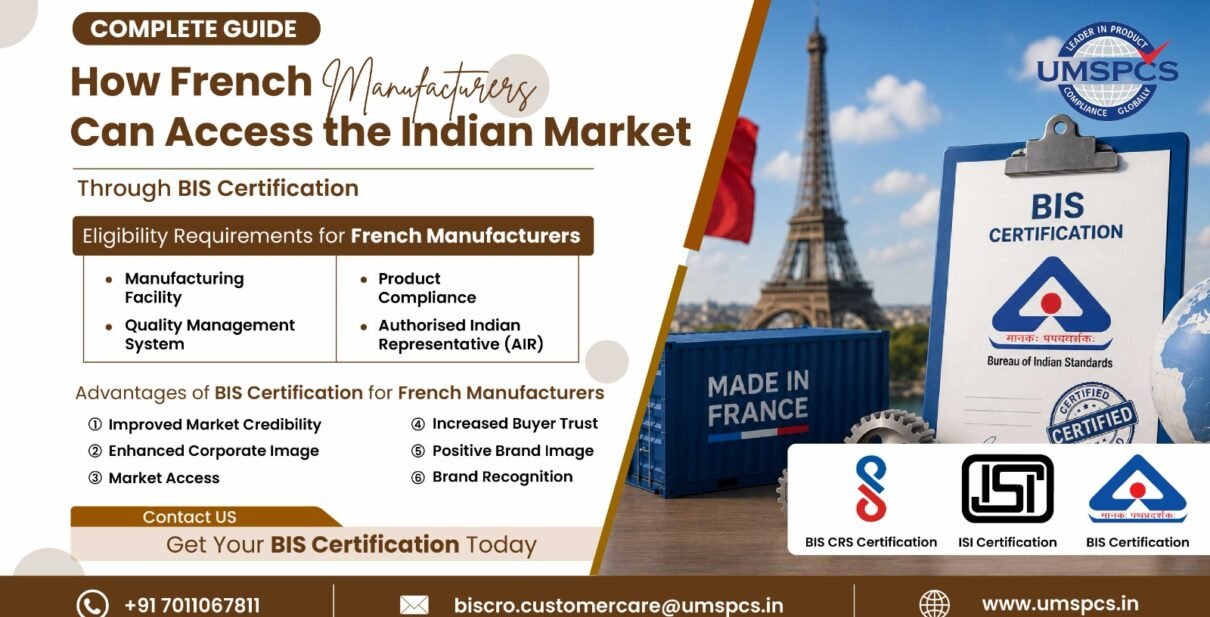
Eligibility Requirements for French Manufacturers
The following requirements are needed in order to seek BIS Certification:
- Manufacturing Facility: The applicant must be the real manufacturer of the products.
- Quality Management System: The manufacturer must have a quality management system documented.
- Product Compliance: Products should be in accordance with the Indian Standard.
- Authorised Indian Representative (AIR): For foreign manufacturers, an AIR is required to communicate on behalf of the manufacturer with BIS.
- Documentation: Complete technical documentation should be available.
Documents Required for BIS Certification in France
The documentation required may differ depending on the product category. Some of the documents that are common are:
- Basic details about the manufacturing plant and product category
- Test report issued by a lab accredited by BIS/NABL as per the Indian standard
- Proof of ownership of manufacturing plant (Ownership deed/utility bill/any other proof)
- Trademark
- License & statutory approvals
- Design a block diagram for manufacturing
- Capacity to manufacture the product
- Raw materials use Specification on and details of manufacturing machinery
- Manufacturing machinery specification & list
- Flow diagram for manufacturing process
- Packaging type & packaging process
- A list of testing equipment, along with its calibration, is available at the manufacturing plant.
- Details of Quality Control personnel
- Process of disposal of non-conforming product
- Layout of Manufacturing Plant
Additional documents for foreign manufacturers
- Letter of appointment for authorised Indian representative (AIR)
- Documents of overseas factory (layout/machinery/QC set-up)
- Undertaking & Affidavit in BIS format
Proper documentation greatly helps in reducing the approval time.
Applicable Product Testing Requirements for French Manufacturers
Tests are some of the most important parts of BIS certification.
The Parameters of Tests Usually Include:
- Safety Tests
- Performance Tests
- Mechanical Tests
- Electrical Tests
- Chemical Tests
These tests should be done as per the relevant Indian Standard. The testing of CRS products is done in BIS-accredited laboratories.
Step-by-Step BIS Certification Process in France
Step 1: Application Preparation and Submission
The process starts with determining the appropriate Indian Standard and creating the necessary documentation to file the BIS application.
This involves:
- Determination of the relevant IS standard
- Preparation of the technical document
- Filing the BIS application
- Payment of the fee
- Creation of Application Number
- Preliminary scrutiny by BIS
Step 2: BIS Queries Resolution
BIS may have queries relating to the documents or technical compliance, which need to be resolved at once.
This involves:
- Analysis of BIS observations
- Submission of clarification
- Document submission (if needed)
- Resolution of compliance issues
Step 3: Factory Inspection by BIS
For the purpose of conformity assessment for FMCS, inspection of manufacturing units by BIS officials is done to confirm conformance to Indian norms.
The inspection will be performed on:
- Manufacturing process
- Quality control system
- Testing facilities
- Calibration
- Product quality control
Step 4: Testing of product samples
Samples of the product are collected and tested in a laboratory recognised by BIS.
These steps include:
- Sampling and sealing of samples
- Laboratory testing
- Conformity check
- Filing of test reports
Step 5: Issue of BIS License
A certification license is issued after successful inspection and testing of the product.
These steps involve:
- License issuance
- Payment of the fee
- Issuance of BIS certification
- Right to use the ISI mark
Step 6: Submittal of Indemnity Bond and Bank Guarantee
Foreign manufacturers have to comply with mandatory requirements through their Authorised Indian Representative (AIR).
These steps include:
- Execution of the indemnity bond
- Submission of Performance Bank Guarantee (PBG)
- Completing procedural formalities
Cost & Estimated Timeline for BIS Certification in France
The total cost of certification includes the following factors:
- Category of product
- Number of products
- Cost of factory inspection
- Government charges of BIS
- Services of AIR
| Particulars | Estimated Cost (Dollars) |
| Application Fees (BIS) | $12.00 |
| Per Diem Expenses for Bis Officers- 3 Days | $900.00 |
| Charges for the Visit | $466.66 |
| Contingency Funds | $111.11 |
| Bis Charges- Travel/Visa etc. -Estimate | $2173.00 |
| Marking Fee (Min.) | $2744.00 |
| Sample Testing | $400 to $3000 |
| Total Bis Cost | $6850.77 to $10000.77 |
Detailed analysis is needed to get the exact costs. Duration of the process changes with product complexity and the type of certification process. It requires 5 – 6 months.
Common Challenges Faced by French Manufacturers
Most organizations fail to recognize the intricacies of Indian regulation requirements.
- Wrong Standard Selection: Often, choosing the wrong standard becomes a reason for delays.
- Inadequate Documentation: Documents that are not complete can result in queries and rejection.
- Product Testing Challenges: Products may have to undergo changes to conform to Indian standards.
- Indian Regulations: Indian regulations change very frequently.
- Coordinating Between Different Agencies: It can be difficult to coordinate between laboratories, BIS and manufacturing units.
Choosing a BIS Certification Consultant in France is one way of minimizing such challenges. And get to know more about TAC approval & Certificate for Automobile.
Key Aspects Every French Exporter Should Know
Prior to submitting an application for BIS certification, manufacturers should pay attention to:
- Identification of product standards
- Factory preparation
- Approach to testing for compliance
- Appointment of Authorised Indian Representative
- Preparation of technical documents
- Labeling issues
- Requirements after certification
A compliance approach will allow for avoiding unnecessary expenses.
Why Choose UMSPCS for BIS Certification?
With more than 6 years of experience in the industry and experience in executing 600+ product compliance projects, UMSPCS is an established regulatory consultancy that offers BIS certification, CRS registration, FMCS approvals, testing coordination, documentation assistance, and complete compliance services for international companies looking to enter the Indian market.
- Industry Experience
- Complete Service Offering
- Specialised Compliance Team
- Documentation Assistance
- Testing Coordination
- Support for Foreign Manufacturers
- Quick and Efficient Process
Regardless of whether you need help with your industrial products, steel material, consumer goods, or BIS CRS Certification for electronic manufacturers, we have you covered!
Conclusion
Opportunities for French brands in India are immense; however, compliance with regulations is essential for achieving success when entering the market. Whether your products are under ISI, FMCS, or CRS certification, getting BIS certification may be compulsory for the process of importing to proceed.
With rising regulatory enforcement and Quality Control Orders, it is recommended that manufacturers follow a proactive approach to compliance. Partnering with a professional BIS Certification Consultant in France will ensure an easy path to certification and save you time and money on the way.
Ready to Import Your Products into India?
Reach out to us today and get assistance with BIS certification from our professionals.
Read more about BIS Certification Consultant in China
FAQs
- Is BIS certification compulsory for French manufacturers shipping products to India?
Yes, many items that come under the ambit of the Quality Control Order need mandatory BIS certification prior to import into India.
- Can a French company make a BIS certification application by itself?
Yes, foreign companies have the option of making the BIS certification application through either FMCS or the CRS scheme.
- What is the job of an Authorised Indian Representative (AIR) for French manufacturers?
The AIR acts as the liaison between the foreign company and BIS authorities in India.
- How long does the process of getting BIS certification take for French manufacturers?
For most applications, the process is completed in 5-6 months from the date of application, depending on product testing.
- What kind of electronic products need to get BIS CRS certification in France?
There are many electronic products that need CRS registration, including laptops, mobile phones, LED lights, adapters, displays, and other electronic devices.
- Does the French manufacturer’s factory need a BIS audit?
Yes, under the FMCS scheme, BIS conducts the factory inspection.
- What would happen if the products were exported without BIS certification by French manufacturers?
The goods could be detained by the customs authority, could lack market access, and could face regulatory actions.
- Why should the French manufacturers collaborate with the BIS Certification Consultant in France?
The consultant would help in managing the documents, testing, audits, compliance, and communication with the BIS authority.
❓ Ask a Question
Have any doubts? Fill the form below and our team will respond shortly.