Nowadays, the Delhi NCR area has emerged as one of the largest centres for food business companies in India. Be it cloud kitchens of Gurugram or home bakers in Noida, be it food processing companies in Faridabad or Ghaziabad, hundreds of food businesses come into existence every year. However, while being obsessed with developing recipes, packing and marketing, many entrepreneurs tend to ignore one important issue – FSSAI License Registration in Delhi NCR.
Indeed, food businesses grow rapidly. Without the license, food businesses may suffer from fines, restrictions in activities, rejection on the market and customers’ mistrust. This is why today it is not only a legal obligation but also a business necessity to register the FSSAI license.
No matter whether your business is a restaurant, food manufacturing facility, cloud kitchen, grocery store, food warehouse or online food business, FSSAI License Registration in Delhi NCR should be known to you.
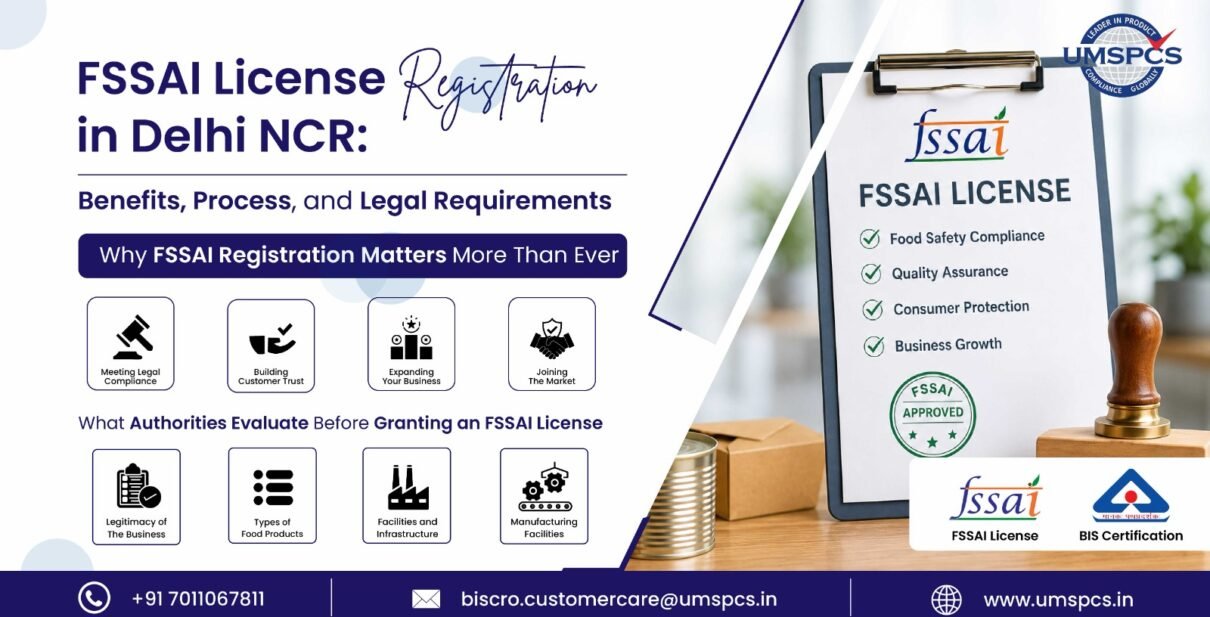
Why FSSAI Registration Matters More Than Ever
Consumers need to be sure about the safety, hygiene, and standard production of food items that they buy from any store or outlet. The Food Safety and Standards Authority of India, which was formed under the provisions of the Food Safety and Standards Act, 2006, oversees food companies in the whole nation and makes sure that food safety norms are followed by these companies.
An authentic FSSAI registration shows that you follow the norms of food safety and are allowed to produce, process, transport, store, and sell food products.
For companies working in the areas of Delhi, Noida, Greater Noida, Ghaziabad, Faridabad, and Gurugram, getting Food License Registration in Delhi NCR will help in:
- Meeting legal compliance
- Building customer trust
- Expanding your business
- Joining the market
- Food import and export
- Building credibility for your brand
In many cases, the requirement of having an FSSAI registration is mandatory for retailers, distributors, and food delivery companies to do business.
Is Your Business Covered Under FSSAI Regulations?
One of the common misconceptions held by many entrepreneurs is that FSSAI registration is limited to just restaurants. However, there are different food activities that fall under FSSAI regulations.
Some Food Businesses that Generally Require FSSAI Registration Include:
- Restaurants and Cafés
Most restaurants, quick service establishments, food courts, and cafes offering food services to customers require an FSSAI license.
- Cloud Kitchen
With the rising popularity of food deliveries, many cloud kitchens require FSSAI Registration Services in Delhi NCR.
- Food Business Conducted at Home
Baking businesses, tiffin services, and food entrepreneurs from home fall under the category of FSSAI regulation.
- Food Manufacturing Units
Food manufacturing units producing packaged food, snacks, beverages, dairy, spices, and processed food require licensing according to the size of the business.
- Food Importers and Exporters
Food importers and exporters generally require a Central FSSAI License.
- Warehouses and Storage Facilities
Food warehouses and storage facilities for food products are required to register themselves with the regulatory body.
- Retailers and Distributors
Supermarkets, grocery stores, wholesalers, and distributors require FSSAI registration.
Which FSSAI License Is Right for Your Business?
Depending on certain factors like turnover, manufacturing capacity, etc., different types of registrations will be needed.
| Business Category | Applicable License |
| Home Baker or Small Food Startup | Basic Registration |
| Small Retail Food Business | Basic Registration |
| Restaurant or Mid-Sized Manufacturer | State License |
| Food Processing Unit | State License |
| Importer or Exporter | Central License |
| Large Food Manufacturer | Central License |
| Multi-State Food Business | Central License |
The most common cause of delays and queries regarding the application process is the incorrect choice of business type.
What Authorities Evaluate Before Granting an FSSAI License
Businesses believe that getting a license is all about documentation. However, the regulatory body evaluates many aspects before granting any license.
- Legitimacy of the Business: This involves the legality of the business entity and the applicant himself.
- Types of Food Products: This involves evaluating the types of food products that are manufactured, processed, and sold.
- Facilities and Infrastructure: Facilities in which food products are stored or processed should be safe and hygienic.
- Storage Requirements: This aspect deals with whether the business stores the food products properly.
- Manufacturing Facilities: This aspect deals with manufacturing facilities for manufacturing food products.
Essential Documents Required for FSSAI Registration
It is based on the kind of registration/license you require, which determines the documentation to be produced.
- Address proof copy (GST certificate/Electricity bill)
- Process of manufacturing, together with a flow chart
- Manufacturing layout plan
- Certification of the brand
- Information about the testing facility
- List of equipment
- Evidence of ownership of premises
- NOC from the municipality and local governing body
- NOC/PA from FSSAI
- Contact details of the directors
- Declaration form of FSSAI
Good documentation increases the probability of quick approval.
Process of FSSAI License Registration Application for Approval in Delhi NCR
Step 1: Document Preparation
Document preparation is the first step of the process that involves gathering all the necessary documents needed for the relevant FSSAI registration category. Documentation is very crucial as it will help the process to go smoothly without any delays.
Step 2: Online Submission of Application
Once the documents have been collected, the applicant will have to register on the relevant FSSAI website and make an online application. All the business details and food categories need to be uploaded at this stage.
Step 3: Submitting the Supporting Documents
In accordance with the nature of the application and regulatory requirement, the applicant may need to submit the signed application form and other supporting documents.
Step 4: Scrutiny of the Application by the Authority
The food safety department will then scrutinize the application and confirm the details submitted. It will either accept the application or raise objections.
Step 5: Inspecting the Premises (If Necessary)
For some types of food businesses, FSSAI officers can inspect the manufacturing unit, kitchen, warehouse, or premises of the business. This will help ensure compliance of hygiene levels, infrastructure, food handling methods, and food safety requirements.
Step 6: Issuance of FSSAI Registration or License
Once the process of filing is completed and all the relevant processes have been carried out, the FSSAI Registration Certificate or License is then provided by the Food Safety Department. There is an FSSAI registration number available in the FSSAI Registration Certificate.
Parameters of Food Testing and Quality that Are Ignored by Most Companies
The safety of foods is not only dependent on the issue of licensing. Everything actually depends on the nature of foods because sometimes tests may be needed.
Parameters for testing are:
- Microbiology Testing: It checks the presence of bacteria or microbes.
- Heavy Metals Testing: It checks if there are any heavy metals present.
- Pesticide Testing: This test is crucial for agricultural and processed foods.
- Chemical Testing: This is related to preservatives, additives, and contaminations.
- Water Testing: It is essential for food production companies.
- Testing for Nutrition: Sometimes required for labelling and product descriptions.
These tests help ensure that food products meet applicable safety standards.
The Real Cost of Delaying FSSAI Registration
Many companies wait till the consumer, retailer, or platform asks for the license. This may cause some business interruption.
- Delayed Market Entry
- Opportunities Loss
- Platform Rejection
- Legal Risks
- Reputation Damage
Common Mistakes That Delay Approval
Even businesses that qualify still face problems due to preventable mistakes.
- Application under the wrong license type: The wrong categorisation leads to rejection or refiling.
- Insufficient Documentation: Lack of documentation leads to frequent questioning.
- Business Details Not Correct: Inaccuracies in the turnover amount, address, or operations can slow down the process.
- Wrong Product Classification: Categories for food products have to be accurate.
- Failing to Answer Regulatory Questions: Inaction when questions arise slows down the process.
Not making these mistakes will save time and money.
Why Do Growing Food Brands Choose UMSPCS?
Food compliance regulations might seem tricky for new companies and those that are growing.
UMSPCS offers full service for FSSAI License Registration in Delhi NCR and ensures that your company meets the requirements easily.
Why Choose UMSPCS?
- More than 600+ projects of experience in compliance and certifications
- Help in obtaining Basic, State, and Central Licenses
- Documentation support
- Filing support
- Queries management
- Compliance advisory
- License renewals and modifications support
Our experts assist businesses in coping with difficult regulations for faster approvals. Also get information about BIS Certification Consultant in China.
What Happens After You Obtain Your FSSAI License?
Receiving the FSSAI license marks the initial stage of the compliance process. Additional steps may include:
- FSSAI license number display
- Hygiene and sanitation level maintenance
- Food labeling regulations compliance
- Record keeping
- Testing in case it is necessary
- Renewing licenses before expiration
- Cooperation with inspections and audits
Such actions will help keep a good name for consumers and the business. Also get information about Bis Certification Consultant.
Ready to Build a Compliant Food Business?
The city of Delhi NCR still provides immense opportunities for food startups, food manufacturers, food restaurants, cloud kitchens, and food brands. But sustainable development can only be achieved through adherence to regulations.
No matter whether you are starting up your food business or trying to grow an existing one, getting your FSSAI License Registration in Delhi NCR becomes a necessary step for establishing trustworthiness and compliance.
Here at UMSPCS, we will help you to get registered with the FSSAI License Registration in Delhi NCR service with ease and convenience.
Contact UMSPCS now and embark on your journey towards effortless FSSAI compliance for your food business.
Read more also: BIS CRS Certification Consultant in Chennai: Complete Guide
FAQs
- Is FSSAI License Registration compulsory for food industries in Delhi NCR?
Yes, Most food businesses that manufacture, process, store, transport, distribute or sell their food products have to obtain FSSAI registration or a license.
- Which FSSAI license in Delhi NCR will suit my business?
The suitable license is determined by a number of considerations, such as turnover, capacity and operations of your business. You could be required to get Basic Registration, State License or Central License.
- How long does it take to get an FSSAI License Registration in Delhi NCR?
It depends on the type of license, submission of documents and the authority’s review process. Timely submission of all the documents reduces the period.
- Are home-based food businesses eligible for FSSAI registration in Delhi NCR?
Yes, Home bakers, Tiffin services and other food start-ups are eligible for FSSAI Registration.
- What are the common reasons for the delay of FSSAI license registration in Delhi NCR?
Wrong selection of license, incomplete documents, wrong information and delayed replies from the authority are some of the common reasons for delay.
❓ Ask a Question
Have any doubts? Fill the form below and our team will respond shortly.