
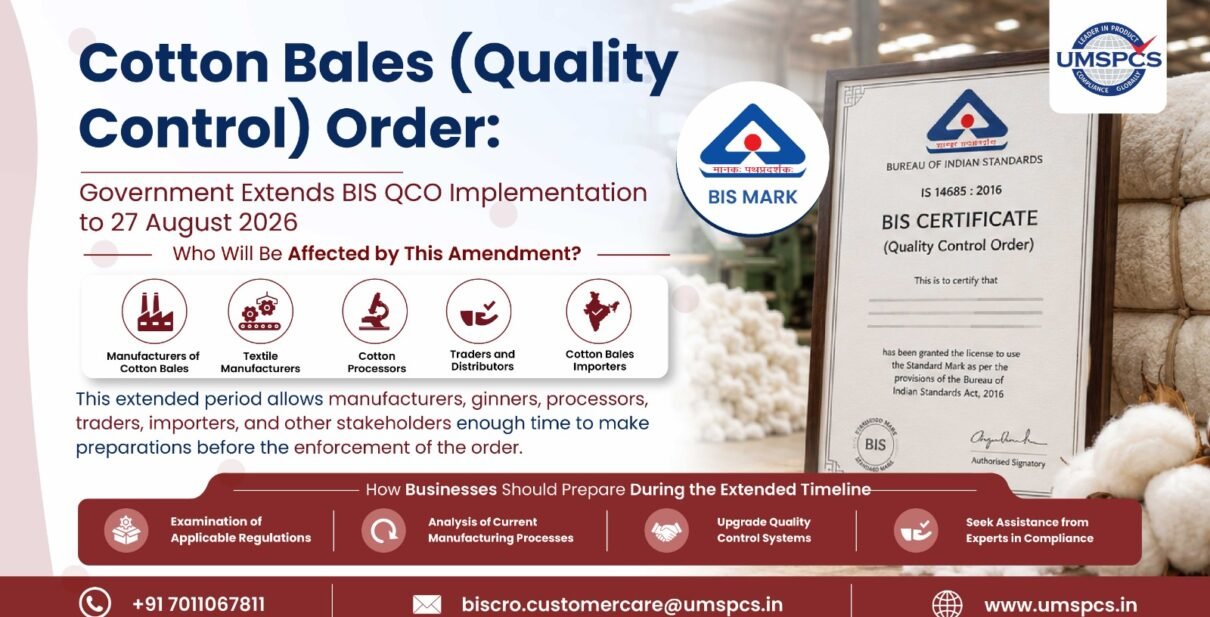
In the recent measures taken by the Government of India for relief to the textile industry, the period of implementation of the Cotton Bales (Quality Control) Order, 2023 has been extended. As per the new amendments made in the Order as published in the Official Gazette on 3rd July 2025, the Ministry of Textiles has revised the period of implementation of the QCO to 27th August 2026.
This extended period allows manufacturers, ginners, processors, traders, importers, and other stakeholders enough time to make preparations before the enforcement of the order.
While there is an extension in the timeline, this should not be considered as an excuse to defer the process of compliance. Compliance with BIS standards often involves product assessment, documentation, quality control measures, and certifications, which may take time.
In this blog, UMSPCS has laid out everything one needs to know regarding the latest Cotton Bales QCO amendment, its changes, impact, and how businesses can take advantage of the extended timeline to ensure compliance ahead of the revised implementation period.
What is the Latest BIS QCO Update for Cotton Bales?
In the latest initiatives taken by the Government of India to provide relief to the textile industry, the period for implementation of the Cotton Bales (Quality Control Order) QCO, 2023 has been recently extended. According to the latest amendments made in the Order that have been published in the Gazette of India on 3rd July 2025, the Ministry of Textiles has extended the period of implementation of the QCO till 27th August 2026.
This period will allow enough time for the preparation of manufacturers, ginners, processors, traders, importers, and others before the implementation of the order.
What Has Changed Under the Cotton Bales (Quality Control) Amendment Order, 2025?
The Cotton Bales (Quality Control) Amendment Order, 2025, issued by the Ministry of Textiles on 3 July 2025, is an amendment order with respect to a single aspect of the original Cotton Bales (Quality Control) Order, 2023, rather than any addition or deletion of any provisions. The Amendment Order is limited to implementation dates.
By virtue of the Amendment Order, Paragraph 1, Sub-paragraph (2) of the main Cotton Bales (Quality Control) Order 2023 will be substituted by the following:
“(2) It shall come into force on the 27th day of August, 2026.”
As can be noted from the above amendment, the implementation of the quality control order has been changed from 31st August, 2025 to 27th August, 2026. This gives sufficient time to the cotton and textile industry to comply with the Order.
Notably, the amended order does not make any changes to the Indian standards applicable to the product, its quality parameters, product specifications, or any other obligations under the original Order.
The amendment order is made pursuant to the powers conferred by Sections 16(1), 16(2), 17, and 25(3) of the Bureau of Indian Standards Act, 2016 after consultations with the Bureau of Indian Standards (BIS). Get BIS Certification for Cotton Bales in India.
| Provision | Amendment |
| Section 2 of the Amendment Order | Substitutes Paragraph 1(2) of the original Cotton Bales (Quality Control) Order, 2023. |
| Revised Enforcement Date | 27 August 2026 |
| Changes to Technical Requirements | No changes; only the implementation date has been revised. |
This extension gives manufacturers, traders, importers, and other stakeholders sufficient time to strengthen their quality management systems, complete compliance preparations, and ensure a smooth transition before the Order becomes mandatory.
Why Has the Government Extended the Implementation Date?
Although the notice in the Gazette does not mention the rationale for the extension of time, such time changes are usually meant to give enough time to the industries to make themselves ready for compliance with the quality control order.
A quality control order usually expects that the business will:
- Upgrade its manufacturing facilities and quality control system
- Ensure that the production process conforms with the Indian standards
- Satisfy test and certification requirements
- Make necessary technical documentation
This revised implementation timeline will help the business perform all these activities without much hassle.
Who Will Be Affected by This Amendment?
The new implementation schedule will be especially pertinent for those stakeholders who are part of the cotton value chain, such as:
- Manufacturers of cotton bales
- Cotton ginning and pressing plants
- Textile manufacturers
- Cotton processors
- Traders and distributors
- Cotton bales importers
- Export-oriented textile companies
- Brands that use cotton products
Firms intending to manufacture cotton bales post the date of implementation must start considering their compliance requirements well ahead of time.
Why This Extension Should Not Delay Your Compliance Planning
Most companies consider an extension as an opportunity for pushing their compliance procedures to the last days prior to enforcement. Unfortunately, such an approach can become quite problematic.
The process of regulatory compliance goes far beyond applying for certification. Depending on the type of product and relevant requirements, businesses will have to:
- Review relevant standards
- Assess production processes
- Undergo product testing via accredited laboratories
- Create technical documentation
- Fix any quality issues revealed through assessment
- Cooperate with relevant authorities when needed
Putting everything off to the last minute can result in some unnecessary delays, extra expenses, repeated testing, and interruptions in production plans.
It is more reasonable to utilize the additional period of time for building a solid plan of compliance actions before the Quality Control Order comes into effect.
How Businesses Should Prepare During the Extended Timeline
The modified deadline creates a great chance for manufacturers and other interested parties to enhance their compliance readiness.
Some measures that are suggested are:
1. Examination of Applicable Regulations
Identify the requirements set by the Cotton Bales (Quality Control) Order and those that apply to your products and manufacturing processes.
2. Analysis of Current Manufacturing Processes
Determine whether the existing manufacturing techniques and the quality control process can meet the regulatory requirements.
3. Upgrade Quality Control Systems
Improve the inspection process, tests, and documentation to ensure product quality is consistent.
4. Document Technical Documents
Prepare all the documents, including technical documents, manufacturing information, and quality manuals that will be needed for certification.
5. Seek Assistance from Experts in Compliance
Collaboration with BIS consultants can help businesses spot compliance issues, minimize mistakes in documentation, and simplify the entire certification process.
Why Businesses Should Use This Extended Timeline Wisely
The postponement of the deadline for implementation should not be considered a setback but rather an advantage. Companies that start their path toward compliance at an earlier stage have more chances to prepare themselves properly and be ready to operate without any problems when the Quality Control Order is obligatory.
Here are some of the main advantages of early preparation:
- Avoiding possible delays or refusals in applications
- Efficient organization of product testing and improvement
- Optimal process of documentation and regulation
- Efficiency in the business process
- Confidence in the fulfillment of compliance requirements before the enforcement of regulations
Thus, it will be possible to ensure business continuity and satisfy all the regulations.
Why Choose UMSPCS for BIS Compliance?
The process of navigating through quality control orders and the BIS certification process is quite tough, especially because the regulatory deadlines, documentation, and quality requirements change from time to time. Any deviation in compliance can result in a number of issues, including delays, extra expenses, and loss of access to the market.
UMSPCS provides regulatory assistance to manufacturers, importers, and organisations in making their entire process of compliance easier.
Areas of Expertise:
- Over 600 successful compliance projects for products
- Experience of more than 6 years in regulatory consultancy
- Compliance assistance for BIS in a comprehensive manner
- Documentation services
- Guidance about relevant Indian Standards
- Coordinating in the certification process
- Assistance till successful compliance
It is our goal to ensure that the process of certification becomes hassle-free and smooth.
Conclusion
Through the Cotton Bales (Quality Control) Amendment Order, 2025, the textile industry is given valuable extra time in terms of deferring the implementation of the Cotton Bales (Quality Control) Order, 2023 until 27 August 2026. The extension gives the manufacturers, traders, importers, and other stakeholders a chance to get themselves ready without any regulatory pressure for mandatory compliance.
Nevertheless, delaying the compliance process until the last minute may create unnecessary problems. By planning ahead of time, businesses will have a chance to detect any possible areas of non-compliance, enhance their quality management system, arrange all the required documentation, and comply with the regulation in good time.
For any organization looking for specialized help regarding the new BIS Quality Control Orders and preparation for compliance, UMSPCS is ready to assist.
Connect with UMSPCS today to benefit from professional guidance regarding BIS compliance, documentation, certification, and other related regulatory matters.
FAQs
- What is the latest news about Cotton Bales BIS QCO?
There has been an amendment made to the Cotton Bales (Quality Control) Order, 2023 by the Government of India, and the implementation of the order is extended until 27 August 2026.
- From which date will this Cotton Bales (Quality Control) Order be enforced?
The enforcement of this order will be from 27 August 2026 according to the latest amendment notification.
- Who made this latest amendment?
This amendment has been made by the Ministry of Textiles, Government of India, in consultation with the Bureau of Indian Standards (BIS).
- Are there any changes in the quality requirement of cotton bales in the latest amendment?
There is no change in the quality requirement for cotton bales in the latest amendment.
- Who all should be prepared for the Quality Control Order?
Manufacturers, ginning units, textile manufacturers, dealers, distributors, importers, exporters, and other enterprises that deal with cotton bales should prepare themselves for the order.
- Why should businesses start the compliance preparations immediately?
It is advisable for businesses to start compliance preparation immediately to avoid any problems.
- What are the advantages of following BIS Quality Control Orders?
Following the regulations ensures the quality of the product, increases customers’ confidence, helps to comply with legal requirements, and allows you to market the products within the mandatory BIS Quality Control Orders.
- How do I begin BIS compliance for my business?
You can contact us for a consultation. Our specialists will evaluate your product, determine relevant regulations, detect gaps in compliance, and help you throughout the BIS compliance process.
❓ Ask a Question
Have any doubts? Fill the form below and our team will respond shortly.