One of the countries experiencing very fast-growing consumption and industrial processes is India. There are different types of goods, including electrical goods, steel products, chemicals, building materials, and industrial goods, which have to meet the requirements of the Bureau of Indian Standards (BIS) before being sold in India.
It is imperative that compliance with the BIS certification process be met if one wants to conduct any business in India, especially Malaysian companies wishing to sell their products there. Failing to comply with the guidelines might result in difficulty when clearing the process through customs.
If you are making electronic products, which need BIS CRS Certification, industrial products, which need ISI Mark Certification, or products that come under various QCOs, then getting your products certified from the Bureau of Indian Standards is mandatory for you.
Here we at UMSPCS help you understand the complete procedure of obtaining the BIS Certification in Malaysia.
Understanding BIS Certification in India
The Bureau of Indian Standards (BIS) is the Indian National Standards Body, which operates under the purview of the Ministry of Consumer Affairs, Food & Public Distribution of the Government of India.
The BIS formulates standards in India and has adopted different conformity assessment schemes for product quality and safety.
As per the product classification, there are various certifications required:
- BIS CRS Certification for electronic products
- BIS ISI Certification for controlled products
- BIS FMCS Certification for foreign manufacturers
- Approvals for Hallmarking requirements for precious metals
- Certifications under mandatory QCO
In the case of products manufactured by Malaysian companies that are exported to India, BIS certification for foreign manufacturers may be mandatory.
Why BIS Certification Matters for Malaysian Manufacturers
BIS Certification comes with a number of benefits:
- Access to Legal Markets: Products under mandatory BIS regulations cannot enter or be sold in India without proper BIS certification.
- Easier Custom Procedures: BIS-certified products will have an easier time during the customs clearance process.
- Better Brand Image: BIS certification is proof of the quality of the products.
- Competitive Edge: Products that are certified enjoy greater acceptance from Indian wholesalers and consumers.
- Less Regulatory Risks: Compliance reduces the risk of fines and/or product recalls.
Applicable Product Testing Requirements
Testing requirements vary according to the product category. Common tests may include:
- Electrical Safety Testing
- Mechanical Testing
- Chemical Testing
- Performance Testing
Only compliant products proceed to certification.
Eligibility Requirements for Malaysian Manufacturers
In Malaysia, the BIS certification can be applied for by a manufacturer if:
- Applicant is the Actual Manufacturer: BIS certification is usually awarded to manufacturing establishments and not traders/distributors.
- Production Facility is Established: The production facility needs to be established and should be able to meet the requirements of Indian Standards.
- Testing of Products: Products need to be tested and pass the testing requirements laid down by the standards.
- Authorised Indian Representative (AIR): Foreign manufacturers are required to appoint a representative in India who is authorised by the BIS.
- Documentation Requirements are Fulfilled: All technical and legal documents must be submitted correctly.
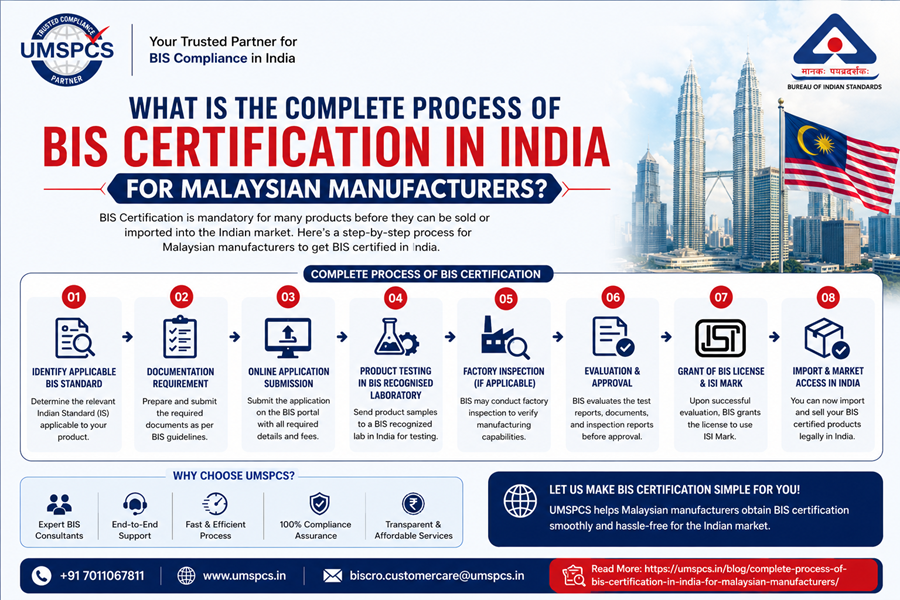
Step-by-Step Process of BIS Certification for Malaysian Manufacturers
Step 1: Product Classification and Standard Identification
The first step includes identifying:
- Indian Standard (IS) applicable
- The BIS certification scheme is relevant
- Testing criteria
- Product scope
Misclassification is perhaps the biggest cause of rejection and delays.
Step 2: Engagement of Authorised Indian Representative (AIR)
An Indian representative is mandatory for foreign manufacturers.
The authorised Indian representative serves as the:
- Contact person
- Person in charge of compliance
- Link of communication between BIS and the manufacturer
Appointment of a qualified AIR is key to achieving certification success.
Step 3: Product Testing
Samples will be tested as per the relevant Indian Standards. Testing will be performed at:
- BIS recognised laboratories
- Approved testing centres
A laboratory provides test reports after assessing the parameters of compliance.
Step 4: Preparation of Documents
A complete set of documents is prepared. Some important documents include:
- Business registration certificate
- Manufacturing license
- Factory plan
- Manufacturing process
- Product specification
- Documents of trademark
- Test reports
- AIR authorization documents
- Documents relating to quality control
- ISO certification (if available)
Step 5: Application Submission to BIS
An application is filed with BIS using:
- Relevant forms
- Applicable documents
- Government fee
- Testing report
BIS assigns a reference number to the application.
Step 6: BIS Scrutiny and Query Handling
Evaluation includes review of:
- Technical documentation
- Test reports
- Manufacture details
- Declaration of conformity
Any shortcomings or ambiguities are highlighted by way of queries that need immediate clarification.
Step 7: Factory Audit (If Applicable)
In case of FMCS and certain ISI certifications, a factory audit can be carried out by BIS officials.
A typical audit encompasses:
- Manufacture processes
- Quality control processes
- Test facility
- Raw material handling
- Traceability
Step 8: Issue of Certification
After successful completion of the evaluation procedure, BIS issues:
- BIS CRS Registration Number (CRS)
- BIS ISI License Number (ISI/FMCS)
The manufacturer is authorised to use the BIS mark.
Documents Required for BIS Certification
Malaysian producers usually require:
- The basic facts about the production facility, along with those of the products they produce are very important.
- Test report of the product obtained from laboratory accredited by BIS/NABL according to Indian Standard.
- Proof of ownership of the manufacturing facility (deed of ownership, utility bills, etc. )
- Proof of brand ownership (trademark registration)
- License/Permits from relevant authorities
- Product design drawing/Schematics
- Manufacturing capacity is installed for the production of the product.
- Facts about raw material
- Product specifications and a list of manufacturing machines would be provided.
- The list of manufacturing machines and their specifications would be given.
- Flow chart for manufacturing process
- Type of Packaging along with its process
- List of testing equipment (cable type both) in the manufacturing facility, and the ability to calibrate the test equipment.
- Quality control personnel details
- Methods of disposing of defective products
- Layout of the manufacturing facility
- The organogram of the factory
Appropriate documents greatly help in speeding up the approval process.
Cost of BIS Certification for Malaysian Manufacturers
The total cost will be calculated based on:
- Category of the product
- Number of products
- Test criteria
- Laboratory costs
- Government costs
- AIR service costs
| Particulars | Estimated Cost (Dollars) |
| Application Fees (BIS) | $12.00 |
| Per Diem Expenses for Bis Officers- 3 Days | $900.00 |
| Charges for the Visit | $466.66 |
| Contingency Funds | $111.11 |
| Bis Charges- Travel/Visa etc. -Estimate | $2173.00 |
| Marking Fee (Min.) | $2744.00 |
| Sample Testing | $400 to $3000 |
| Total Bis Cost | $6850.77 to $10000.77 |
With every category of products having different needs, getting a professional evaluation will give an idea of the actual certification cost. Most of the projects take 5 to 6 months to complete.
Common Challenges Faced by Malaysian Manufacturers
Problems that most international applicants face include:
- Indian Standard Selection Mistakes: Choosing the wrong standard results in testing failure and rejection of the application.
- Documenting Problems: Failure to provide adequate documents creates avoidable delays.
- Technical Queries Handling: Proper answers are needed for technical queries raised.
- Laboratory Testing Procedures: Testing procedures can be complicated for first-time applicants.
- Factory Audits Preparation: Preparation for BIS audits needs proper planning.
- Authorised Indian Representative (AIR): The choice of an AIR should be made correctly.
Key Compliance Tips Before Applying
Prior to proceeding with the process for certification, manufacturers may:
- Check product eligibility as per the BIS regulations
- Identify the right Indian Standard
- Do pre-compliance checks
- Study technical specifications
- Collect full documentation
- Institute their own quality control system
- Arrange time schedules in advance for certification
All these make the chance of approval much greater.
Why Choose UMSPCS as Your BIS Certification Consultant in Malaysia?
UMSPCS is a reputed compliance consultant company that helps manufacturers all around the world get BIS certified in India.
Our range of services includes:
- Full Package BIS Certification Support: From product classification to obtaining the BIS certificate, we take care of everything.
- Experience in a Variety of BIS Programmes: We offer assistance in a variety of programmes such as BIS CRS Certification, FMCS Approvals, and much more.
- Application Documentation: Our consultants prepare and submit comprehensive application documents.
- Coordinating with Testing Labs: We coordinate with certified testing labs in case of any problem related to lab testing.
- Handling of BIS Queries: Any kind of queries related to BIS, our team solves them.
- Authorised Indian Representative Support: Our professionals help in obtaining an AIR status for foreign manufacturers.
- Faster Certification Journey: Our experience helps reduce delays and improve approval efficiency.
Future Opportunities for Malaysian Manufacturers in India
Emerging opportunities are still being created by India’s expanding infrastructure, electronics, automobile, construction, and manufacturing industries for Malaysian exporters.
Items that comply with the BIS are eligible for entry into:
- Government procurement tenders
- Industry purchasers
- Retail networks
- Online marketplaces
- Infrastructure/construction projects
The BIS is more of a business opportunity for market entry than a regulation per se.
Conclusion
The regulations of India now focus heavily on product quality, safety, and the protection of consumers. To enter the Indian market legally, BIS certification is critical for manufacturers from Malaysia.
Whether your products are required for BIS CRS Certification of electronic products or require ISI certifications or FMCS approval, it is important to know the processes involved.
Working with an established BIS Certification Consultant in Malaysia, such as UMSPCS, can be beneficial in ensuring the success of testing, documentation, filing applications, audits, and certification.
Need BIS Certification for Your Products?
UMSPCS will help you achieve successful BIS certification for foreign manufacturers in India and get your products approved with BIS CRS registration and FMCS.
Visit us at UMSPCS today and get started on your journey in the Indian market.
FAQs
- Can the Malaysian manufacturing units get BIS certification to export their goods to India?
Yes, the Malaysian manufacturing units can obtain BIS certification under relevant BIS schemes and legally export the products in India.
- Is there any mandatory requirement for foreign manufacturers to have the Authorised Indian Representative?
Yes, it is mandatory for foreign manufacturers to have an Authorised Indian Representative.
- For which electrical products is BIS CRS certification required?
Mobile phones, LED bulbs, laptops, chargers, smartwatches, and other electronic goods may need to go through the BIS CRS certification procedure.
- How long will it take for Malaysian manufacturers to get the certification?
The Malaysian manufacturer may generally take around 5 to 6 months to complete their certification procedure.
- What would happen in case there is no BIS certification for imported products?
Detention, fines, banning the sale, and rejecting the product may happen in case there is no mandatory BIS certification.
- Why do the Malaysian manufacturers require hiring a BIS Certification Consultant?
Professional consultancy for the certification process reduces the risk of any issues for the Malaysian manufacturers.
❓ Ask a Question
Have any doubts? Fill the form below and our team will respond shortly.