Be it high-rise structures or industrial sheds, bridges, warehouses, airports, or commercial complexes, hollow steel sections are among the top choices of structural material used today. The reason lies in their high strength-to-weight ratio, durability, and adaptability in structural applications.
But in the wake of increasing quality and safety considerations in the Indian construction industry, there is a need for compliance with Indian Standards before launching your products. In such a situation, BIS Certification of Hollow Steel Sections becomes mandatory.
As per IS 4923, hollow steel sections for use in construction have to meet quality, dimensional, and performance criteria. With a license from BIS, you will be able to apply ISI marking to your product, which implies that your product is in accordance with the Indian Standard.
In this blog post, UMSPCS will give you all the details regarding BIS Certification for Hollow Steel Sections in India. It will include eligibility, testing, certification process, documentation, duration, costs involved, and how we can assist you throughout the process.
Understanding IS 4923: Hollow Steel Sections for Structural Use
IS 4923 Indian Standard sets out the specification requirements for welded steel hollow sections to be employed for structural purposes.
This specification applies to the hollow sections that are produced using hot-rolled steel sheets and designed for construction and engineering uses.
These sections are widely utilized in:
- Commercial structures
- Industrial buildings
- Warehouses
- Airports
- Railways
- Stadiums
- Bridges
- Power stations
- Telecommunication towers
- Pre Engineered Buildings (PEBs)
To obtain BIS ISI Certification for Indian manufactures, we need to make sure that the requirements of IS 4923 are met.
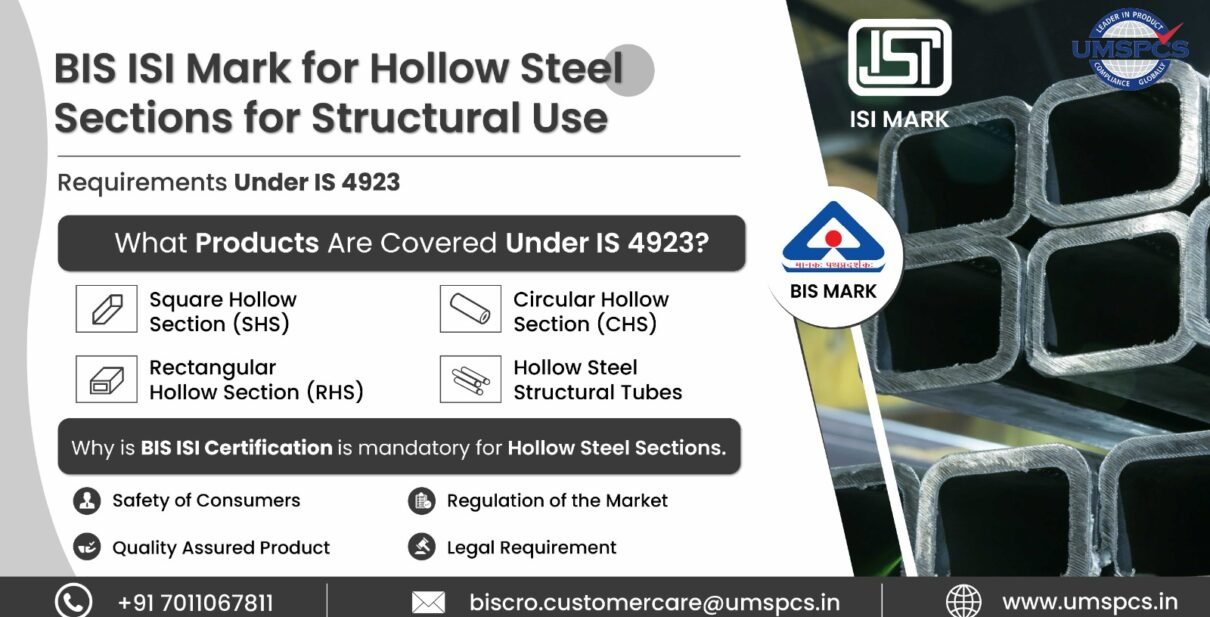
What Products Are Covered Under IS 4923?
This code applies to the use of welded hollow structural sections for structural uses, which include:
- Square Hollow Section (SHS): Commonly utilized in the construction of structures, support structures, columns, and engineering works.
- Rectangular Hollow Section (RHS): Utilized in structural frames, bridge building, and engineering works.
- Circular Hollow Section (CHS): Utilized in tower constructions, pipelines, poles, and scaffolding works.
- Hollow Steel Structural Tubes: Applied in fabrication, construction works, and engineering works.
Any manufacturer of these products for the Indian market might need BIS Certification for Hollow Steel Sections as per the relevant Quality Control Order (QCO), if notified.
Why BIS Certification Matters for Structural Steel Products
Structural steel materials play an important role in the safety of people and the strength of infrastructure.
Certification from BIS guarantees the following aspects:
- Adherence to Indian quality standards
- Uniformity in performance
- Structural integrity
- Increase in consumer trust
- Fewer chances of failure in projects
- Government regulation adherence
- Market acceptability all over India
Steel products with the ISI logo certify that the products have been tested thoroughly under the guidelines of BIS.
Applicable Tests for BIS Certification Under IS 4923
As a part of the process of certification, the goods are checked in the laboratories that have been approved by the BIS.
Types of common tests include:
- Chemical Analysis Test
- Tensile Test
- Flattening Test
- Bend Test
- Verification of Dimensions
- Visual Inspection
The exact testing requirements may vary depending on product category and applicable BIS guidelines.
Who Can Apply for BIS Certification?
The following can be qualified as follows:
- Indian Manufacturers: Indian manufacturing units making hollow steel sections.
- Large-scale manufacturers: Indian companies supplying structural steel sections all over India.
- MSME Manufacturers: MSME companies engaged in the manufacture of steel sections.
- Contract Manufacturing Units: In accordance with the BIS ISI Certification criteria and manufacturing control.
The following is required for certification of Indian manufacturers under the BIS ISI certification scheme, a functional manufacturing unit and a testing facility.
Documents Required for BIS Certification for Hollow Steel Sections
The process involved includes:
- Basic details of the manufacturing unit and product range
- Documents to prove the manufacturing unit’s location address (registration/leasing, electricity bill, etc.)
- Certificate of trademark registration if the brand name is used and is registered
- Manufacturing license/approvals, as needed (for example, pollution control clearance)
- Product design drawings/schematics
- Manufacturing capacity
- List of materials employed and specifications
- Details of manufacturing machines and equipment
- Details of the factory’s layout, comprising the manufacturing area, testing area, and storage area
- A detailed manufacturing process flow is included here
- Test equipment is available for the manufacturing process in the factory, and calibration details are available
- Details regarding the quality control staff
- Factory organizational structure diagram
More documents may be required by the BIS according to the application.
Step-by-Step BIS Certification Procedure for Hollow Steel Sections
Step 1: Identify the Applicable Indian Standard (IS 4923)
The certification process starts with determining the appropriate Indian Standard of the product. The standard that applies to hollow steel sections for structural purposes is IS 4923.
Manufacturers at this step should:
- Know the requirements laid out in IS 4923
- Make sure that products comply with the BIS standard
- Evaluate production and quality control procedures
- Take corrective actions to become compliant
Step 2: Product Testing and Technical Documents Preparation
Before submitting the application, the product has to be tested in a BIS-approved and NABL-accredited lab.
This step involves:
- Testing the product samples according to IS 4923 requirements
- Preparation of technical documentation
- Gathering information on the manufacturing process and factories
- Quality control documentation
- Filling out the BIS application forms
Step 3: Submitting the BIS Application
The manufacturer submits the BIS application online with all necessary documentation and fees prescribed by BIS.
An application package usually consists of:
- Test report for the product
- Factory and manufacturing information
- Technical documentation
- Government-prescribed fees
Upon submission of the application, the BIS reviews it for completeness.
Step 4: BIS Factory Inspection
After the assessment of the application, BIS officers conduct an inspection of the manufacturing facility.
During the inspection, the following aspects are assessed by the BIS:
- Manufacturing processes
- Production facilities
- Quality control systems
- In-house test capabilities
- Adherence to IS 4923 standards
Samples may also be taken during the inspection phase for third-party testing.
Step 5: Testing of Product and Submission of Laboratory Report
The samples taken during inspection are sent to labs for testing. Laboratory tests the product according to IS 4923 standards and sends the Lab Test Report (LTR) to the BIS directly.
Step 6: Resolution of Non-conformities (if any)
In case there are any non-conformities found during the inspection or laboratory testing, BIS may ask manufacturers to take corrective actions.
Manufacturers will have to:
- Take corrective actions
- Submit revised documents
- Correct quality issues
- Comply with the BIS requirements
All non-conformities should be resolved before proceeding with the certification process.
Step 7: Payment of License and Marking Fees
Post the successful evaluation and approval of the products, the BIS fee as prescribed for the said products must be paid by the manufacturer, which includes:
- Annual license fee
- ISI marking fee
The BIS fee varies according to the classification of the product.
Step 8: Granting of ISI License
Once the entire process of testing, inspecting, complying, and paying the fees is successfully done, the ISI license is granted by BIS.
The manufacturer thus obtains the ISI Mark for the certified hollow steel sections according to IS 4923.
Costing & Timeline of BIS Certification for Hollow Steel Sections
Generally speaking, the cost for obtaining the BIS Certification in India consists of the following:
- Application fees
- Inspection fees
- Testing fees
- License fees
- Consultancy fees
| Particulars | Estimated Cost (INR) |
| Application Fees (BIS) | ₹1,000 |
| Testing Charges (Lab Fees) | 15000- ₹2,50,000 |
| Factory Inspection Charges | ₹7000 |
| Annual License Fees | ₹1,000 |
| Marking Fees (ISI Mark Usage) | As per BIS norms (based on production) |
| Consultancy Charges (UMSPCS) | ₹ 50000 |
This entire cost depends upon the number of variants of the products and the testing required.
The time frame for the entire process depends on whether the application process is complete and the testing and inspection are available. In general, the time period is approximately 30 to 40 days.
Common Challenges Faced by Manufacturers
Applicants often face certification delays for reasons like:
- Incompleteness in Documentation: Lack of correct documentation.
- Failure in Tests: Not meeting the IS 4923 specifications.
- Lack of Calibration: Not using calibrated equipment during testing.
- Insufficient Quality Control: Lack of adequate production control.
- Query from BIS: Delay in responding to the compliance queries.
Good preparation can prevent certification delays.
Business Benefits of BIS Certification for Hollow Steel Sections
Benefits of getting BIS Certification for Hollow Steel Sections include:
- Market Credibility: Boosts confidence in the customer as well as in project developers.
- Legal Requirement: Helps maintain compliance with the laws of India.
- Competitive Edge: Enhances eligibility for government and private bids.
- Product Acceptance: Increases market presence.
- Quality Complaints: Decreases complaints about quality.
- Brand Reputation: Strengthens trust and recognition in the marketplace.
Why Manufacturers Choose UMSPCS for BIS Certification
UMSPCS brings to you more than 6+ years of experience in the domain of regulatory compliance and has successfully executed 600+ product compliance projects in various verticals.
We offer practical and standards-based advice on BIS certification for manufacturing organisations by providing professional documentation services, laboratory testing, regulatory advice, and complete BIS certification support.
Our areas of expertise include:
- Complete BIS certification support
- Application preparation & filing
- Documentations review & compliance management
- Laboratory testing support
- BIS queries management
- Inspection preparation support
- Compliance fast track assistance
- Certification renewal & post certification support
Our vast experience across various products and complete knowledge about BIS certification in India help our clients in obtaining their certifications without any hassles. Need to get more information about BIS Consultant in Rajasthan.
Conclusion
Demand for structural steel products of high quality will only continue to increase as India develops its infrastructure and construction industries. Not adhering to IS 4923 is no longer an option; it is an indication of a lack of quality and safety.
Acquiring BIS Certification for Hollow Steel Sections will ensure that your products have reached the high Indian quality standards for their use in structural purposes. Be it a new player in the manufacturing sector or one who already exists, UMSPCS can help you through the whole process.
Do you need BIS Certification for Hollow Steel Sections?
Contact UMSPCS now and streamline your BIS certification process with our guidance and comprehensive compliance services.
Read more about Lab QCO Temporarily Suspended until 30 September 2026
FAQs
- Is BIS certification compulsory for hollow steel sections in India?
This will depend on the specific Quality Control Order and the applicable BIS notification. Manufacturers should ascertain the regulatory requirements before selling any product.
- What standard covers hollow steel sections for structural applications?
IS 4923 is the applicable Indian Standard for the welding of hollow steel sections for structural applications.
- Who can apply for BIS ISI certification for manufacturers in India?
Any eligible manufacturing unit manufacturing hollow steel sections and meeting the BIS criteria can make an application.
- What tests have to be conducted according to IS 4923?
The various types of tests that are done are chemical test, tensile test, flattening test, bend test, size test, and visual test.
- What documents are necessary for getting the BIS certification?
Company Registration Documents, Factory License, Quality Control Documentation, Manufacturing Information, and Test Report are some of the major documents.
- How much does it cost for BIS certification for hollow steel section manufacturers?
Costs depend on the testing, the number of variations, the charges by BIS, and the consultancy services.
❓ Ask a Question
Have any doubts? Fill the form below and our team will respond shortly.