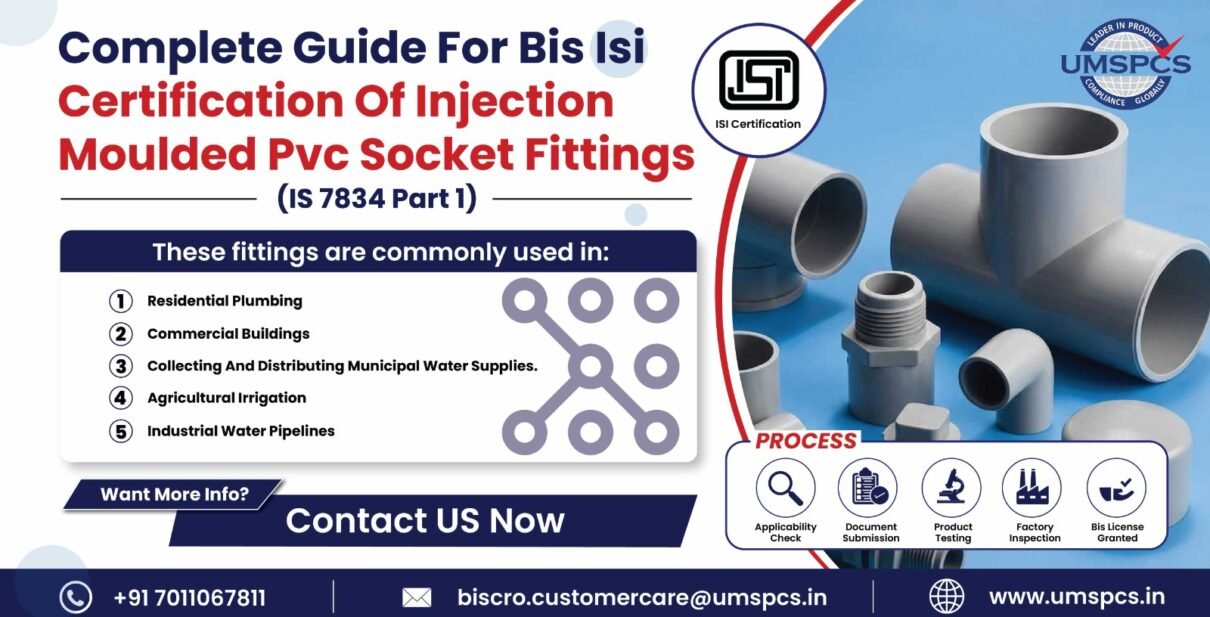
Injection-moulded PVC socket fittings are commonly used in water supply systems for residential, commercial, agricultural and industrial applications. The fittings are intended for use with PVC pipes to form solvent cement joints that will distribute water securely and provide long service. They can come into use in water pipelines, irrigation systems, water pipelines in public and private buildings, municipal water supply and water distribution systems, and industrial water distribution and supply systems.
As these fittings are important in providing safe water transport, they should be produced from quality raw materials, and dimensional and performance standards must be observed. Badly fitted fittings can cause leakage, pressure loss, cracking and contamination of the water supply, which results in expensive repairs and safety issues.
The Bureau of Indian Standards (BIS) has enacted IS 7834 (Part 1), which provides for general requirements for injection-moulded PVC socket fittings for water supplies with cement joints. BIS ISI certification of Injection Moulded PVC socket is mandatory for all the products which are under the concerned Quality Control Order (QCO) to be manufactured, sold or distributed in India.
UMSPCS will support manufacturers in the entire process of BIS ISI certification, such as product testing, documentation, filing of applications, factory inspection support and post-certification compliance.
What Does BIS ISI Certification Mean for PVC Socket Fittings?
The BIS ISI Certificate is the mandatory product certification issued by the Bureau of Indian Standards (BIS) as per Scheme I for the product covered under the concerned Quality Control Orders.
With respect to injection-moulded PVC socket fittings, the BIS Certification guarantees that the product conforms to IS 7834 (Part 1) along with the standard requirements for quality, safety, design, and performance.
BIS assesses before granting the licence:
- Product test reports
- Manufacturing facilities
- Quality control system
- Testing infrastructure
- Factory inspection findings
Once approved, the manufacturers are permitted to affix the ISI Mark on approved products.
What are Injection Moulded PVC Socket Fittings?
Injection-moulded PVC socket fittings are fittings made from unplasticized polyvinyl chloride (PVC-U) by the injection moulding process, which are used in plumbing. Their purpose is to join PVC pipes together by solvent cement joints to form a leakproof pipeline system.
These fittings are commonly used in:
- Residential plumbing
- Commercial buildings
- Collecting and distributing municipal water supplies.
- Agricultural irrigation
- Industrial water pipelines
- Water treatment plants
They are offered in various shapes like elbows, tees, couplers, reducers, adaptors, end caps, and bends, depending on the pipeline design.
What is the Requirement of BIS ISI Certification?
The Government of India has announced BIS isi certification as mandatory for notified products to ensure that only good-quality products are made available in the market.
The following are some of the benefits of BIS ISI certification:
- Conformance to Indian Standards
- Reliable and leak-proof performance.
- Distributing drinking water safely.
- Uniform product quality
- Higher consumer confidence
- Licensing authorisations for the production and sale of controlled substances
There is no way for manufacturers of products falling under the scope of the applicable QCO to legally market them in India without a valid BIS ISI licence.
What is IS 7834 (Part 1)?
The general requirements for injection-moulded PVC socket fittings used for water supply with solvent cement joints are covered by IS 7834 (Part 1).
The standard lays down the requirements relating to:
- Material quality
- Dimensions and tolerances
- Workmanship and finish
- Pressure performance
- Joint compatibility
- Mechanical strength
- Marking requirements
- Product identification
This standard will increase the reliability of the performance and durability of the piping system during its service life.
Types of PVC Socket Fittings Covered
The following are typical examples of products generally covered by IS 7834 (Part 1):
- Couplers
- Elbows
- Bends
- Tees
- Reducers
- Adaptors
- End caps
- Socket unions
- Cross fittings
Other injection-moulded solvent cement joint fittings, for water supply. The manufacturers are advised to ensure that their particular product is in the scope of the Indian Standard before applying for certification.
Applicable Tests for PVC Socket Fittings
The product samples are tested in the ISI-recognised laboratories to check the compliance with IS 7834 (Part 1).
Typical tests include:
- Visual examination
- Dimensional verification
- Hydrostatic pressure test
- Leak-proof performance test
- Impact resistance test
- Workmanship inspection
- Material quality verification
- Joint performance test
- Marking verification
The products that passed the prescribed test requirements are only eligible for BIS ISI certification.
Process of BIS ISI Certification for Injection Moulded PVC Socket
Typically, the certification process will go through the following stages:
Step 1: Identify the Applicable Indian Standard
The first step is to find the appropriate Indian Standard (IS code) for the product.
Manufacturers must:
- Understand product requirements
- Make products according to the BIS standards
- Improve production techniques, if necessary
Step 2: Product Testing & Documentation
The product needs to be tested in a BIS-recognised and NABL-accredited lab.
At this stage, product samples are tested for this.
- Technical documents are developed.
- Data is collected relating to the factory and manufacturing.
- Application forms filled out.
Step 3: Application Submission
The BIS application is available online and consists of an application letter, a BIS form, and a copy of the DHS grant letter.
Required documents:
- Test reports
- Factory information
- Applicable government fees
- After the application is submitted, it is reviewed by the BIS authority.
Step 4: BIS Factory Inspection
The BIS officials visit the manufacturing plant to check the following:
- Manufacturing process
- Production setup
- Quality control system
- Testing capabilities
Samples of the product might also be taken for independent testing during the inspection.
Step 5: Product Testing & Lab Report Submission
Samples collected are sent for analysis at approved laboratories. The Lab Test Report (LTR) is then directly forwarded to BIS for evaluation by the lab.
Step 6: Closure of Non-Conformities (If Any)
If BIS finds there are issues during its inspection or testing,
- There is a need for corrective measures to be implemented
- New documents will have to be provided
- Any non-conformance should be taken care of
Step 7: Payment of License & Marking Fees
Once BIS has completed the certification process, the manufacturer must pay:
- Annual license fee
- ISI marking fee
Step 8: Grant of ISI License
Once the testing, inspection and payment procedures are completed, BIS grants an ISI license. The manufacturer can then use the ISI mark of certified products.
UMSPCS supports manufacturers all throughout the way to minimise documentation mistakes and improve coordination with laboratories and BIS authorities.
Documents Required for BIS ISI Certification for Injection Moulded
Typically, the documents needed are the following:
Common Documents Required
- Basic data of the manufacturing unit and the product segment
- Proof of manufacturing unit address (ownership/lease deed, utility bill, etc.)
- Trademark registration certificate (if brand name is used and registered)
- Manufacturing licence / statutory approvals (where relevant, such as pollution
control and industry-specific approvals) - Product drawings/design schematics
- Installed manufacturing capacity
- List of materials used, and specifications
- Details of manufacturing machinery and equipment
- The layout plan of the factory, including production and testing areas, and storage areas
- A detailed manufacturing process flow is provided. A detailed manufacturing process flow is given.
- In-house test equipment and calibration information
- Information about the quality control personnel
- Factory organisational chart
When the documentation is correct and complete, delays and objections are minimised in the certification process. Get to know more about BIS Certification Consultant in Ahmedabad and Surat, Gujarat.
Cost & Timeline
The fees for BIS ISI Certification will depend on the following:
- Product category
- Laboratory testing charges
- Factory inspection
- Documentation requirements
- Consultancy support
Estimated Timeline
- Approximate length of time: 30 – 40 working days
- AIF Products: Up to 180 days, in some instances
Benefits of BIS ISI Certification for Injection Moulded
There are several benefits to getting BIS ISI certification of Injection Moulded PVC socket:
- Adhere to the rules of the Indian laws.
- Improved product quality
- Better market acceptance
- Increased customer confidence
- Enhanced brand reputation
- Reduced regulatory risks
- To be qualified to work on government and institutional projects.
Common Challenges Faced by Manufacturers
Delays for manufacturers can happen for the following reasons:
- Incorrect product classification
- Incomplete documentation
- Product test failures
- Delays in laboratory testing
- Factory inspection observations
- Incorrect application details
- Issues that only respond to BIS queries later in the run.
These pitfalls can be minimised with forethought and good documentation.
Why Choose UMSPCS for BIS Certification for Injection Moulded?
To gain BIS ISI certification, one must have technical expertise and knowledge of the BIS procedures. UMSPCS will offer full support during the certification process.
Our services include:
- Product applicability assessment
- A unique identification of the Indian Standard relevant to the problem.
- Documentation preparation
- Laboratory coordination
- BIS application filing
- Factory inspection assistance
- BIS query handling
- Post-certification compliance support
Our team is experienced in working with manufacturers to make the bis certification process easy and ensure that the manufacturers comply with all BIS requirements.
Conclusion
As a crucial part of a water supply system, product quality and reliability are critical with injection-moulded PVC socket fittings. The manufacturers should ensure compliance with IS 7834 (Part 1) and, if applicable, should also get the ISI Certification from BIS for their product before selling in the Indian market.
Each step is planned and completed, such as product testing, documentation, inspection of the factory, and BIS licensing. UMSPCS provides a complete service for the manufacturers to help them go through the entire process and get their BIS license.
Get Expert Support for BIS ISI Certification
Are you planning to get BIS ISI certification for injection-moulded PVC socket fittings (IS 7834 Part 1)?
UMSPCS provides full support for product testing, product documentation, BIS application filing, factory inspection support, and compliance with the certificate.
Read more about: BIS Certification Consultant in Hyderabad.
FAQs
- Do PVC socket fittings require the ISI certificate of Injection Moulded PVC sockets?
Yes, the products under the relevant quality control order are required to get BIS ISI certification.
- Which Indian Standard applies to PVC socket fittings for water supplies?
The general requirements for these fittings are in IS 7834 (Part 1).
- Who is eligible for a BIS ISI certificate of Injection Moulded PVC socket?
Under the applicable BIS scheme, the eligible Indian and foreign manufacturers can apply.
- What is the turnaround time for BIS certification of the injection-moulded PVC socket?
The entire process can last approximately 6-10 weeks.
- Does a factory inspection need to be done?
Yes, BIS usually inspects the factory before issuing the licence.
- What happens if regulated products are sold without BIS certification?
Manufacturers can be subject to regulation, and products that fall under notification cannot be legally sold.
- How can UMSPCS help?
UMSPCS offers full support for testing, documentation, BIS application filing, factory inspection and after-certification compliance.
❓ Ask a Question
Have any doubts? Fill the form below and our team will respond shortly.