Agriculture is perhaps one of the most valuable resources, and drip irrigation can be regarded as one of the most effective ways to increase the efficiency of agriculture while ensuring minimal wastage of water. Emitters play an essential role in any drip irrigation system; being small parts, they deliver to plants’ roots the right amount of water. Irrigators will encounter poor yields and increased operating expenses if using low-quality emitters due to uneven watering, clogging, leakage, and inefficiency of irrigation.
The Government of India prescribes compliance with the relevant Indian standard for introducing the products into the market to ensure the quality, safety, and performance of irrigation emitters. Irrigation equipment emitter manufacturers should get BIS ISI certification based on IS 13487 before production and marketing of their products in India.
This guide outlines all the information regarding BIS ISI certification for irrigation equipment emitters IS 13487, such as the Indian Standard, scope of the product, process for achieving BIS Certification, documents required for the process, testing criteria, cost, and duration, along with how the manufacturers can achieve BIS approval efficiently with UMSPCS.
What is BIS ISI Certification for Irrigation Equipment Emitters?
BIS ISI Certification is a product certification scheme under the Bureau of Indian Standards (BIS) for the quality and safety of the products and their performance as per the Indian standards.
Irrigation equipment emitters are covered by the Indian Standard IS 13487. Even the manufacturers have to obtain a BIS license prior to manufacturing, selling, and supplying such products within the Indian market. On certification, manufacturers will be authorised to use the ISI mark, which ensures that the product complies with the requirements of the Indian standard.
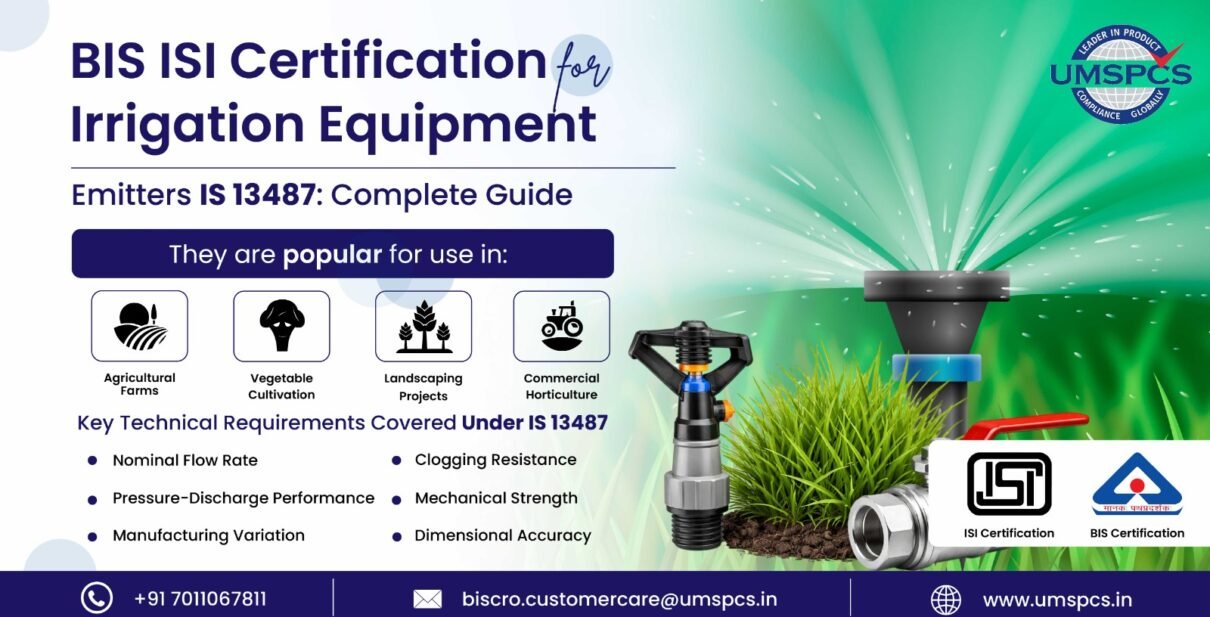
They are popular for use in:
- Agricultural farms
- Orchards
- Vineyards
- Vegetable cultivation
- Greenhouses
- Nurseries
- Landscaping projects
- Commercial horticulture
Compliance with recognised quality standards by manufacturers is directly related to the quality and performance of the emitters, which, in turn, are critical to irrigation efficiency.
What is IS 13487 for Irrigation Equipment Emitters?
Irrigation Equipment Emitters used in drip and micro-irrigation systems is an Indian Standard published by the Bureau of Indian Standards (BIS). The standard defines technical requirements, performance criteria, testing procedures, classification, and marking requirements to guarantee the performance of the emitters under various operating conditions.
Adheres to the internationally recognised agricultural irrigation equipment standard, ISO 9261. Together with this alignment, the Indian manufacturers are able to manufacture emitters that comply with the quality and performance standards accepted in the market.
Key Technical Requirements Covered Under IS 13487
IS 13487 establishes the quality, design, testing, and performance requirements that irrigation emitters must satisfy before they can receive BIS certification.
The standard assesses some key parameters, such as:
- Nominal flow rate
- Pressure-discharge performance
- Flow uniformity
- Manufacturing variation
- Clogging resistance
- Performance is on both short and long durations.
- Mechanical strength
- UV resistance
- Dimensional accuracy
To get BIS ISI certification for IS 13487, these technical requirements are crucial.
Types of Irrigation Equipment Emitters Covered Under IS 13487
IS 13487 covers different types of emitters used in drip and micro-irrigation systems.
| Emitter Type | Typical Applications |
| Online Emitters | Orchards, vineyards, plantations, and row crops |
| Inline Emitters | Vegetable cultivation, commercial farming, and drip irrigation laterals |
| Pressure Compensating (PC) Emitter Devices | Ungular topography, inclined fields, and lengthy irrigation pipelines |
| Micro Sprinklers/ Micro Jets | Orchards, nursery farms, gardening, and landscaping |
| Foggers / Misters | Greenhouses, nurseries, mushroom cultivation, and humidity control |
| Drip Tape Emitters | Cotton, sugarcane, vegetables, and other row crops |
| Adjustable Flow Emitters | Home gardens, container irrigation, and landscape applications |
Before applying for BIS ISI Certification, manufacturers of irrigation emitters of any of these types should ensure that they meet the relevant requirements of IS 13487.
Why is BIS ISI Certification Required for Irrigation Equipment Emitters?
Irrigation systems can perform very well or poorly, depending on the quality of their emitters. Faults in the emitters or substandard quality of the emitters can result in uneven water distribution, clogging, leaks, pressure imbalance, and high water losses, which will impact crop growth and agricultural productivity.
The Government of India has imposed a BIS ISI certification requirement for Irrigation Equipment emitters as per the applicable Quality Control Order (QCO) to ensure uniformity of products and to safeguard the end-users. Manufacturers have to ensure the compliance of their products with IS 13487 before manufacture, sale, or supply to the Indian market.
Getting BIS certification allows manufacturers to:
- Follow the Indian regulatory regulations
- Ensure reliability and quality of the products
- Improve customer confidence
- Enhance market acceptance
- Reduce regulatory risks
- Strengthen brand credibility
Process for BIS ISI Certification for Irrigation Equipment Emitters
Step 1: Identify the relevant IS code.
One of the foremost steps is the identification of the relevant Indian Standard (IS code).
Manufacturers must: 1.
- Know product requirements
- Make Products according to BIS Standards
- Increase production techniques if necessary
Step 2: Product Test & Documentation
Testing should be done in a BIS-approved & NABL-accredited laboratory.
At this point:
- This is tested on samples of the product.
- Technical documentation is written.
- Data is collected on factories and manufacturing.
- Application forms filled in.
Step 3: Submit Application
The BIS application is available online and includes an application letter, a BIS form, and a copy of the DHS grant letter.
- Test reports
- Factory information
- Applicable government fees
- Once the application is made, it gets checked by the BIS authority.
Step 4: BIS Factory Inspection
The BIS officials come to inspect the manufacturing plant and check the following:
- Production process
- Production Environment
- Quality control scheme
- Testing capacity
- During the inspection, samples of the product may also be taken for independent analysis.
Step 5: Product Testing & Lab Report Submission
Samples taken are analysed at approved laboratories. The Lab Test Report (LTR) is then sent directly to the BIS for evaluation by the lab.
Step 6: Close Non-Conformities (If Any)
If BIS finds any problems during inspection/testing:
- There is a need to take action to correct it
- New documents will have to be filed
- Any nonconformance needs to be taken care of
Step 7: Payment of Marking & Licence Fees
Once the BIS certification process is completed, the manufacturer has to pay the following:
- Annual Licence Fee
- ISI marking fee.
Step 8: Issuance of the ISI licence
On successful completion of testing, inspection and payment procedures, BIS issues an ISI licence. It allows the manufacturer to use the ISI mark of certified products.
Documents Required: BIS Certificate for Irrigation Equipment
Documentation is key to fast approval and certification.
Documents Required Frequently
- Manufacturing unit and fundamental data product segment
- Proof of address for the manufacturing unit
- Trademark registration certificate (in case the brand name is used and registered)
- Manufacture licence / statutory approvals
- Product drawings/design schematics.
- Manufacturing Capacity Installed
- And the specifications list, materials used
- Details of machinery and equipment for manufacture
- The layout plan of the factory, including production and testing areas, and storage areas
- The manufacturing process flow is explained in detail.
- Calibration data and internal testing apparatus
- Information about quality control personnel
- Factory org chart
When the documentation is correct and complete, the certification process minimises delays and objections.
Applicable Tests for Irrigation Equipment – Emitters Under IS 13487
An emitter is assessed by several performance and quality checks, as specified in IS 13487, before getting BIS certification.
Some of the critical tests are:
- Visual examination
- Dimensional verification
- Flow rate test
- Pressure-discharge performance test
- Flow uniformity test
- Manufacturing variation assessment
- Clogging resistance test
- Short-duration performance test
- Long-duration performance test
- Mechanical strength test
- UV resistance test
- Leakage test
These tests enable the emitters to be efficient in different operating conditions and meet the quality requirements laid down in BIS.
Cost and Timeline of BIS Certification for Irrigation Equipment
The typical costs of certification are:
| Particulars | Estimated Cost (INR) |
| Application Fees (BIS) | ₹ 1,000 |
| Testing Charges (Lab Fees) | ₹15,000 – ₹250,000 |
| Factory Inspection Charges | ₹ 7,000 |
| Annual License Fees | ₹ 1,000 |
| Marking Fees (ISI Mark Usage) | As per BIS norms (based on production) |
| Consultancy Charges (UMSPCS) | ₹ 50,000 |
The above charges are subject to change depending on the nature of the products to be certified. Can also get a BIS certificate for foreign manufacturers.
Some products may be available for longer than the date indicated due to BIS processing and product readiness.
- Estimated time: 30 – 40 working days
- AIF Products: Up to 180 days in some instances
Benefits of BIS ISI Certification for Irrigation Emitters
Apart from the regulatory aspect, manufacturers have several benefits from getting BIS ISI certification.
The advantages of this are:
- Issued a certified permit for the manufacture and sale of emitters in India.
- Adherence to the appropriate Quality Control Order (QCO)
- Enhanced product quality and reliability through consistent performance.
- Improved customer trust and credibility
- Lower legal and regulatory hassles
- Enhanced opportunities for government and institutional procurement.
- Irrigation equipment market competitive advantage.
- Improved the brand’s reputation by using the ISI Mark to promote their products
Common Challenges Faced by Manufacturers
There are some manufacturers who find they have delays in the certification process because they’ve got compliance problems that don’t need to be there.
Some of the common challenges include:
- Identification of the wrong Indian Standard;
- Poorly documented or poor documentation.
- Product testing failures
- Laboratory scheduling delays.
- Any deviation from standards during the factory inspection.
- BIS technical observations
- Poor quality control in-house systems
- Failure to respond to regulatory requirements.
Hiring professionals at the beginning can help minimise these difficulties and make the certification process faster.
Why should you consider applying for UMSPCS for BIS ISI certification?
Managing the process of obtaining BIS ISI certification demands technical knowledge, understanding of the regulations, and coordination during the entire certification journey. We at UMSPCS offer full support to manufacturers when it comes to the certification process, making it smooth and hassle-free.
Our services include:
- Determining whether your irrigation equipment falls under mandatory BIS certification.
- The identification of the applicable Indian Standard is not required.
- Document preparation and review.
- The coordination with BIS-recognised laboratories.
- BIS application filing
- Factory inspection assistance
- BIS query handling
- Licence renewal support
- Ongoing compliance guidance
Our team is dedicated to providing you with the best guidance and support throughout the entire certification process, whether you are taking the first step towards BIS certification or expanding your product line.
Conclusion
The use of good-quality irrigation equipment is a key factor in increasing water use efficiency and productivity. Clearly, one of the most crucial components in a drip irrigation system is the emitters, so ensuring that they are of quality, durability and performance is crucial. Irrigation equipment emitter manufacturers must adhere to the BIS ISI certification for IS 13487, not just for legal compliance, but also to ensure that they supply reliable and compliant products to the market.
UMSPCS offers comprehensive support throughout the BIS ISI certification process, spanning from product standard identification, documentation, coordinating laboratories, providing factory inspection assistance, and filing applications to post-certification compliance. With a well-experienced team, we work hand in hand with the manufacturers to make the certification process easy for them and get their BIS licence in the least possible time.
Get Expert Assistance BIS ISI Certification for Irrigation Equipment Emitters.
UMSPCS fully supports you in the certification process, from documentation assistance, product testing, and factory inspection to BIS approval. Reach out to our experts to get trustworthy advice and certification without hassle.
Read more also: Why Spanish Manufacturers Can not Ignore BIS Certification 2026
FAQs
- Is BIS ISI certification mandatory for Irrigation Equipment Emitters?
Yes. For manufacturers of irrigation equipment emitters, BIS ISI certification is mandatory under the applicable quality control order before they can manufacture or sell their products in India, as per IS 13487.
- What is IS 13487?
IS 13487 is the Indian Standard for emitters for drip and micro-irrigation systems, which include technical requirements, performance, testing and quality parameters.
- In IS 13487, what types of emitters are covered?
The standard applies to all online emitters, inline emitters, pressure-compensating emitters, micro sprinklers, micro jets, foggers, misters, drip tape emitters, and adjustable flow emitters.
- What is the validity period for irrigation equipment emitters?
Normally, about 30-45 working days are required for the certification procedure for the following reasons, such as testing schedules, documentation, factory inspection and BIS approval.
❓ Ask a Question
Have any doubts? Fill the form below and our team will respond shortly.