A deep freezer is used in many settings to maintain the quality and safety of products, including in a supermarket for storing frozen food, a pharmaceutical company for storing temperature-sensitive products, or a commercial kitchen for inventory storage. But manufacturers will need to ensure their deep freezers meet the relevant BIS standards to sell them in the Indian market.
Deep freezer manufacturers need to comply with the Indian quality and safety standards by obtaining BIS ISI certification for deep freezers. If a business doesn’t have certification, it’ll probably have trouble getting its products approved, gaining access to markets, and complying with regulations.
Having a grasp of the certification process can help manufacturers, importers, and brand owners navigate the process with ease and help them avoid delays. UMSPCS helps businesses throughout the documentation, testing coordination, application filing and compliance process.
Why is BIS ISI Certification for Deep Freezers Important?
Deep freezers are used to store food products, medicines, vaccines and other temperature-sensitive goods. It is expected that these products will operate under various operating conditions and will achieve a certain standard of quality and safety.
BIS ISI Certification for deep freezers is to ensure that the product meets the relevant Indian standard before being offered in the market.
Certification helps:
- Show the quality and safety of the product
- Comply with relevant regulations
- Improve customer confidence
- Enhance market credibility
- Reduce compliance-related risks
Certification is a crucial part of manufacturers’ legal market access and long-term growth process.
Understanding IS 7872 Requirements for Deep Freezer Manufacturers
IS 7872 is the Indian Standard that specifies the requirements for deep freezers. The standard addresses performance, construction, safety and testing requirements which manufacturers are expected to comply with.
The standard aims to make sure that deep freezers
- Operate safely
- Keep within the recommended temperature limits
- Deliver reliable performance
- Do things up to BIS quality standards
Following IS 7872 is proof to the manufacturers that their products meet the Indian requirements.
Types of Deep Freezers Covered Under IS 7872
Depending on the design and use, various configurations can be used in deep freezers that comply with the standards of IS 7872.
These are some common product categories:
- Hard-top deep freezers
Popularly used for frozen food storage on commercial premises.
- Glass Top Deep Freezers
Usually used in a retail store or supermarket to be used for display and storage.
- Commercial Deep Freezers
For hotels, restaurants, food processing units & commercial units.
- Vertical Deep Freezers
Utilised when space is limited for storage.
It is always important to verify the applicability of certification, depending on the product’s specification and/or use.
Who Needs BIS ISI Certification for Deep Freezers?
The certification requirements may apply to businesses involved in manufacturing, importing, branding, or supplying deep freezers in India.
Indian Manufacturers
Indian manufacturers are those companies that make deep freezers in India and plan to sell them in the domestic market. When a product is covered by relevant BIS specification, then deep freezers must be certified by BIS ISI before they can be sold. The certification ensures conformity to Indian quality and safety requirements. The BIS ISI certificate for Indian manufacturers requires them to undergo product testing and factory assessment. They will be allowed to use the ISI Mark for deep freezers on those certified products.
Foreign Manufacturers
Foreign manufacturers are those that are outside of India, producing deep freezers and selling them in India. They may require a BIS certificate for foreign manufacture.
The regulation scheme applicable to deep freezers in India. The foreign manufacturers are normally required to have an authorised Indian representative (AIR) to deal with the BIS authorities. They have to ensure technical documents, support product testing and maintain compliance with Indian standards. This facilitates access to and approval in the market.
Brand Owners
Brand Owners are companies that sell the deep freezers under their own brand name, even if they don’t make them. They should make sure that the products have a valid BIS ISI Certification for deep freezers before selling in India. It is the brand owner’s responsibility to check the status of a brand’s certification and ensure compliance with the relevant requirements. They also need to keep records of the products’ certification and track and watch product quality. This helps to promote adherence to BIS Quality Standards and promotes consumer confidence.
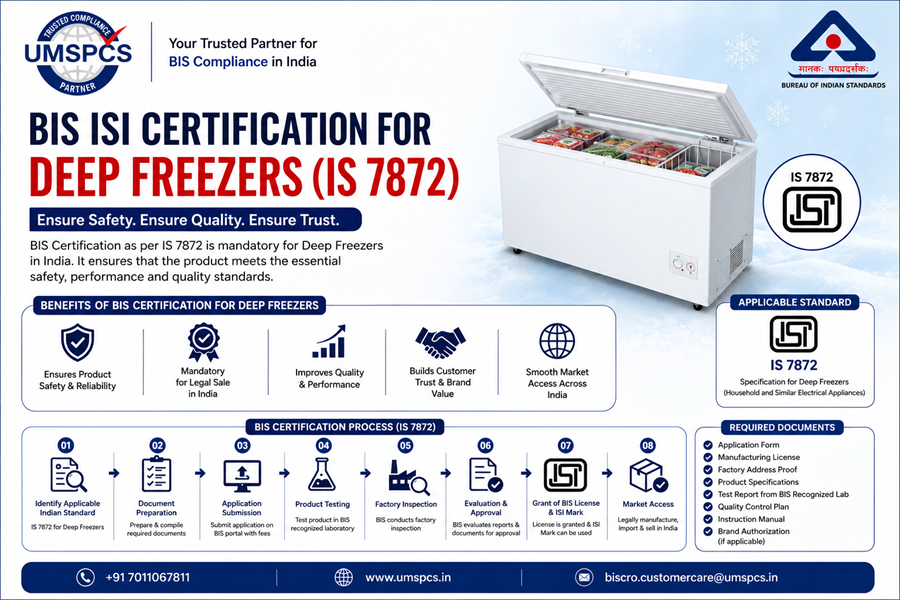
Process for BIS ISI Certification for Deep Freezers
The documents listed below are required for BIS ISI certification of deep freezers.
It takes around 30 to 40 working days to acquire the BIS ISI certificate for an Indian manufacturer if the product testing and factory inspection are passed successfully.
Step 1: Identify the Applicable Indian Standard
The first step towards compliance is for manufacturers to determine which Indian Standard (IS Code) applies to their product.
At this stage:
- Determine the applicable IS standard.
- Check the technical specification of the standard.
- Quality assurance of the product according to BIS Standards.
- Improve manufacturing processes, if needed.
Step 2: Product Testing & Documentation
The product should be subjected to laboratory testing by a laboratory that is recognised by BIS and accredited by NABL.
At this stage:
- Samples of the product are sent out for testing.
- Technical documentation is done.
- The details of factories and manufacturing activities are gathered.
- Application-related documents are prepared.
Step 3: Application Submission
Applications for BIS are made using the prescribed online application form.
Required submissions:
- Laboratory test reports.
- Manufacturing unit details.
- Supporting documents.
- Applicable government fees.
Step 4: BIS Factory Inspection
An inspection of the manufacturing facility is done by the BIS officials.
During the inspection:
- Processes of manufacturing are examined.
- Production plants are visited.
- The quality control systems are evaluated.
- In-house testing facilities are certified.
Step 5: Product Sample Evaluation
Samples may be taken for inspection and sent for analysis to approved laboratories.
At this stage:
- Samples are compared to the specified standard.
- The reports of performed tests will be sent directly to BIS.
- BIS conducts a compliance assessment of test results.
Step 6: Non-conformities closed
If there are any observations raised by BIS
The manufacturer must:
- Implement corrective actions.
- Submit other documents, if necessary.
- Implement all non-conformities within the agreed timeframe.
Step 7: Payment of Licence & Marking Fees
Once the manufacturer has passed the evaluation, they pay the following:
- Licence fee.
- Applicable marking fee.
- Other special taxes (if any).
Step 8: Grant of ISI Licence
Following successful completion of all requirements:
- The ISI’s licence is provided by BIS.
- The manufacturer is permitted to display the ISI Mark.
- BIS can be used for selling certified products.
Documents Required for BIS Certification for Deep Freezers
Knowing what paperwork is needed and having it ready ensures a streamlined certification process and minimises delays.
Common Documents Required:
- General information about the manufacturing unit and product group.
- Address – proof of factory address (ownership documents, lease deed, utility bill, etc.).
- Registered brand name trademark registration certificate (if the trademarked brand name is used).
- Issuing of a manufacturing licence and statutory approvals (if applicable).
- Product drawings, designs and technical specifications.
- Information about the installed capacity of manufacturing.
- List of raw materials along with their specifications.
- Details of manufacturing machinery and equipment.
- Production, testing and storage areas are outlined in the factory layout plan.
- Manufacturing process flow chart.
- Details on any in-house testing facilities.
- Calibration records of test equipment.
- Information about the quality control staff members.
- Factory organisational chart.
Documentation is important for BIS to ensure that the requirements are met and can speed up the certification process.
Cost and Timeline of BIS ISI Certification for Deep Freezers
The total cost of BIS ISI Certification for Deep Freezers varies with the type of product, the kind of test, the infrastructure of the factory and the type of documentation involved.
| Particulars | Estimated Cost (INR) |
| BIS Application Fee | ₹ 1,000 |
| Product Testing Charges | ₹15,000 – ₹250,000 |
| Factory Inspection Charges | ₹ 7,000 |
| Annual Licence Fee | ₹ 1,000 |
| ISI Marking Fee | As per BIS norms |
| Consultancy Charges (UMSPCS) | ₹ 50,000 |
Estimated Certification Timeline
The time to certification can differ from product type to product type and testing requirements.
- The standard duration of the timeline is 30 to 40 working days.
- Practice of AIF products: Up to 180 days in certain cases
- If corrective actions are required, additional time may be needed.
Common Challenges in BIS ISI Certification
There are several difficulties that manufacturers may encounter when going through the certification process.
Common issues include:
- Complex documentation requirements
- Incorrect product classification
- When laboratory tests are delayed. When lab tests are delayed.
- Factory compliance gaps
- Questions/queries posed by BIS
- Some technical knowledge of the certification requirement.
With proper planning and expert guidance, these challenges can be overcome efficiently and with minimal delays to make sure that manufacturing gets certified.
Benefits of BIS ISI Certification for Deep Freezers
There are various benefits of having BIS ISI-certified deep freezers:
- Improved market access
- Higher customer confidence
- Enhanced product credibility
- Better compliance management
- Reduced regulatory risks
- Stronger brand reputation
- More trust in buyers and distributors.
Certification facilitates sustainable growth, and it can also be used to prove conformity to Indian standards.
Why Manufacturers Choose UMSPCS for Deep Freezer Certification
With 600+ successful BIS projects are evidence of our track record. We have helped numerous manufacturers across a range of product categories obtain timely certification. Having worked as a BIS consultant for many years.
- Expert Advice for IS 7872 Compliance
- Documentation and Application Support
- Testing Coordination
- Guidance and assistance to Indian and foreign manufacturers
- End-to-End Compliance Assistance
Conclusion
For manufacturers looking to sell deep freezers in India in compliance with BIS ISI certification, acquiring the BIS ISI certificate is a crucial measure. A proper testing, documentation and regulatory compliance process helps businesses to avoid delays and market acceptance. UMSPCS offers documentation preparation, testing coordination, BIS application filing, compliance guidance & more.
By following proper planning and professional guidance, manufacturers can meet the certification process requirements efficiently and confidently introduce the compliant products to the market.
Looking for BIS ISI Certification for Deep Freezers?
Call UMSPCS today to talk about certification needs. Our experts guide manufacturers through the certification process in a smooth and efficient manner.
Read more about: BIS Certification for Power Inverters in Photovoltaic Power Systems
FAQs
- Do deep freezers have to be BIS ISI certified?
Manufacturers are advised to check the applicable BIS requirements for the product category and market requirements.
- Which of the following is true about deep freezers?
Deep freezers are specified in IS 7872.
- Can foreign manufacturers apply for certification?
Yes. The foreign manufacturers may apply through the respective BIS certification process and may need to obtain an Authorised Indian Representative (AIR).
- How long does the BIS ISI Certification for Deep Freezers process take?
Overall process duration typically is 30-45 working days, as per the preparedness of testing and documentation.
- How can UMSPCS help with BIS ISI Certification for deep freezers?
UMSPCS supports the documentation, testing coordination, application filing and compliance management process for BIS ISI Certification for deep freezers.
❓ Ask a Question
Have any doubts? Fill the form below and our team will respond shortly.