Ever wonder why some water supply systems last for years without any leaks, and water systems with the same water treatment infrastructure experience problems sooner? The solution is frequently in the fittings that are installed in the pipeline system. Although high-quality pipes are installed, the quality of the fittings can still have an impact on the performance and safety of the water supply system.
BIS Certification HDPE fittings for potable water supplies is an essential part of potable water supply systems and is produced by injection moulding and/or machining. These fittings are smooth to allow the drinking water to flow and are used to connect the pipes together in a secure manner. Because they are applied in projects that involve critical infrastructure, compliance and quality of products are key.
This is where the importance of BIS certification for injection-moulded/machined HDPE fittings potable water supplies as per IS 8008 (Part 1) lies. The certification will show that the product meets the relevant quality and safety standards in India.
Why is BIS Certification for HDPE Fittings for Potable Water Supplies Important?
HDPE fittings readily replace the traditional metal fittings in potable water supply systems due to their durability, corrosion resistance and long service life. These products add to the water distribution infrastructure directly and are essential for quality assurance.
If any specification, procurement requirements, or market demand requires it, or if BIS certification is required under applicable regulations, the manufacturer shall show compliance with the applicable Indian Standard.
There are multiple advantages to certification:
- Validates adherence to IS 8008: (Part 1)
- Builds product credibility within the marketplace.lace
- Supports participation in government and infrastructure projects
- Shows dedication to quality practices
- Improves customer confidence
Supplies support the manufacturing process. Supplies support the manufacturing process.
Furthermore, buyers tend to favour certified products that meet quality standards and regulations.
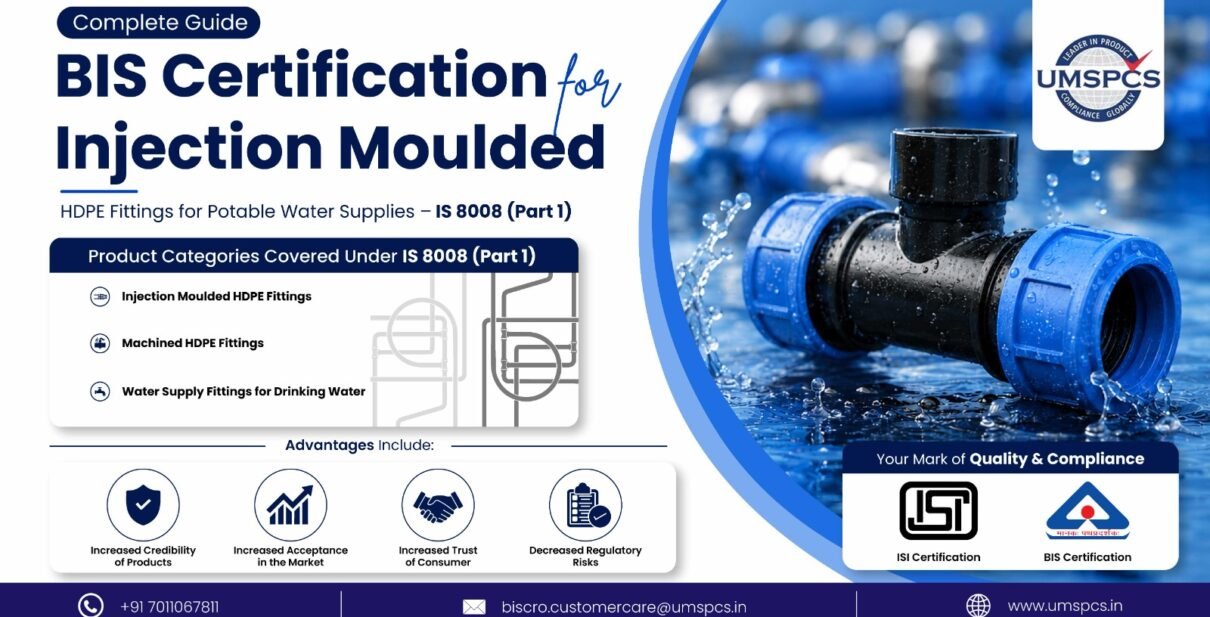
Product Categories Covered Under IS 8008 (Part 1)
HDPE fittings are important components of any water supply system. They are used to join pipes together, regulate water flow and maintain a safe pipeline system. These fittings are classified as below based on the manufacturing process and usage:
Injection Moulded HDPE Fittings
Injection moulded HDPE fittings are made by forcing molten HDPE through moulds that are designed to create the specific shape of the part. This process can be useful in manufacturing fittings of a consistent size and performance.
Common features include:
- Excellent strength and durability
- Excellent resistance to corrosion and chemicals
- The walls are smooth and provide smooth flow of water.
- Can be used for long-term potable water applications.
- Improved quality because of the moulding process.
Examples:
- Elbows
- Tees
- Reducers
- End Caps
These fittings are used throughout water distribution systems in residential, commercial and municipal applications.
Machined HDPE Fittings
Machined HDPE fittings are made by precision machining HDPE material. They are often used if a particular project needs customised dimensions or special configurations.
Key benefits include:
- Specific application custom-made designs
- High dimensional accuracy
- Appropriate for complicated pipe systems
- Good performance under various conditions of use
Examples:
- Customized Connectors
- Transition Fittings
- Special-Purpose Fittings
These fittings are frequently used for infrastructure projects where standard fittings are not suitable for the project.
Water Supply Fittings for Drinking Water
Injection moulded and machined HDPE fittings can be used in potable water supply systems and have several advantages, including:
- Leak-resistant connections
- Long service life
- Low maintenance requirements
- Safe transportation of drinking water
- Excellent performance under a range of environmental conditions.
Hence, they are widely utilised in public water supply projects, residential schemes, industrial complexes, and public infrastructure systems.
Who Should Get BIS Certification for HDPE Fittings Potable Water Supplies?
HDPE fittings might require BIS certification for several stakeholders depending on regulatory needs, customer specifications and market expectations.
The process for obtaining BIS Certification HDPE Fittings for Potable Water Supplies involves documentation review, product testing, and compliance verification.
Manufacturers
Indian manufacturers of HDPE fittings can apply for certification to show that their products comply with the relevant standards.
Importers
Importers may wish to ensure products conform to the required quality requirements to be supplied to the Indian market for HDPE fittings.
Brand Owners
Companies that sell products under their brand name may need to get certified for increased market acceptance.
Foreign Manufacturers
If export products are subject to export certification as required by regulations or requirements of the buyer, the overseas manufacturer may have to obtain such certification.
Infrastructure and Utility Suppliers
In water supply projects, companies often require certified products that meet quality standards.
Step-by-Step BIS Certification Process for HDPE Fittings Selection and Installation
There are usually several steps in the BIS Certification HDPE Fittings for Potable Water Supplies process.
Step 1 : Choose the Appropriate Indian Standard
The first step is to procure the relevant Indian Standard (IS) code for the product.
- Manufacturers need to:
- Understand product requirements
- Make products according to the BIS standards
- Improve production techniques, if necessary
Step 2: Product Testing & Documentation
Product testing should be carried out in a laboratory recognised by BIS and NABL.
At this stage:
- In this, samples of the products are studied.
- Technical documents are developed.
- Information about the factory and manufacturing is gathered.
- Completed application forms.
Step 3: Submit Your Application
The BIS application is electronic and contains an application letter, an application form (BIS) and a copy of the DHS grant letter.
Required documents:
- Test reports
- Factory Info
- Other government charges
The application, once submitted, is put under review by the BIS authority.
Step 4: BIS Factory Inspection
The BIS officials visit the manufacturing plant to check the following:
- Production process
- Production Environment
- A system of quality control is in place.
- Testing facilities
Samples of the product may be taken for independent testing during the inspection.
Step 5: Lab Report Submission & Product Testing
Samples collected are sent for analysis to authorised laboratories. The lab then sends the lab test report (LTR) directly to BIS for evaluation.
Step 6. Close Non-Conformities
BIS will identify any problems they find in their inspection or testing process and require corrective action to be taken.
- New documents will have to be provided
- Any non-conformity should be dealt with
Step 7: Payment of Licence & Marking Fees
- Once BIS has completed the certification process, the manufacturer must pay the following: Annual licence fee
- ISI marking fee
Step 8: Issuing of ISI Licence
BIS issues the ISI licence after the completion of the testing, inspection and payment process. The manufacturer can then avail of the ISI mark of certified products.
Documents Required for BIS Certification
Most of the following documents are also usually requested for a certification:
The document list may change based on the applicant’s and certification needs.
| Document | Purpose |
| Business Registration Certificate | Establishes legal identity |
| Manufacturing License | Confirms manufacturing activity |
| Factory Address Proof | Verifies production location |
| Product Specifications | Provides technical details |
| Quality Control Documents | Demonstrates quality management practices |
| Manufacturing Process Details | Explains production methodology |
| Testing Reports | Confirms product performance |
| Authorized Signatory Details | Supports application submission |
| Trademark Documents (if applicable) | Verifies brand ownership |
| Application Forms | Required for certification processing |
Cost, timeline and validity for BIS Certification
Cost may differ depending on the complexity of the product, the tests that must be carried out and the area of certification.
| Particulars | estimate cost (INR) |
| Application Fees (BIS) | ₹ 1,000 |
| Testing Charges (Lab Fees) | 15000- ₹2,50,000 |
| Factory Inspection Charges | ₹ 7,000 |
| Annual License Fees | ₹ 1,000 |
| Marking Fees (ISI Mark Usage) | As per BIS norms (based on production) |
| Consultancy Charges (UMSPCS) | ₹ 50,000 |
Compliance experts should be consulted by businesses for project-specific estimates.
Project Timeline
- Time needed: 30-40 working days
- AIF Products: As long as 180 days in some cases
Common Mistakes to Avoid while doing BIS certification
The BIS Certification for Injection-Moulded/Machined HDPE Fittings Potable Water Supplies process can cause delays for many applicants due to avoidable errors.
Incomplete Documentation
One of the most frequent causes of delays in the application process is the lack of documents.
Incorrect Product Information
Technical details must be correct to meet product specifications and test reports.
Testing Failures
If the product does not comply with performance requirements, corrective actions may be necessary and retesting may be required.
Labeling and Marking Errors
Marking may lead to compliance problems in the assessment.
Manufacturing Process Gaps
If quality control measures are lacking, this could lead to concerns over the factory evaluations.
Delayed Responses
Authorities and/or laboratories may take longer to communicate with one another.
Therefore, it is very important to be well-prepared to avoid any unnecessary delays and additional expenses.
Why go for BIS Certification with UMSPCS?
The process of getting BIS Certification includes technical documentation, testing coordination, and regulatory knowledge. It can be difficult for many companies to manage the entire process themselves.
UMSPCS offers professional support for the entire certification process.
Key advantages include the following:
- certification
- Advice on standards and certification requirements that apply
- Support for documentation review and preparation.
- The coordination with known testing laboratories.
- Support in the application process
- Compliance enquiry support
- End-to-end certification management
- Updates on certification progress are given regularly.
Also, the UMSPCS team is able to communicate effectively to the businesses what is required of certification, thus minimising the chances of delays and problems in the attainment of compliance.
Conclusion
Injection-moulded and Machined HDPE Fittings play a crucial role in potable water supply systems. Their quality is directly related to the reliability and efficiency of water distribution networks.
BIS Certification of HDPE fittings for potable water supply as per IS 8008 (Part 1) ensures the product is in compliance with the recognised quality standards as per the relevant regulation, project specification or market expectation.
Manufacturers who learn the certification process, know what to put in and maintain quality in their products will be better positioned to comply and gain credibility in the marketplace.
BIS Certification of Injection Moulded / Machined HDPE Fittings for Drinking Water Supplies?
UMSPCS offers a complete solution for BIS certification, documentation support, testing coordination and regulatory compliance guidance.
Talk to our experts today about your certification needs and make compliance easier. Get to know more about BIS CRS Certification for LED Lighting Chains IS 10322
FAQs
- What is IS 8008 (Part 1)?
IS 8008 (Part 1) covers the general requirements of injection-moulded and machined HDPE fittings for potable water supply systems.
- What is the role of BIS in HDPE fittings?
The certification is a way of showing adherence to relevant Indian quality and safety requirements.
- Who can apply for BIS certification?
Depending on the certification scheme, manufacturers, brand owners, importers and foreign manufacturers may apply.
- Do all the HDPE fittings come under IS 8008 (Part 1)?
This applies to the types of products and their intended use. The manufacturers are advised to check the requirements of the applicable standard.
- How long does the certification process take?
The timeframe will depend on the documentation preparation, testing, inspections and BIS review.
- Do products have to be tested?
Testing is usually a vital aspect of certification; it is typically performed in laboratories that are recognised.
❓ Ask a Question
Have any doubts? Fill the form below and our team will respond shortly.