Though LED lamps may appear simple in their design, several factors contribute to their suitability for the Indian market. During the manufacturing and importing processes of a product, meeting these requirements is not merely an indication of product quality, but also compliance with the Indian government’s mandatory product certification.
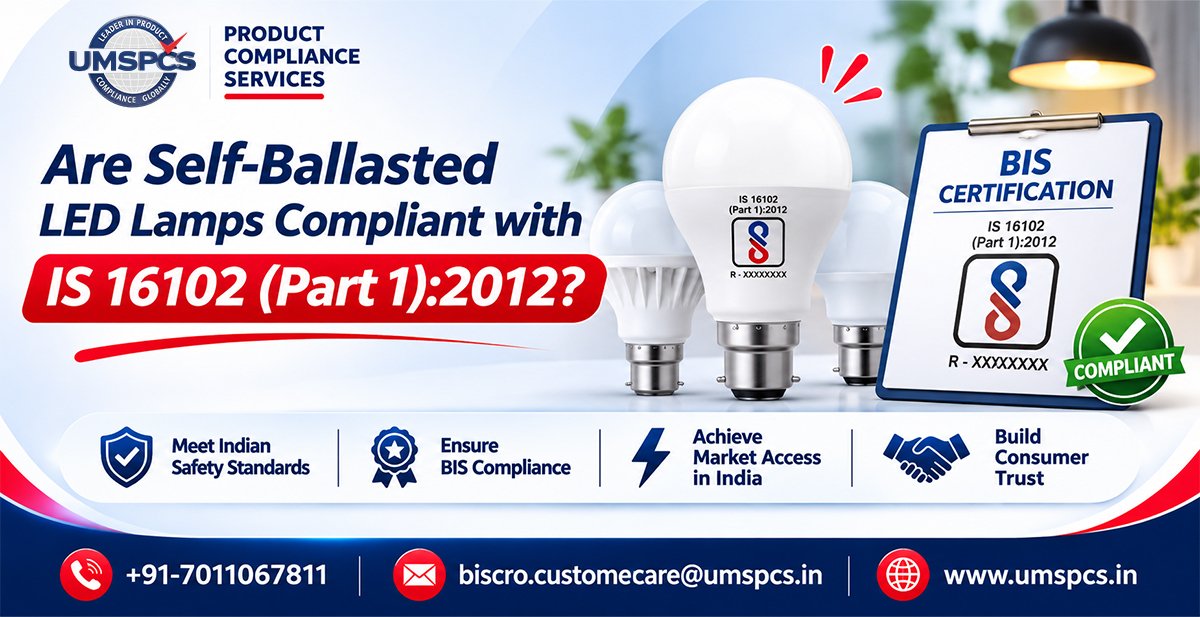
IS 16102 (Part 1):2012 covers self-ballasted LED lamps and defines safety requirements for LED lamps used in general lighting services. Per the Indian government’s Compulsory Registration Scheme (CRS), manufacturers and importers of LED lamps covered in IS 16102 (Part 1):2012 must obtain the relevant BIS registration before selling or importing the lamps to India.
But what does this standard cover? What are the testing requirements, documents, costs, and the approval process?
This blog provides information and clarifies the regulatory requirements, certification process, and legal framework for BIS Certification for Self-Ballasted LED Lamps. The information in this blog provides the necessary details to assist foreign and Indian manufacturers in complying with the legal requirements to sell their products in the Indian market.
Understanding IS 16102 (Part 1):2012: What Does the Standard Cover?
IS 16102 (Part 1):2012 was developed by the Bureau of Indian Standards (BIS) to outline safety requirements for self-ballasted LED lamps used for general lighting services.
A self-ballasted LED lamp contains LEDs and the necessary control gear within the lamp to operate the lamp from the electrical supply without requiring external control gear.
The standard is as follows:
IS 16102 (Part 1):2012 – Self-Ballasted LED Lamps for General Lighting Services, Part 1: Safety Requirements
There are two parts of this Indian Standard, and it is crucial to interpret both parts separately.
| Indian Standard | Scope | Certification status |
| IS 16102 (Part 1):2012 | Safety requirements | Mandatory under CRS |
| IS 16102 (Part 2):2012 | Performance requirements | Voluntary under the BIS product certification scheme |
Hence, it should not be confused that safety compliance as stipulated in Part 1 is equivalent to performance certification as stipulated in Part 2. BIS has clarified this interpretation in its official processing guidelines.
Important Regulatory Update: IS 16102 (Part 1):2012 Has Been Revised
Manufacturers aiming for BIS Registration must be aware of changes to the applicable Indian Standards.
BIS released the first revision of IS 16102 (Part 1):2026 on 2 February 2026, and it replaced IS 16102 (Part 1):2012.
According to the BIS implementation guidelines dated 24 February 2026, the deadline for implementation was 2 August 2026. In the extension notification dated 5 August 2026, BIS mentioned the new deadline as 2 September 2026. Therefore, manufacturers should confirm the latest deadline and the instructions concerning the change to the standard, prior to filing or amending their applications.
Some of the major changes and additions made in the first revision to IS 16102 (Part 1):2012 are as follows:
- Incorporation of LED lamps with rated input power up to 60 W.
- Addition of photobiological safety requirements.
- LED lamps with non-removable rechargeable batteries have been included in this standard.
- The requirements for abnormal operating conditions have been revised.
- Additional ingress protection requirements have been included.
- The requirements for marking photobiological safety and suitability for water contact have been revised.
- Fault-condition requirements have been revised.
- Additional testing for the axial strength of Edison caps has been included.
What Safety Parameters Are Evaluated During LED Lamp Testing?
Testing of products is an integral part of the process of BIS Certification for LED Lamps.
The Indian Standards establish safety parameters for assessing whether the lamps can operate safely under defined conditions.
The important aspects of assessment are:
- Electrical Safety
- Mechanical Strength
- Thermal Safety
- Fire & Ignition Resistance
- Construction & Marking
- Fault Conditions
The nature and extent of tests required are defined in the respective clauses of the standard.
Complete End-to-end Procedure for BIS CRS Certification
The procedure to obtain BIS Certification for India mandates that the manufacturer go through the registration process governed by the Compulsory Registration Scheme.
The details provided below are a general description of the CRS route; applicants are required to strictly adhere to the latest product-specific BIS instructions.
Step 1: Online Application and Registration
The applicant has to register on the BIS-CRS portal and obtain the login details.
Key Activities:
- Register on the BIS-CRS portal.
- Enter manufacturer details.
- Get login credentials.
- Access the portal to proceed further.
Step 2: Product Testing at a BIS-Recognized Laboratory
The applicant has to register on the BIS-CRS portal to obtain login details.
Key Activities:
- Create a test request.
- Choose a BIS-recognized laboratory.
- Hand over sample LED lamps.
- Get the laboratory test report.
Step 3: Submission of CRS Application
The applicant has to obtain the test report and submit the application along with supporting documents.
Key Activities:
- Test report: Submit the test report to BIS within 90 days of receipt, as applicable.
- Required documents: Upload required documents.
- Manufacturer and Product details: Confirm manufacturer and product details.
- Application: Complete and submit the application, and pay the fee.
Step 4: BIS Application Scrutiny
BIS officials check the application and accompanying laboratory test report to see if requirements are met.
Key Activities:
- Verify Test report: Verify the test report.
- Review documents: Review the documents.
- Reply to BIS queries: Respond to queries of BIS.
- Supply supplementary data: Supply supplementary information, if necessary.
Step 5: BIS CRS Registration
BIS provides registration to the manufacturer.
Key Activities:
- Obtain BIS CRS Registration.
- Obtain R-number.
- Use BIS Standard Mark with R-number.
- Comply with labelling and marking requirements of BIS.
Required Documents for BIS Certification for Self-Ballasted LED Lamps
Various documents are required for the BIS registration process; therefore, it is important for the applicant to provide all necessary details in the application form based on the Indian Standard (IS).
- Business Registration Certificate
- Product Specifications & Details
- Test Reports
- Trademark Certificate (if applicable)
- Authorization Letter (for authorized signatory/representative)
- AIR Documents (if applicable)
Based on the applicant’s business location and the nature of the business, the BIS may demand supplementary documents.
Cost of BIS CRS Certification for Self-Ballasted LED Lamps
BIS CRS Certification cost is product dependent. It consists of costs for test and documentation as per the relevant Indian Standard, and laboratory costs.
| Applicant Category | Total Cost (Excluding GST) |
| Indian Manufacturer | ₹55,000 + GST |
| Overseas Client | ₹90,000 + GST |
Additional costs may be incurred based on the product scope and other applicable regulations.
BIS CRS Certification Process Time in India
Generally, the BIS CRS Certification process takes 20 to 30 working days, depending on the availability of the BIS.
- Documentation: 5 to 7 working days
- Product Testing: 10 to 15 working days
- BIS Approval: 7 to 10 working days
Things can take longer due to testing delays, document issues, and BIS queries.
Validity and Renewal of BIS CRS Registration
As per the applicable BIS regulations, a BIS CRS registration is valid for 5 years. Manufacturers must renew their registration by submitting an online application at least 90 days before expiration.
UMSPCS aids in the completion of Renewal Applications, Document Update Requests, Model Additions, Product Modifications, and resolution of BIS queries.
Common Problems Faced by Manufacturers While Achieving BIS Registration
Although manufacturers may have a technically sound product, there are several problems they face while obtaining BIS registration.
Some of the problems are:
- Identifying wrong standards
- Failing tests
- Incomplete documentation
- Brand and model mix-ups
- Foreign manufacturer issues
- Revisions of standards
- Lab delays
Early compliance and planning can help resolve some of the above challenges for the manufacturers.
How UMSPCS Helps With BIS Certification of Self-Ballasted LED Lamps?
BIS Registration is a detailed process and requires identification of the correct standard by the manufacturer, preparation of technical documentation, test coordination, and completion of the registration process by the manufacturer.
UMSPCS has about 6+ years of experience with product compliance and has supported more than 600 product compliance requirements across a wide range of industries. With this experience, we have guided manufacturers through product certification requirements.
The services offered by UMSPCS include:
- Identification of Correct Standard
- Preparation of Documentation
- Coordination with Lab
- Completing Application
- Assistance with Foreign Manufacturer
- Query Resolution
- Registration and Renewal Support
- Revision of Standard
Conclusion
Finally, for self-ballasted LED lamps to be marketed in India, they must comply with the safety requirements of BIS. Though IS 16102 (Part 1):2012 was the first standard to define compliance for the same, its recent revision as IS 16102 (Part 1):2026 mandates manufacturers to re-evaluate their existing approvals and align their new applications to the recent mandates of BIS.
Whether you are an Indian manufacturer looking to manufacture self-ballasted LED lamps for the domestic market, or an overseas manufacturer looking to export self-ballasted LED lamps to India, understanding the CRS registration process would be of assistance to you in remaining compliant with the laws of India.
Seeking BIS Certification for Self-Ballasted LED Lamps?
We can help you with documentation, product testing, lab coordination, AIR requirements, and BIS registration.
Read more also: BIS ISI Certification for Iron Pipes: Manufacturers Need to Know
FAQs
- What is the mandatory requirement for BIS certification for self-ballasted LED lamps in India?
Self-ballasted LED lamps that are covered under the applicable Indian Standard require mandatory BIS CRS registration for sale in India.
- Is IS 16102 (Part 2) also mandatory?
No, Part 2 deals with performance requirements and has been voluntary under the BIS product certification scheme. The revision and certification applicability need to be reviewed separately.
- Can foreign manufacturers also apply for BIS CRS registration?
Yes, the foreign manufacturer can make an application directly through the CRS process. If they do not have an eligible office in India, they need to appoint an Authorized Indian Representative (AIR)
- Is it mandatory to do laboratory testing for BIS Registration?
Yes, the product has to be tested by a BIS-recognized laboratory for the Indian Standard concerned.
- Can we include multiple LED lamp models under a single BIS Registration?
Yes, eligible models can be covered under the same registration if the requirements are satisfied.
- What happens if an LED lamp fails the BIS laboratory test?
It is the responsibility of the manufacturer to identify the reason for failure and get the non-conforming product tested and corrected before registration.
❓ Ask a Question
Have any doubts? Fill the form below and our team will respond shortly.