- November 17, 2026
- by umspcs
- News & Updates
- 24 Views
- 0 Comments
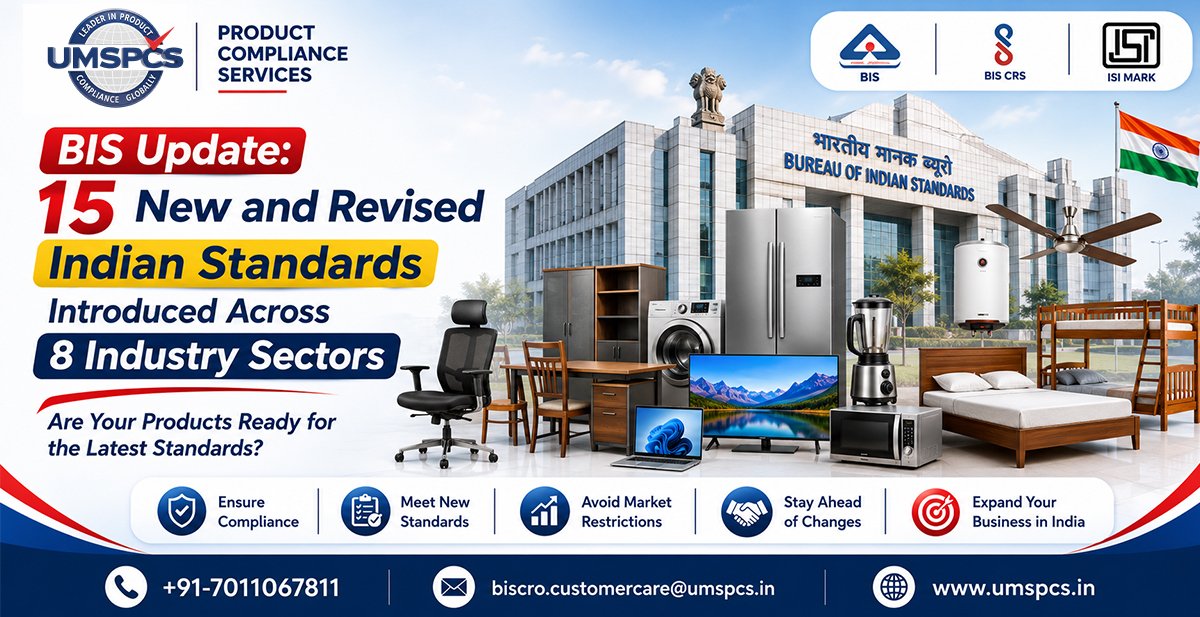
BIS Update: 15 New and Revised Indian Standards Introduced Across 8 Industry Sectors
15 New Standards Published On: 28 October, 2026 | Withdrawal of Old Standards On: 28 April, 2027
The Bureau of Indian Standards (BIS) has published 15 new and revised Indian Standards across eight industry sectors. These new Standards specify terminology, technical specifications, measurements and other relevant provisions for various industrial and commercial products.
The Standards were published by BIS on 28 October, 2026, and the notification was published in the Gazette of India on 3 November, 2026. As part of this exercise, BIS has announced the withdrawal of nine old standard versions, which will co-exist with their revised versions till 28 April, 2027.
This is of interest to manufacturers, importers, suppliers, testing laboratories, and other users who are governed by these standards, to see whether their product specifications, manufacturing practices and procedures, testing methods, and quality need to be revised.
Now, let us look at the newly published standards and their impact on various industries.
Complete List of 15 New and Revised Indian Standards
The latest BIS notification covers eight broad areas, including stationery, leather, metallurgy, textiles, agriculture, metrology, environmental meteorology, and construction.
A. Stationery and Leather Industry
IS Code | Standard Description | Revision |
IS 788:2026 | Ink, Drawing, Waterproof, Coloured – Specification | Second Revision |
IS 2954:2026 | Vegetable Tanned Leather for Belting – Specification | Second Revision |
IS 4056:2026 | Fish Oil for Leather Industry – Specification | First Revision |
Impact on Industry: This will affect manufacturers of drawing inks, tanneries, and belting material manufacturers and suppliers to the leather industry.
B. Metallurgy and Corrosion Protection
Three revised and new standards were published relating to structural weather-resistant steels and thermal spraying.
IS Code | Standard Description | Revision |
IS 5905 (Part 1):2026 | Thermal Spraying: Design Considerations and Quality Requirements for Corrosion Protection Systems | New Edition |
IS 5905 (Part 2):2026 | Thermal Spraying: Execution of Corrosion Protection Systems | New Edition |
IS 11587:2026 | Structural Weather Resistant Steels – Specification | First Revision |
The two thermal spraying standards have been developed based on ISO 2063-1:2019 (MOD) and ISO 2063-2:2017 (MOD) respectively.
The modified standards will affect the industries of steel and metals coating, as well as the fabrication industry and companies that deal with anti-corrosion measures.
C. Textile and Agriculture
Three new standards have been released in regard to textiles and agriculture, namely, horticultural coverings, the language used in irrigation, and the packaging of fertilizers.
IS Code | Standard Description | Revision |
IS 9755:2026 | HDPE/PP Woven Sacks for Packaging of Fertilizers – Specification | Seventh Revision |
IS 14178:2026 | Pressurized Irrigation Equipment – Terminology | First Revision |
IS 16202:2026 | Agro Textiles: Woven Ground Covers for Horticulture Applications – Specification | First Revision |
Industry Impact: These standards would impact HDPE and PP woven sack manufacturers, suppliers of irrigation equipment, and agricultural textile and horticulture product manufacturers.
D. Metrology and Measurement Systems
BIS has developed standards on geometrical product specifications and industrial measurement systems.
IS Code | Standard Description |
IS 15635 (Part 13):2026 | Geometrical Product Specifications (GPS): Acceptance and Reverification Tests for Coordinate Measuring Systems (CMS), Part 13 – Optical 3D CMS |
IS 18431 (Part 3):2026 | Geometrical Product Specifications (GPS): Surface Texture, Part 3 – Specification Operators |
Impact on Industry: These standards are crucial for companies involved in precision engineering, metrology laboratories, quality control, and those using advanced measurement and inspection systems.
E. Environmental Meteorology
Three standards under IS 19950 deal with some aspects of environmental meteorology using ground-based remote sensing.
IS Code | Standard Description |
IS 19950 (Part 1):2026 | Ground-Based Remote Sensing of Visual Range by Lidar |
IS 19950 (Part 2):2026 | Ground-Based Remote Sensing of Wind by Heterodyne Pulsed Doppler Lidar |
IS 19950 (Part 3):2026 | Ground-Based Remote Sensing of Wind by Continuous-Wave Doppler Lidar |
These standards are in conformance with ISO 28902-1:2012, ISO 28902-2:2017 and ISO 28902-3:2018, respectively.
Industry Impact: The revised standards benefit consistency in atmospheric monitoring systems and environmental observing systems.
F. Circular Economy in the Construction Sector
One standard has been developed to formulate a common basis for circular economy in the construction sector.
IS Code | Standard Description |
IS 19964:2026 | Circular Economy in the Construction Sector: Framework, Principles and Definitions |
Impact on Industry: This standard offers an understanding of and ability to implement the principles of a circular economy in construction-related activities.
Important Dates: When Will the Previous Standards Be Withdrawn?
Along with introducing the new and revised editions, BIS has offered a transition period for nine earlier standard versions.
The important dates are as follows:
Particulars | Date |
Establishment of new and revised standards | 28 October 2026 |
Gazette notification published | 3 November 2026 |
Withdrawal of nine earlier standard versions | 28 April 2027 |
Important Clarification: Revised standards will coexist with the earlier versions until 28 April 2027. The nine earlier versions, as specified in this notification, will be withdrawn after this date.
The withdrawal schedule does not include a withdrawal date for the six standards that do not have an earlier version specified in this notification.
What Should Manufacturers and Importers Do Now?
New and revised Indian Standards mandate businesses to assess their existing compliance. All concerned stakeholders must:
- Identify the Indian Standards that are applicable to their products.
- Understand the requirements of the Indian Standards that are applicable to their products.
- Assess their products against the requirements of the applicable Indian Standards.
- Prepare to adjust to the Indian Standards.
- Take guidance from experts to answer any questions they have.
Last-minute changes to product design to comply with Indian Standards can be costly and time-consuming.
How UMSPCS Can Help with BIS Compliance
Staying current with Indian Standards is vital to ensuring product compliance and the alignment of the manufacturing process with the applicable legal requirements.
UMSPCS has 6+ years of experience in product compliance and has worked with over 600 clients across various industries. With such experience, the team understands the applicable legal obligations of businesses and manages the product certification processes.
We help businesses:
- Identify the Indian standards and regulations applicable to their products.
- Analyze the latest specifications and requirements for products.
- Arrange for testing at laboratories certified by the Bureau of Indian Standards (BIS).
- Prepare and assess documents for BIS certification.
- Learn the methods used to achieve ISI marking and other certifications.
- Familiarize oneself with the auditing process and getting BIS certification.
Conclusion
With every new amendment to Indian standards, firms must adapt to the introduced changes concerning the certification of their products. Companies in the affected sector should investigate what standards are applicable to them, carry out audits and get ready to stop using the old editions by 28th April 2027.
Do you require information about BIS standards? Are you seeking assistance with product compliance?
Connect with us at UMSPCS for more information or to schedule a free consultation!
Read more also: BIS Announces 28 New Indian Standards - April 2027 Transition
Frequently Asked Questions (FAQs)
As of October 2026, BIS has released 15 new or revised Indian Standards in eight major industry sectors.
The latest Standards were established on 28 October 2026, and the Gazette notification was published on 3 November 2026.
Older versions will be withdrawn on 28 April 2027, according to the applicable validity period.
The latest update from BIS covers the stationery, leather, metallurgy, textile, agriculture, metrology, environmental meteorology and construction industries.
It is the responsibility of the affected industries to review the latest requirements and evaluate their product specifications and quality control systems, if any.
No, the notification indicates withdrawal of nine of the older standards. The six standards which do not have any older versions do not carry withdrawal date in the notification.
❓ Ask a Question
Have any doubts? Fill the form below and our team will respond shortly.