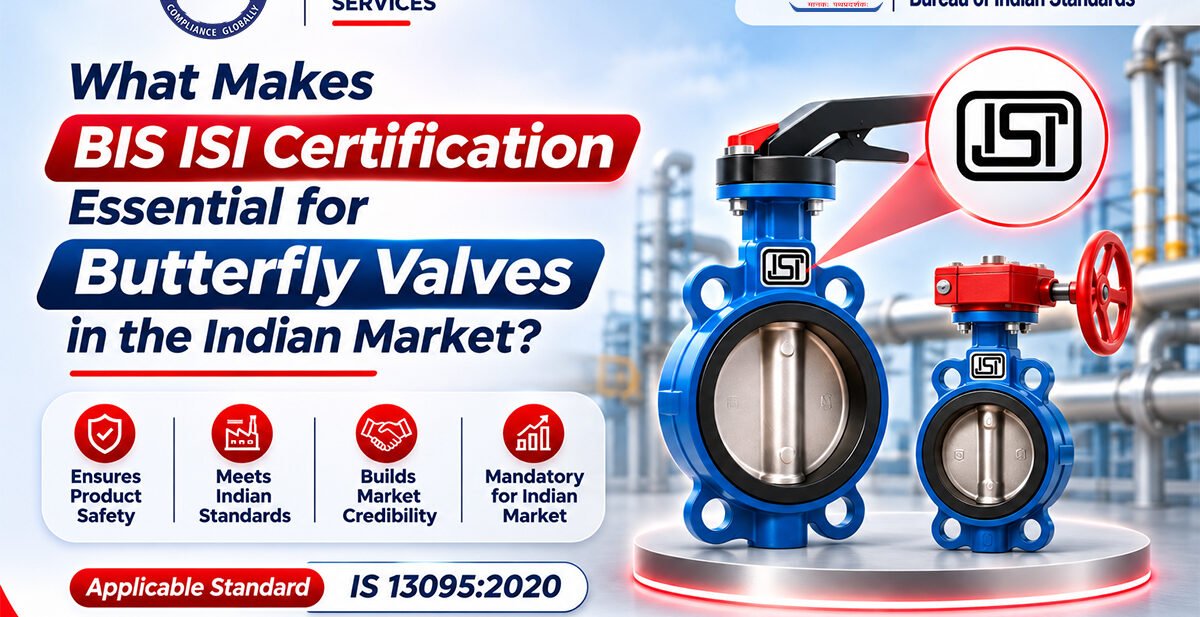
A butterfly valve may appear to be a fairly simple flow control device, but its performance can have a very direct bearing on the safety, efficiency, and reliability of the whole system. It’s a component that’s used right across the board from water distribution networks and sewage treatment plants through to chemical plants and power stations. It’s a device that’s used for the control of the flow of both liquids and gases.
However,r when these products get into the Indian market,t the manufacturer has to bear in mind far more than just the technical performance. Compliance with the relevant Indian Standards, the product quality requirements, and the regulatory obligations are all equally important.
This raises a very pertinent question: is BIS ISI certification for butterfly valves actually necessary for manufacturers who are selling in India, and what impact does it have on their ability to get into the Indian market?
To manufacture, import,t or sell butterfly valves in India, you need to have a clear understanding of the relevant Indian Standard, the certification requirements, and the Quality Control Order (QCO) provisions. This blog looks at the compliance framework, the certification process, the documentation required, the benefits and the challenges, as well as the support that is available from UMSPCS.
Why Does the Indian Market Need Quality-Assured Butterfly Valves?
Butterfly valves are used to regulate, isolate, and control the flow of fluid through a pipeline. They are a very widely used type of valve due to their compact construction, relatively simple operation, and their suitability for a wide range of pipeline applications.
Nevertheless, a badly made valve can lead to leakage, pressure-related failures, downtime, and maintenance costs.
Quality assurance is particularly important in this instance as butterfly valves may be operating under a range of pressure conditions, temperatures, and fluid types.
Some common applications include:
- Water supply and distribution.
- Sewage and Wastewater Treatment Works.
- Chemical and petrochemical industries.
- Power generation plants.
- Oil and gas pipeline systems.
- Industrial manufacturing facilities.
- HVAC and fire protection.
In this case, the technical requirements act as a means of ensuring the quality assurance of the performance of the product as well as the uniformity in manufacturing.
What Are the Technical Requirements for BIS ISI Certification?
Manufacturers need to know about the technical and administrative requirements before they make an application.
The primary requirements include:
- Applicable standard
- Manufacturing facility
- Raw materials
- Testing facilities
- Quality control
- Product identification
- BIS assessment
The BIS product manual for IS 13095 contains further guidance on sampling, product grouping, testing equipment, and the Scheme of Inspection and Testing.
Why is BIS ISI Certification Essential for Butterfly Valves?
The significance of certification goes well beyond just getting the go-ahead to sell a product. It has an impact on manufacturing as well as on customer confidence and on future business opportunities.
- Compliance with Indian regulations
- Improved product reliability
- Greater buyer confidence
- Better manufacturing discipline
- Access to regulated Indian markets
- Stronger international business positioning
How Can Companies Obtain BIS ISI Certification for Butterfly Valves?
Step 1: Identification of the Relevant Indian Standard
The first thing to do is identify the relevant Indian Standard based on the design, type, size, and pressure rating of the butterfly valve.
- Identify the relevant Indian Standard, IS 13095.
- Identify the valve type, nominal size, and pressure rating.
- All you need to do is look at the relevant technical specifications.
Step 2: Preparation of the Product and Documentation
The next thing is to present the product sample and the documentation needed for certification.
- Prepare the product specifications, the technical drawing, and manufacturing details.
- Identify the raw materials and maintain the quality control records.
- Prepare a set of representative butterfly valve samples for lab testing.
Step 3: Submission of BIS Application
The manufacturer shall submit the certification application via the BIS online portal with the requisite information and supporting documents.
- Provide company and plant details.
- State the product category and the relevant Indian Standard.
- Just upload the required documents and pay the relevant application fees.
Step 4: BIS Factory Inspection
BIS officers visit the manufacturing facility to assess the production capacity, quality control, and test facilities.
- Look at the manufacturing plant and the production processes.
- Just check that the test equipment is available and in good order.
- Review the QC procedures and the manufacturing records.
Step 5: Product Testing and Laboratory Report
Representative butterfly valve samples are subjected to the required lab tests to verify compliance with IS 13095.
- Carry out the appropriate tests for pressure, leak, dimensions, and all other specified parameters.
- Assess the valve construction, the quality of the materials, and the performance requirements.
- Just submit the lab test report to BIS for assessment.
Step 6: Closure of Non-Conformities
If any defects are found during factory inspection or product testing, the manufacturer must take corrective action.
- Fix product defects and resolve test failures.
- Improve the manufacturing processes and the quality control.
- Submit any further documentation or product samples as may be required.
Step 7: Payment of Licence and Marking Fees
Once the relevant assessment requirements have been met, the manufacturer must meet the required financial obligations.
- Pay the relevant BIS licence fee.
- Fulfil the minimum marking fee requirement.
- Clear any other relevant certification fees.
Step 8: Grant of BIS ISI Licence
Once BIS is satisfied with the application, the factory assessment, the product testing, and all other applicable requirements, it will issue the licence to use the ISI Standard Mark.
- Get approval for the specified butterfly valve category and product scope.
- Apply the ISI mark in accordance with the BIS marking guidelines.
- Maintain product quality via regular inspection, testing, and ongoing compliance requirements.
Which Documents are Required for BIS ISI Certification?
Documentation is a key part of the BIS certification process in India. Manufacturers are expected to have all the technical, business, and factory documentation in place before submission of their applications.
The commonly required documents include:
- Basic data of the manufacturing unit and the product segment
- For example, a title deed showing the ownership or a utility bill could be submitted as proof of the address of the manufacturing unit.
- Trademark registration certificate (if brand name is used and registered)
- Manufacturing licence / statutory approvals (where relevant – such as pollution
- control and industry-specific approvals)
- Product drawings/design schematics
- Installed manufacturing capacity
- List of materials used, and specifications
- Details of manufacturing machinery and equipment
- The layout plan of the factory, including production and testing areas, and storage areas
- A detailed manufacturing process flow is given
- In-house test equipment and calibration information
- Information about the quality control personnel
- Factory organisational chart
Cost of BIS ISI Certification for Butterfly Valves
The cost of getting BIS ISI certification for Butterfly Valves will vary depending on the applicable Indian Standard, the type of valve, the size, the product specification, the lab tests required, the manufacturing facilities,s and the documentation.
The following table provides an estimated cost breakdown for general planning purposes only. These are indicative figures and not the official BIS fee schedule.
| Particulars | Estimated Cost (INR) |
| BIS Application Fees | ₹1,000 |
| Laboratory Testing Charges | ₹15,000 – ₹2,50,000 |
| Factory Inspection Charges | ₹7,000 |
| Annual Licence Fees | ₹1,000 |
| ISI Marking Fees | As per BIS norms and production |
| UMSPCS Consultancy Charges | ₹50,000 |
Timeline and Validity of BIS ISI Certification for Butterfly Valves
The time taken to get BIS ISI certification on Butterfly Valves will depend on the readiness of the application, the accuracy of the documentation, the time taken for the lab testing, the time taken for the factory inspection, and the time required to deal with any observations that may be raised by BIS.
For general planning, manufacturers can consider the following estimated timeline:
| Certification Stage | Estimated Time |
| Documentation and Application | 5 – 7 working days |
| Product Testing | 10 – 15 working days |
| Factory Inspection and BIS Evaluation | 10 – 18 working days |
| Overall Estimated Timeline | 30 – 40 working days |
These are illustrative timelines and will depend on the lab schedule, BIS review, and any corrective action required.
Validity of the BIS ISI License: The license is generally valid for one to two years and can be renewed for up to five years (depending on BIS regulations, conditions in the license, and payment of the relevant fees and compliance). Read more also: BIS Certificate for Foreign Manufacture
What Problems Can Manufacturers Encounter During Certification?
Even though they have manufacturing facilities, businesses can still run into a number of problems when applying for BIS ISI certification for butterfly valves.
- Selecting the correct product scope
- Inadequate testing infrastructure
- Product testing failures
- Outdated technical documentation
- Factory inspection observations
- Foreign manufacturer coordination
Getting these issues right prior to submitting the application will go a long way to making the certification process more orderly.
How Can UMSPCS Help You to Get Your BIS ISI Certification for Butterfly Valves?
To get a BIS licence, you need to get the technical documentation right; you need to have the product tested; you need to have the manufacturing in place, and you need to get the regulatory submissions in.
With over 6 years of experience in compliance and having managed compliance for 600+ products across a range of industries, UMSPCS can help you get through the certification process in a very systematic way.
Our support includes:
- Identifying the relevant Indian Standard and QCO requirements.
- Reviewing product specs and certification scope.
- Assisting with the production of technical documentation and application preparation.
- Coordinating product testing with appropriate laboratories.
- Helping manufacturers get ready for BIS factory inspections.
- Assisting foreign manufacturers with their AIR requirements.
- Supporting manufacturers in responding to BIS queries and dealing with compliance observations.
We aim to make the certification process as simple as possible and to help manufacturers understand and meet their relevant regulatory requirements.
Conclusion
In the Indian market, BIS ISI certification for butterfly valves is not just an extra quality mark. It is a mandatory compliance requirement under the Butterfly Valves (Quality Control) Order, 2020 for products within its scope.
Conformity with IS 13095 (including the latest amendments), appropriate manufacturing arrangements,s and a valid BIS licence are all essential for any manufacturer supplying these products in India.
Whether you’re operating a manufacturing facility in India or you’re planning to export butterfly valves to India, it’s absolutely essential that you understand the certification requirements prior to market entry. That will go a long way to avoiding any regulatory headaches.
Do you plan to produce or import Butterfly Valves in India?
Contact UMSPCS for professional guidance regarding BIS ISI certification and other documentation and regulatory requirements.
Read more also: Is Your Furniture or Electricals from Nepal Ready for Indian Market
FAQs
- Is BIS ISI certification necessary for butterfly valves in India?
Yes, the general-purpose butterfly valves that fall within the scope of IS 13095 are subject to the Butterfly Valves QCO, 2020 and will become effective from 1st January 2021.
- Which Indian Standard is relevant to BIS ISI Certification of Butterfly Valves?
IS 13095:2020 (Butterfly Valves for general purposes) is the applicable IS, including the relevant amendments.
- Can manufacturers sell butterfly valves without an ISI Mark in India?
Manufacturers cannot manufacture or sell covered butterfly valves in breach of the relevant QCO. A valid BIS licence is required.
- Can foreign manufacturers obtain BIS certification for butterfly valves?
Yes, foreign manufacturers can apply under the Foreign Manufacturers Certification Scheme (FMCS) and will need to meet the relevant BIS requirements.
- Is an Authorised Indian Representative necessary for foreign manufacturers?
Foreign manufacturers applying under FMCS must nominate an eligible AIR in accordance with BIS requirements.
- Does the BIS inspect the manufacturing facility before granting certification?
Yes, BIS looks at the manufacturing infrastructure, process controls, quality arrangements, and testing capability as part of the certification process.
❓ Ask a Question
Have any doubts? Fill the form below and our team will respond shortly.