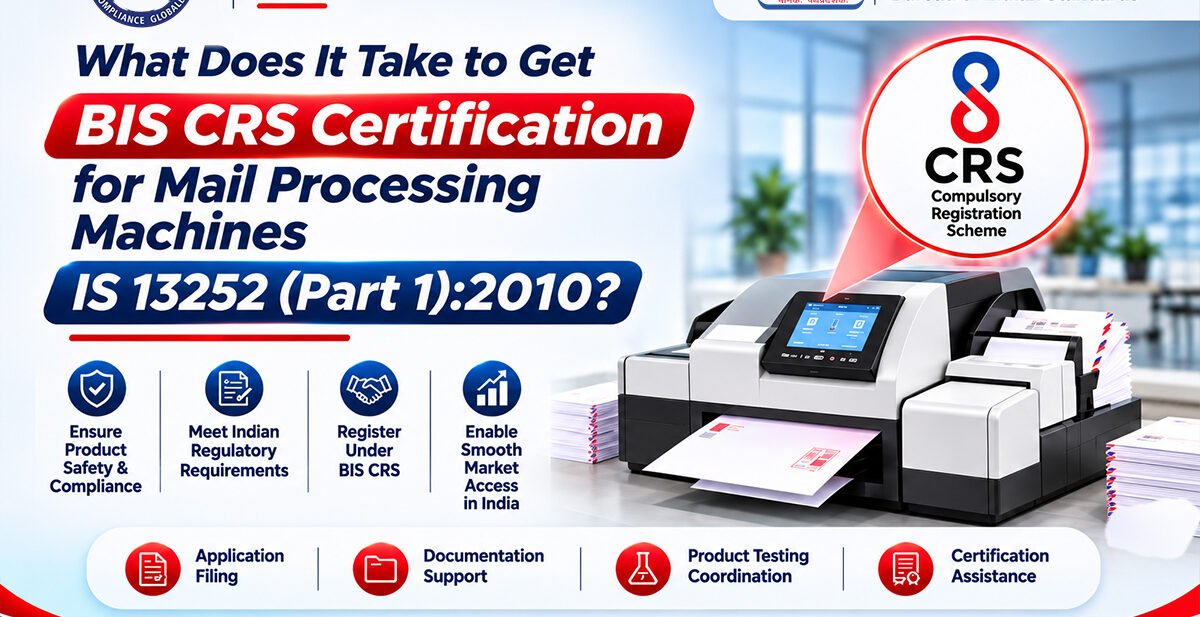
A mail processing machine may seem like a fairly specialised office machine, but prior to it being able to go on the Indian market, it will have to be properly assessed in terms of electrical safety and compliance with the relevant regulations. That applies regardless of what the machine is being used for, whether it’s for postage printing, mail sorting, franking, or whatever. Getting it to meet the Indian product safety requirements is a key part of getting onto the market.
For the manufacturers and importers, one key question is whether BIS CRS Certification for mail processing machines is mandatory and what the process is to obtain it. It is known as the Compulsory Registration Scheme (CRS) of the Bureau of Indian Standards (BIS), which applies to mail processing machines, postage machines, and franking machines in accordance with the Indian Standard.
This blog provides an insight into the certification process, testing procedure, documentation process, time schedule, the legal framework involved, and all other aspects associated with BIS CRS Certification under Indian Standard IS 13252 (Part 1):2010. It also explains how UMSPCS can help both Indian and overseas manufacturers with the process of compliance.
Why Do Mail Processing Machines Need BIS CRS Certification?
Mail processing machines are electrically operated IT equipment used in post offices, postal facilities, commercial premises, and in the logistics sector. Their function will vary according to the machine, but may include postage calculation, franking, printing, mail handling and so on.
As these machines contain electrical parts and are powered by electricity, it is essential to evaluate the safety of such devices considering the relevant requirements.
The Government of India has included mail processing machines, postage machines and franking machines within the scope of the Compulsory Registration Order from 13th May 2015.
What Exactly Does IS 13252 (Part 1):2010 Mean?
IS 13252 (Part 1):2010 is the Indian standard relating to safety requirements of Information Technology Equipment. It is based on IEC 60950-1:2005 and covers the dangers related to electrical and electronic equipment.
For mail processing machines, the standard focuses on evaluating safety aspects such as:
- Electrical safety
- Insulation requirements
- Temperature limits
- Mechanical safety
- Fire hazards
- Component safety
The precise tests and relevant clauses will of course depend on the machine’s construction, its electrical design and its configuration. The manufacturer should therefore confirm with a BIS-recognised laboratory what the applicable test requirements are.
The BIS standard database contains the 2010 edition and all of its amendments (the 2013 and 2015 amendments).
What Are the Basic Requirements for BIS CRS Registration?
Prior to commencing the BIS registration for Mail Processing Machines, the manufacturer should ensure that their product, manufacturing facility, and supporting documents are in line with the scheme requirements.
The following conditions should be considered:
- Eligible manufacturer
- Applicable product standard
- BIS-recognised laboratory testing
- Model and brand identification
- Technical compliance
- Registration before market entry
There may also be separate registration requirements applicable to different manufacturing locations and brands. The scope of registration should be appropriately reflective of the models and products being marketed.
What Documents are Required for BIS CRS Certification?
Docs are an absolutely critical part of the BIS CRS certification process. Incomplete or inconsistent docs will result in application queries and delays.
Manufacturers should generally prepare the following documents:
- Business Registration Certificate – Proof of company incorporation or legal entity
- Product Details & Specifications – Complete technical information of the product
- Test Reports – Issued by BIS-recognized labs confirming compliance
- Trademark Certificate – Proof of brand ownership (if applicable)
- Authorization Letter – For authorized signatory or representative
- AIR Documents – Mandatory for foreign manufacturers appointing an Authorized Indian Representative
How Can Manufacturers Obtain BIS CRS Certification for Mail Processing Machines?
The process of certification involves product testing, online registration, and BIS scrutiny. The following are the steps involved in getting the registration.
Step 1: Online Application Submission
Register on the official BIS CRS portal to get your login details and go ahead and register.
- Sign up on the CRS portal and enter the manufacturer’s details.
- Complete the initial registration requirements to receive your login credentials.
Step 2: Product Testing
Submit the mail processing machine for testing at a BIS-recognised laboratory to confirm compliance with IS 13252 (Part 1):2010.
- Generate a test request via the CRS portal.
- Just submit the product sample to the lab of your choice for testing.
- Get the test report upon completion of the requisite tests.
Step 3: CRS Application Submission
Once you’ve got the test report, you then submit the formal CRS registration application together with the required supporting documentation.
- Make sure the test report is submitted within the required time (normally 90 days from issue).
- Upload the requisite technical and manufacturer documentation.
- Verify the product and manufacturing details before submission of the application.
- Pay the relevant BIS registration fees.
Step 4: Review of the Application
The BIS looks at the application, the lab test report, and all the supporting documentation to check that it’s in compliance with the relevant requirements.
- Respond to any questions or requests for clarification raised by the BIS.
- Submit further information or amended documents where necessary.
- Make sure all the discrepancies are ironed out for the next stage.
Step 5: Grant of CRS Registration
Once BIS is happy with the application and compliance requirements, it will grant CRS registration for that particular product.
- The manufacturer is issued a unique BIS registration number (R-number).
- The manufacturer must ensure that the prescribed BIS Standard Mark, R number, and product labelling are all in place prior to marketing the product in India.
BIS CRS Certification Cost for Mail Processing Machines
The cost of BIS CRS Certification for Mail Processing Machines depends on several factors, including:
- Product category and applicable Indian Standard (IS 13252(Part 1):2010)
- Laboratory testing requirements.
- Number of models or product variants.
- Technical documentation requirements.
- Lab charges and relevant BIS government fees.
| Applicant Category | Indicative Cost (Excluding GST) |
| Indian Manufacturer | ₹55,000 + GST |
| Overseas Client | ₹90,000 + GST |
The final cost will, of course, vary depending on the product configuration, the testing required, the number of models, any additional compliance requirements, etc. These are indicative only and would need to be confirmed once the specific mail processing machine has been evaluated.
BIS CRS Certification for Mail Processing Machines Timeline in India
The process of BIS CRS certification for mail processing machines typically takes 20 – 30 working days, assuming there are no major delays in the documentation, sample submission, lab testing, or application assessment.
| Stage | Estimated Duration |
| Documentation | 5 – 7 working days |
| Product Testing | 10 – 15 working days |
| BIS Approval | 7 – 10 working days |
The actual timeline will of course, vary depending on lab availability, the results of the testing, the completeness of the documentation, and the time that BIS takes to review the application.
What Problems Could Delay BIS Registration?
Even if the manufacturer has a clear understanding of the basic requirements, there are still various issues which can complicate the certification process.
- Incorrect product classification
- Testing failures
- Documentation inconsistencies
- Expired test reports
- Multiple product variants
- Foreign manufacturer coordination
Early technical assessment and proper documentation will go a long way to minimising these complications.
How UMSPCS Helps You Obtain BIS CRS Certification for Mail Processing Machines
Getting BIS CRS certification for mail processing machines involves a number of technical and administrative tasks. The manufacturer may find it difficult to determine the applicable requirements, arrange for laboratory testing, put together the documentation, and respond to BIS queries.
With 6+ years of experience in compliance and having worked through 600+ product compliance requirements across a number of different industries, UMSPCS can help you get through the product certification requirements in a very systematic way.
Our support includes:
- Product Classification
- Documentation Assistance
- Laboratory Coordination
- Application Support
- AIR Assistance
- BIS Query Support
- Post-Registration Guidance
Conclusion
Obtaining the BIS Registration is one of the most important criteria that need to be met by a manufacturer intending to import mail processing machines, postage machines, and franking machines to India. Compliance with IS 13252(Part 1):2010 entails not only testing in the lab but also obtaining proper documentation, proper product classification, registration, and conformity.
For both Indian and foreign manufacturers or suppliers, it would be wise to familiarize oneself with all requirements before introducing the product into the market.
Planning to obtain BIS CRS Certification for mail processing machines?
Connect with UMSPCS for professional help with product compliance, lab coordination, documentation, and BIS registration.
Read more also: How Does BIS ISI Certification Ensure Quality of Woven Sacks
FAQs
- Is BIS CRS certification mandatory for mail processing machines in India?
Yes, mail processing machines, postage machines and franking machines are covered by the Compulsory Registration Scheme and must meet the relevant requirements prior to being sold or introduced into India.
- When was BIS CRS made mandatory for mail processing machines?
The implementation date for mail processing machines, postage machines, and franking machines under CRS was 13 May 2015.
- Can an importer apply for BIS CRS certification for mail processing machines?
No, the actual manufacturer must apply for the BIS CRS registration. An importer or distributor cannot apply for registration on behalf of the manufacturer.
- Can foreign manufacturers get BIS CRS certification in India?
Yes, foreign manufacturers can apply under CRS. Those who don’t have a liaison office or branch office in India will have to appoint an Authorised Indian Representative (AIR).
- Can more than one model of mail processing machine be covered by a single BIS registration?
Further models of the same product and brand may be included under an existing registration, subject to BIS requirements and approval. The relevant testing and documentation will need to be assessed on a model-by-model basis.
❓ Ask a Question
Have any doubts? Fill the form below and our team will respond shortly.