Though the cardiovascular device could be of very tiny dimensions and normally just a few millimetres, the regulatory obligations for it can be tremendous. Whether it is a stent, heart valve, cardiac monitor, or some other cardiovascular device, its influence on the health of the patient is enormous. That is why entering the Indian market with such a cardiovascular device cannot be done only by its production but also should include proving that the device meets all the regulatory obligations required in India.
Therefore, it is crucial for the manufacturers or importers of cardiovascular devices to be aware of the CDSCO Certification for Cardiovascular Devices before putting their product on the Indian market.
The regulatory authority of medical devices in India is the CDSCO (Central Drugs Standard Control Organisation) as per the Medical Devices Rules, 2017 (MDR 2017). Medical devices’ regulatory obligations and procedures are defined according to their risk categorization, as set out in the MDR 2017.
This blog outlines some of the most important requirements, classification, documentation, process, validity, difficulties, and the importance of a CDSCO Certification Consultant for cardiovascular devices.
Understanding CDSCO Certification for Cardiovascular Devices
The expression CDSCO certification is often used in the industry, but in practice, the appropriate regulatory approval is either a medical device license or a permission, depending on the activity performed and the device classification.
According to MDR 2017, medical devices are categorized in terms of risks as follows:
- Class A – Low Risk
- Class B – Low Moderate Risk
- Class C – Moderate High Risk
- Class D – High Risk
Depending on the class of the medical device, the appropriate regulatory authority and corresponding regulations apply. According to CDSCO, the Central Licensing Authority (CLA) regulates the import and manufacturing of all classes of medical devices and the manufacturing of Class C and Class D devices, whereas the State Licensing Authority deals with the manufacturing of Class A and Class B devices.
Thus, Cardiovascular Device Classification in India becomes one of the initial and critical steps of the approval procedure.
Why Cardiovascular Devices Need Careful Classification
It should be noted that cardiovascular products are not placed into one category. This categorization is dependent on various aspects like the purpose of the device, the period of contact, invasiveness, whether it is an implantable device, active, etc., and the risk associated with it.
The classification of cardiovascular devices is provided by CDSCO in a separate list of classifications. Such products include, but are not limited to, arrhythmia detectors, cardiac monitors, drug-eluting stents, heart valves, vascular devices, and cardiovascular prosthetics. They are categorized into different risk classes – e.g., according to CDSCO’s classification document, drug-eluting stents and heart valves are classified as Class D, whereas some of the cardiac monitors are Class B.
Thus, the only definition of a product as a “cardiovascular device” will not be sufficient.
The Legal Framework Behind CDSCO Certification in India
The main regulatory framework consists of the Medical Devices Rules, 2017, which are notified under the Drugs and Cosmetics Act, 1940. MDR 2017 sets out regulatory requirements for medical device regulation, such as import and manufacture.
These include:
- Risk-based classification
- Licensing requirements
- Quality management
- Principles of safety and performance
- Requirements for clinical investigations
- Device and Plant Master Files
- Labeling requirements
- Post-market activities
- Testing and evaluation
- Import and manufacture control
MDR 2017 also stipulates that when there is an existing Indian standard for the medical device, then the latter should conform to it. In case there is no relevant Indian standard, applicable ISO, IEC, pharmacopoeia, or validated manufacturer standards can be considered.
What Does the CDSCO Certification Process Look Like?
For cardiovascular devices, the regulatory process can be outlined in the following steps.
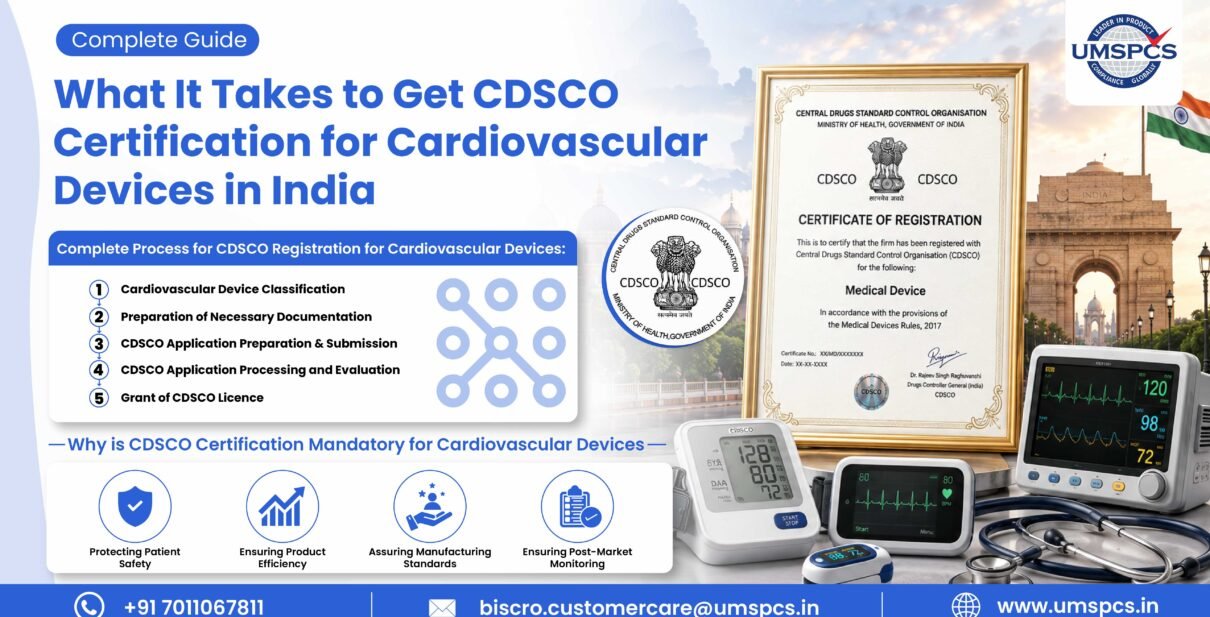
Step 1: Cardiovascular Device Classification
Establish the risk classification of the cardiovascular device under the Medical Devices Rules, 2017, based on the purpose, design, invasiveness, duration of use, and level of risk.
Considerations:
- Find the relevant risk class – Class A, B, C, or D.
- Ascertain the relevant cardiovascular device classification
- Find out the relevant regulatory and licensing authority
Ascertain the appropriate approval process depending on whether the device is manufactured or imported
Step 2: Preparation of Necessary Documentation
Prepare the necessary documents for the relevant CDSCO application.
Considerations:
- Device Master File (DMF)
- Plant Master File (PMF)
- ISO 13485 Certification, if required
- Technical specifications and test reports
- Risk management and performance-related documentation
- Product labels and Instructions for Use (IFU)
- Clinical data, if applicable
- Manufacturing site documents
Step 3: CDSCO Application Preparation
Prepare the appropriate CDSCO application with complete and accurate information concerning the cardiovascular device, the applicant, and the manufacturer.
Considerations:
- Choose and fill in the relevant CDSCO application form
- Include detailed product and intended use information
- Include manufacturer and manufacturing facility information
- Include information concerning the applicant or authorized agent, wherever applicable
- Ensure that all documents are verified prior to submission
Step 4: Online Submission of Application
Submit the filled-in application using the relevant CDSCO online portal along with the necessary documents and government fees.
Considerations:
- Upload the necessary technical and regulatory documents
- Submit the relevant application form online
- Pay the relevant government fee
- Check that the application is complete before submitting
- Keep the application acknowledgment and records
Step 5: CDSCO Application Processing and Evaluation
After submission, CDSCO evaluates the submitted application and the accompanying technical and regulatory information. Depending on the device and the relevant pathway, further evaluation or inspection may be required.
Considerations:
- Verification of the submitted documents
- Technical and regulatory evaluation
- Evaluation of test reports and supporting evidence
- Replying to queries raised by CDSCO, wherever necessary
- Facility evaluation/inspection, wherever necessary
- Submission of additional information/evidence, wherever required
Step 6: Grant of CDSCO Licence
- On successful satisfaction of the requisite requirements in regard to the same, the relevant CDSCO licence/permission is granted by the regulatory authority.
The following are some of the highlights of such a grant:
- Grant of the relevant CDSCO licence
- Permission to produce the authorized cardiovascular device
- Compliance with specifications of the approved product
- Regulatory and post-market compliance
- Maintaining records for any future regulatory requirement
- Retention of supporting records for future regulatory requirements
CDSCO Certification for Foreign Manufacturers: What Changes?
There is some additional regulatory coordination involved for manufacturers who operate outside the country.
An authorized Indian agent for a foreign manufacturer is appointed through the Power of Attorney document. CDSCO defines an authorized agent as any individual, firm, or organization that is appointed by a foreign manufacturer using a Power of Attorney for the purposes of importing medical devices into India.
The authorized agent should be eligible to conduct the activities, including being in possession of a valid wholesale license, Form MD-42 registration certificate, manufacturing license, or any other document required under the relevant framework.
The foreign manufacturer will be expected to provide the following documents, among others:
- Power of Attorney
- Free Sale Certificate Authorization, if required
- Foreign site registration for manufacturing
- Certificate of Quality Management System
- Declaration of Conformity
- Plant Master File
- Device Master File
- Labels for the product and Instructions for Use
- Regulatory approval from other countries, if available
- Audits and inspection reports, if required
These are the categories of documents that have been specifically identified in the current CDSCO import checklist.
Therefore, the certification process for foreign manufacturers at CDSCO is a document-heavy exercise.
Key Documents Required for CDSCO Certification
Even though the documents to be submitted may vary depending on the nature of the product and the application, you must be ready to submit the following:
- Form MD 40
- TR6 Challan
- Power of Attorney
- Device Master File
- Covering Letter
- Plant Master File
- Quality Assurance Certificate
- Declaration of Conformity
- Covering Letter
- Certificate of Incorporation
- Approval Documents
It is always advisable to cross-check CDSCO’s official checklist with your application.
How Long Does CDSCO Certification Take?
There is no specific time frame for all cardiovascular devices.
| Activity | Estimated Timeline |
| Product Classification | 1 – 3 Working Days |
| Documentation Preparation | 1 – 3 Weeks |
| Product Testing (if applicable) | 2 – 6 Weeks |
| Application Submission | 2 – 5 Working Days |
| CDSCO Review & Queries | Depends on Product & Risk Class |
| Grant of Licence | Subject to Regulatory Approval |
For this very reason, it is suggested that the organization does not make use of a set time frame but rather make plans depending upon the document preparation and regulatory pathway that needs to be taken.
A CDSCO Certification Consultant in India can help in identifying the gaps in documents before submission.
Common Challenges Businesses Face
Approval of cardiovascular medical devices can become hard for companies that do not appreciate the technicalities involved in the process.
Difficulties include:
- Device Misclassification
- Incompleteness of Technical Files
- Authentication of Foreign Documents
- Insufficient Clinical Evidence
- Labelling Problems
- Regulatory Changes
Benefits of Obtaining CDSCO Approval for Cardiovascular Devices
Regulatory compliance is more than just filling in documents. It assists companies in building their legal base for commercialization in India.
Benefits include:
- Accessing the market via regulatory means through the appropriate license
- Compliance with the regulatory requirements of India in terms of medical devices
- Gaining the trust of distributors and healthcare professionals
- Showing an eye towards safety and efficacy
- Assists foreign companies in accessing the Indian market via a regulatory process
- Provides a systematic approach to documentation and regulatory compliance
- Avoids any regulatory issues that could arise due to improper marketing
Why Choose UMSPCS for CDSCO Certification for Cardiovascular Devices?
The process of navigating through the rules for medical devices could become difficult when classification, technical documents, foreign manufacturers, and online applications all have to be sorted out together.
Through our 6+ years of experience and support on over 600 product compliance requirements, UMSPCS helps in making the complicated regulatory process easy for your business.
UMSPCS helps manufacturers, importers, and overseas organizations with CDSCO certification consultancy for medical devices.
UMSPCS helps in:
- Product and intended use analysis
- Classification of Cardiovascular Devices
- Determining the pathway for regulatory compliance
- Assessment of documentation gaps
- Preparation of application
- Online application assistance
- Support for regulatory queries
- Testing and regulatory compliance
- Licence-related assistance
- Post-approval compliance assistance
Conclusion
CDSCO Certification of Cardiovascular Devices in India is much more than filling out an online form. This process commences with proper identification and categorization of the product and can go to the extent of including technical documentation, quality management systems, testing, clinical data, foreign regulatory documents, authorized agent appointment, etc.
As cardiovascular devices can vary from comparatively less risky monitoring products to more risky implants like heart valves and drug-eluting stents, the respective compliance route has to be established in regard to the individual product. Cardiovascular Classification by CDSCO and MDR 2017 serves as the base for this process.
Are you looking for CDSCO Certification Consultancy?
Please contact us at UMSPCS for cardiovascular medical devices in India.
Read more also: DPIIT Notifies BIS Certification for Wrought Aluminium Utensils
FAQs
- CDSCO Licence For Cardiovascular Devices
CDSCO Approval As Per MDR 2017 For Cardiovascular Devices
- Does a CDSCO License need to be obtained for Cardiovascular Devices?
Yes, all applicable cardiovascular devices have to conform to the CDSCO standards prior to their production or import.
- How do I classify cardiovascular devices in India?
Classification of Cardiovascular devices into classes A, B, C & D based on risk factors.
- What license is needed for importing cardiovascular devices?
An import license application is submitted in Form MD-14, with the issue of Form MD-15.
- Can foreign companies apply for CDSCO certification?
Yes, applicable foreign companies can apply through the applicable process with an Indian authorized agent.
- What are the required documents for a foreign company?
The key documents required are DMF, PMF, QMS certificate, Power of Attorney, FSC/MA, Labels and IFU.
- Is a clinical study required for cardiovascular devices?
It depends upon the classification and risk profile of the cardiovascular device.
- How much time does CDSCO certification take?
Timeline depends upon device classification, document preparation, testing, and regulation.
❓ Ask a Question
Have any doubts? Fill the form below and our team will respond shortly.