
- August 11, 2026
- by umspcs
- Latest Notifications, News & Updates
- 191 Views
- 0 Comments
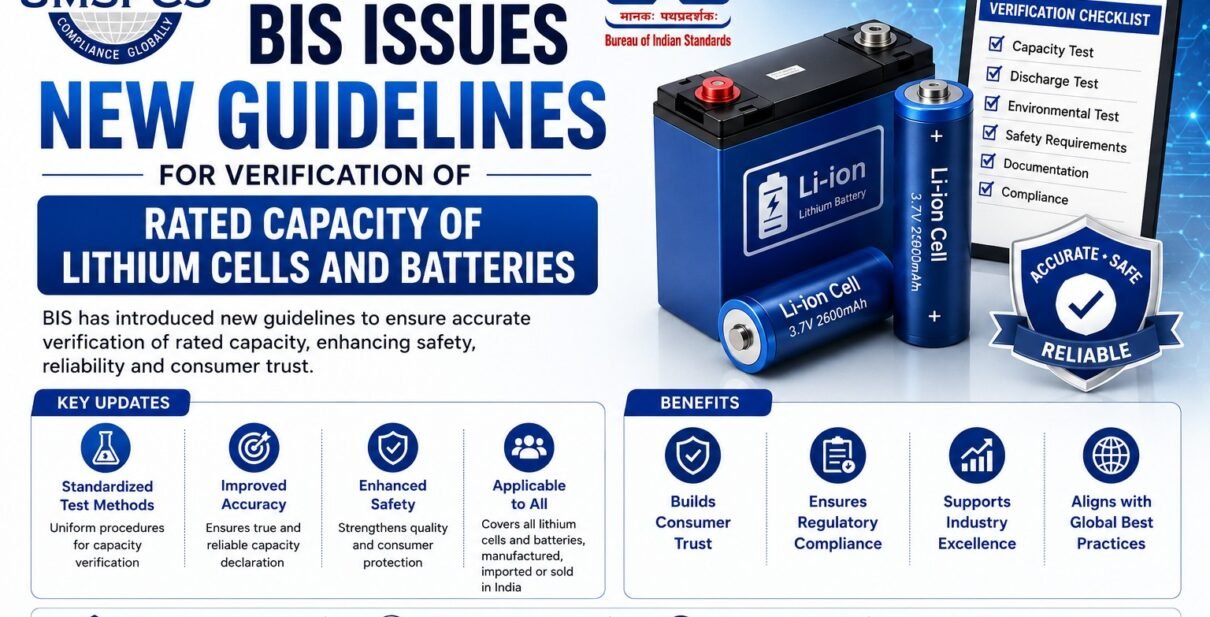
BIS Issues New Guidelines for Verification of Rated Capacity of Lithium Cells and Batteries
The capacity rating of a lithium battery is more than a figure mentioned on the product label; it is a crucial factor that affects consumer judgment of battery performance, duration of use, and appropriateness of products. What will be the appropriate measure to adopt in case of the mismatch between claimed capacity and actual capacity of the battery?
As far as the problems associated with the wrong capacity statement are concerned, the following Orders have been issued by the Ministry of Electronics and Information Technology (MeitY) on 03 February 2026 concerning testing of the rated capacity of the lithium cells and batteries in accordance with IS 16046 (Part 2):2018.
Standards for testing the rated capacity of the sealed secondary lithium cells and batteries will be developed by the Bureau of Indian Standards (BIS). This would be done with the aim of increasing the correctness of the capacity rating, product compliance, and consumer interest.
This information is essential for manufacturers, importers, and organizations with BIS CRS registration for lithium cells and batteries.
Why Has MeitY Introduced This Requirement?
The standard on lithium-ion systems IS 16046 (Part 2):2018 has been notified under the Electronics and Information Technology Goods (Requirement of Compulsory Registration) Order, 2021.
This standard mandates the declaration of the rated capacity of lithium cells and batteries. But MeitY has come across grievances and cases of mis-declaration of the rated capacity of such batteries and cells.
As per the Order, the above requirement has been made with an intent to safeguard consumer interests and that the rated capacity declared for sealed secondary lithium cells and batteries shall be measured and verified.
MeitY Order mandates that the rated capacity shall be measured through the procedure mentioned under Clause 7.3.1 of IS 16047 (Part 3) and reported as per IS 16046 (Part 2) for compliance purposes.
The above regulation intends to do the following:
- Verification of declared battery capacity based on the test result
- Supply of correct specifications to consumers
- Prevention of misleading or incorrect claims about capacity
- Greater transparency regarding compliance with applicable BIS CRS
- Verification of battery performance declarations through a testing procedure
What Is the New Rated Capacity Verification Requirement?
The rated capacity shall be determined in accordance with the testing method given in:
- Clause 7.3.1 of IS 16047 (Part 3):2018 / IEC 61960-3:2017
The test applies to discharge characteristics at 20°C - rated capacity. The measured rated capacity then needs to be reported under:
- IS 16046 (Part 2):2018 / IEC 62133-2:2017
The above clearly establishes a relationship between the measurement of capacity and the prevailing compliance process for safety of lithium cells/batteries.
The Order from the Ministry of MeitY also directs BIS to bring out an updated Test Report Format along with guidelines for implementation of the requirement.
What Does the BIS Implementation Mean for Existing Registrations?
The implementation of these requirements by manufacturers implies planning the capacity test of each model and providing relevant reports.
1. Licences Valid Until 30 April 2027
This means that manufacturers should start evaluating their registration documents, test reports, and rated capacities instead of postponing the implementation of compliance requirements until the last day.
2. Licences Valid After 30 April 2027
The MeitY Order also states that all existing licenses remain valid until their validity period, with the condition that the sample selected under the surveillance has rated capacity within the prescribed range.
Mandatory Actions for Existing Licensees
Preparedness on the part of existing manufacturers will have to take care of the following activities related to compliance:
1. Carrying out Rated Capacity Testing
2. Providing Test Reports of Applicable Third-Party Laboratories
3. Generation of Test Requests via LIMS
4. Making an Online Submission of Application
5. An undertaking for the remaining models (wherever necessary)
What About New Applicants?
The implementation requirements also outline the framework for new applicants who intend to register under the BIS CRS for lithium cells and batteries.
Considering the implementation information provided:
- Applicants whose applications have already been subjected to testing need not undergo further testing to register their applications.
- Applicants whose applications are already undergoing processing need to undertake to provide the rated capacity test report before the validity of the licence expires.
- From 01 May 2027, any licence will only be issued when accompanied by the relevant rated capacity test report.
The MeitY Order explicitly states that the aforementioned requirements will take effect from 01 May 2027 for new registrations, inclusion and renewal of registration for cells and batteries.
Key Dates Manufacturers Should Remember
| Compliance Activity | Important Date |
|---|---|
MeitY Order issued |
03 February 2026 |
Implementation guidelines |
10 February 2026 |
Compliance for existing licence valid till 30 April 2027 |
30 April 2027 |
Mandatory rated capacity reporting for new registrations |
01 May 2027 |
New requirement applicable to new registration, inclusion and renewal |
01 May 2027 |
How Will This Affect Lithium Battery Manufacturers and Importers?
- Accuracy of Rated Capacity
- Testing Requirements
- Technical Documentation
- Compliance Model-wise
- Registration/Renewal
- Surveillance Compliance
Why Is Rated Capacity Verification Important?
- Accurate product specifications
- Accurate battery performance claims
- Consumer trust
- Improved testing procedures
- Increased scrutiny of lithium battery performance claims
- Decreased possibility of misleading capacity claims
- Improved compliance assessment process
How UMSPCS Can Support Your BIS CRS Compliance
Tracking changes in BIS and MeitY requirements may prove to be difficult, especially where more than one model, test report, laboratory, and registration is concerned.
Having more than 6 years of experience handling 600+ product compliance requirements, UMSPCS will help you go through the regulatory process with a systematic approach.
The following services can be provided by UMSPCS regarding BIS CRS requirements for lithium cells and batteries:
- BIS CRS registration support
- Evaluation of product and applicable IS standard
- Arrangement of rated capacity test
- Third-party laboratory support
- Test report documentation and assessment
- LIMS-based submission support
- Support in revisions and amendments
- Applications of essential requirements
- Change-in-scope applications
- Renewal and compliance support
Conclusion
MeitY Order came into existence following cases and complaints regarding rated capacity misdeclaration. The new order mandates that the rated capacity of sealed secondary lithium cells and batteries be determined based on the test method as per Clause 7.3.1 of IS 16047 (Part 3) and declared in accordance with IS 16046 (Part 2).
For companies, the change implies increased focus on capacity verification, testing, documentation, and BIS registration procedures. Since the requirements come into effect starting from 01 May 2027 for new registration, inclusion, and renewals, it will be wise to start preparing in advance.
Need help with BIS CRS Registration or Scope Change applications?
Get in touch with UMSPCS for expert advice on your BIS registration requirements.
Frequently Asked Questions (FAQs)
The rated capacity of applicable sealed secondary lithium cells and batteries has to be validated. The test procedure has to be carried out in accordance with the specified method as per IS 16047 (Part 3).
This requirement will cover misdeclaration of the rated capacity. This requirement is intended for consumer protection.
IS 16046 (Part 2):2018 is the standard for the relevant lithium cells and batteries. The said standard is compulsory as per the Electronics and Information Technology Goods (Requirement of Compulsory Registration) Order, 2021.
Rated capacity is tested as per Clause 7.3.1 of IS 16047 (Part 3):2018. A test report is made for compliance under IS 16046 (Part 2).
The requirement will come into force from 01 May 2027 for new registrations, inclusion, and renewal.
Current licenses should conduct rated capacity testing and provide the necessary reports. They are required to fill out the appropriate BIS documents and submit the application.
Yes, change-in-scope applications will have to adhere to the rules applicable to new licensees. Businesses should keep in mind that rated capacity testing is mandatory in this case.
❓ Ask a Question
Have any doubts? Fill the form below and our team will respond shortly.