The telecom industry in India is regulated to ensure that communication equipment is safe, performs well, and is compatible with the telecom network. For this purpose, the Department of Telecommunications launched the Mandatory Testing and Certification of Telecom Equipment scheme. In this scheme, all products of the telecom sector will be required to meet the prescribed essential requirements by the Telecommunication Engineering Center before being sold or deployed in the country.
CLIP Phones are included in the products included in MTCTE Phase I. The compulsory certification for such products came into effect from 1st October 2019, and any manufacturers/importers supplying CLIP phones to the Indian market will be required to comply with the process.
For businesses involved in manufacturing, importing, or supplying CLIP phones, it is essential to be familiar with the MTCTE framework to ensure compliance with regulations and maintain uninterrupted market access. This blog is intended to introduce CLIP Phone MTCTE certification in India, its applicability, its importance, and what businesses need to be aware of before launching their products in India. In an organized way, UMSPCS assists both foreign and Indian manufacturers in obtaining BIS certification.
What is a CLIP Phone?
A CLIP (Calling Line Identification Presentation) phone is a telephone that, if the telecom network supports the CLIP service, shows the telephone number of the caller before it is answered. Depending on the network infrastructure, either Frequency Shift Keying (FSK) or Dual Tone Multi-Frequency (DTMF) is used to send the caller information.
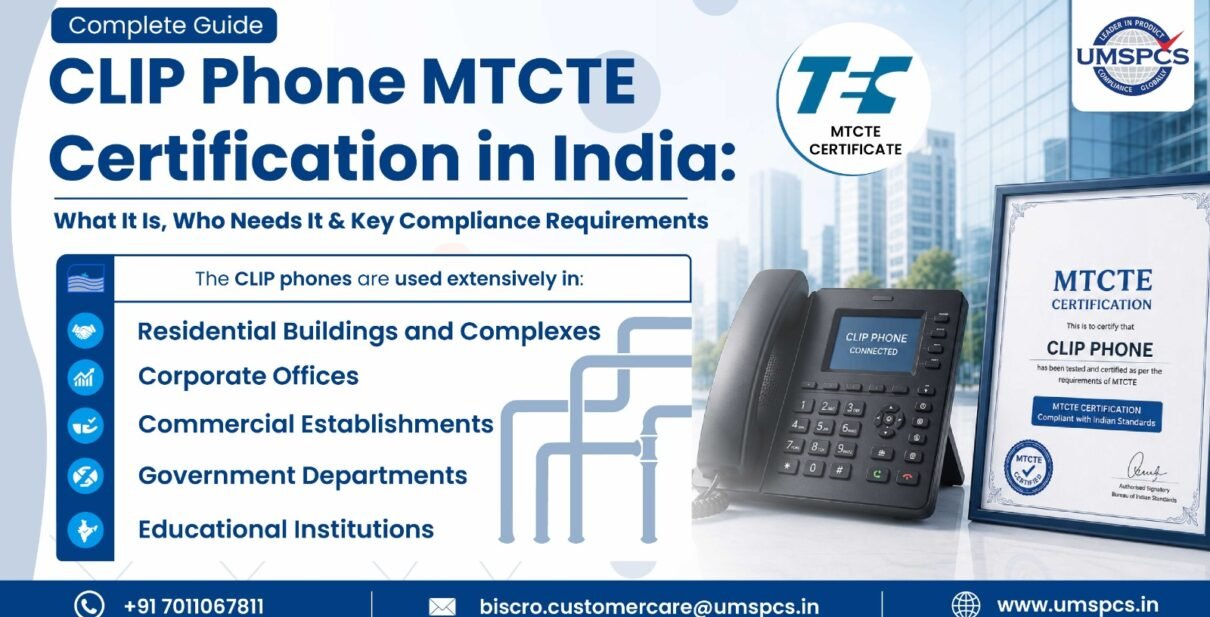
The CLIP phones are used extensively:
- Residential buildings and complexes
- Corporate offices
- Commercial establishments
- Government departments
- Educational institutions
- Hotels and health care providers
These phones ensure the communication is more efficient by giving the caller identity before a call is answered, helping the user to recognize the incoming call.
What Is MTCTE Certification?
The Mandatory Testing and Certification of Telecom Equipment (MTCTE) is a regulation under the control of the Department of Telecommunications. It aims to make sure that any telecom equipment introduced to the Indian market meets the relevant technical, safety, electromagnetic compatibility (EMC), and other notified requirements.
The Telecommunication Engineering Center makes the development and notification of the essential requirements for different classes of telecom equipment. These requirements must be satisfied to certify products under MTCTE.
The framework ensures that telecom equipment used in connection with communication networks in India is of quality, reliable, and interoperable.
Who Should Get the CLIP Phone MTCTE Certification?
Normally, the placement party is responsible for complying with MTCTE requirements.
This may include:
- Indian manufacturers
- Foreign manufacturers exporting to India
- Importers
- Brand owners
- Authorised Indian Representatives (AIR) as applicable
Businesses need to establish whether the introduction of a CLIP phone falls under the applicability of the MTCTE notification and which MTCTE essential requirement is to be considered.
When Did CLIP Phone Certification Become Mandatory?
CLIP phones have been covered by MTCTE Phase I, and the compulsory certification has been in effect since 1 October 2019.
This implies that applicable products should meet the pertinent essential requirements prior to marketing, importation, or deployment in India. With that in mind, businesses intending to introduce new products should take regulatory compliance into account while developing their products, rather than after the products are manufactured.
Why Is CLIP Phone Included Under MTCTE Phase I?
CLIP Phones are unlike numerous consumer electronic products, as they are connected directly to the Public Switched Telephone Network (PSTN). These devices have to communicate with India’s telecom network infrastructure and therefore need to be reliable, with no impact on the network or user safety.
With its inclusion in the MTCTE Phase I, consistent technical standards are set in the industry. It also provides a mechanism for ensuring that products notified achieve TEC’s essential requirements prior to being put on the market.
This provides a clear regulatory environment and helps to ensure the quality and reliability of telecom equipment in use throughout India for manufacturers and importers.
What Are the Key Essential Requirements for CLIP Phones?
In order to be granted the MTCTE certification, the CLIP phones have to meet the relevant essential requirements (ERs) published by the Telecommunication Engineering Centre (TEC). These requirements set the technological standards to ensure that the telecom equipment sold in India is fit for purpose.
For CLIP phones, the evaluation generally focuses on:
- Functional Performance: The phone must reliably execute its communication functions and be able to provide accurate caller identification when provided by the telecom network (if available).
- Electricity Safety: The equipment must work as intended and safely by minimizing the hazards related to electrical failures.
- Electromagnetic Compatibility (EMC): In the presence of electromagnetic interference from the outside world, the product must work correctly without causing electromagnetic interference that could be dangerous.
- Call Identification Functionality: According to the way of signaling that is used in the telecommunications network through which the phone works, either FSK or DTMF, the phone will be able to identify the call.
- Network Interface Compatibility: The equipment must be compatible with the respective public telephone network and must meet the respective technical interface specifications mentioned by the TEC.
It is always important to confirm the applicable essential requirement with the most recent TEC notification since the requirements can change over time.
Why Does MTCTE Certification Matter for Businesses?
MTCTE certification for manufacturers and importers is more than just a regulatory requirement. It shows the product has been tested in accordance with India’s telecoms standards before it hit the market.
Including some of the following key benefits:
Supports Regulatory Compliance
Products under the ambit of MTCTE are expected to meet the relevant essential requirements before they are marketed or put into use in India. Businesses can help to meet these regulatory expectations through certification.
Strengthens Product Reliability
Compliant with technical requirements, this enhances the product performance and compatibility with India’s telecom infrastructure.
Builds Market Confidence
Products that meet recognized regulatory requirements are often preferred by distributors, institutional buyers, and commercial customers. Certification is a sign of a product’s quality and compliance.
Minimizes Obstacles to Market Entry
Early certification planning can help companies reduce the time it takes for product launches and regulatory approvals.
Most common compliance issues Businesses Need to Understand
A number of compliance problems occur due to starting regulatory planning too late in the life of the product. Knowing the common issues can aid businesses in preparing better.
Some of the most frequent problems are the following:
- Confusing the correct category for telecom equipment.
- Citing old regulatory notices.
- Lags in grasping the appropriate essential requirement.
- Inadequate technical information at the time of compliance planning.
- Delaying the decision on certification until after the product has been introduced to the market.
Compliance obligations can be identified early through the review process, leading to lower risk of compliance delays and greater overall regulatory readiness.
Why Choose UMSPCS for CLIP Phone MTCTE Certification?
India’s telecom sector has strict regulations, which can be confusing for businesses looking to bring new products to market. UMSPCS can help manufacturers, importers, and brand owners with practical assistance in the MTCTE certification journey.
With six years of experience in this field, the specialist has assisted manufacturers by offering easy-to-use certificates. Additionally, it has successfully completed more than 600+ certificates.
Our support includes:
- Product applicability assessment.
- Defining the appropriate essential requirement.
- Documentation guidance.
- Coordinating with recognized test laboratories.
- MTCTE application support.
- Regulatory query assistance.
- End-to-end compliance guidance.
We want to provide businesses with an understanding of the regulatory requirements and guide them through the certification process with more clarity and confidence. Also get to know more information about MTCTE Certification for Multipoint Conferencing Server in India.
Conclusion
Compliance with the relevant TEC essential requirements is a critical factor for businesses that are providing CLIP phones in India under MTCTE Phase I.
The MTCTE framework is important for any Indian manufacturer, overseas manufacturer exporting to India, or importer introducing telecom equipment into the market because it allows them to have a head start in meeting regulatory compliance requirements before commercial deployment.
Businesses should consider, at an early stage, whether a product can be certified, the associated essential requirements, and the activities required for compliance. This will enable easy entry into the market, help mitigate the regulatory risks, and ensure that the products are compliant with the standards expected in the Indian telecom ecosystem.
For businesses needing guidance on CLIP Phone MTCTE certification in India, UMSPCS offers end-to-end regulatory assistance to ensure compliance with the necessary regulations in an efficient manner.
Read more also: MTCTE Essential Requirements (ER) List
FAQs
- What is a CLIP Phone?
A CLIP (Calling Line Identification Presentation) A phone is a telephone that prints the number of the calling party before the handset picks up the call when the telecom network has the CLIP service enabled.
- Do the CLIP Phones need to be certified by MTCTE for sale in India?
Yes. CLIP phones are covered by MTCTE Phase I, and certification was made mandatory from 1 October 2019 for notified products.
- Which body oversees MTCTE certification?
The Department of Telecommunications (DoT) oversees the MTCTE framework, and the Telecommunication Engineering Center establishes the fundamental specifications for the notified telecommunication equipment.
- What are Essential Requirements (ERs)?
Essential requirements are technical specifications that are notified by TEC that telecom equipment must meet to meet the MTCTE framework.
- Do CLIP phones need to be certified by MTCTE?
Those who place notified CLIP phones on the Indian market, whether Indian manufacturers or foreign manufacturers exporting to India, importers, brand owners, etc., should decide whether their products are subject to certification.
- Does MTCTE certification apply to imported CLIP phones?
Yes. Any imported products covered under MTCTE are also expected to meet the applicable regulatory requirements before they are introduced to the Indian market.
- Why is it important to start compliance planning at an early stage?
Planning in advance enables companies to be aware of their regulatory obligations, complete all technical documentation, and reduce delays when introducing products.
- What can UMSPCS do to help with MTCTE certification?
UMSPCS supports product applicability assessment, documentation guidance, testing coordination, application assistance, and regulatory compliance support for telecom equipment.
❓ Ask a Question
Have any doubts? Fill the form below and our team will respond shortly.