Suppose you have a product ready for launch, have rolled out your marketing campaigns, and have the first shipment all packed. However, it cannot be sold in India?
Surprisingly enough, such a scenario is much more common than many manufacturing companies expect. If your product is subject to any mandatory Quality Control Order (QCO) or government notification, then you cannot manufacture, import or sell it without getting the necessary BIS ISI Certification for Indian Manufacturers.
The ISI mark is not just another symbol you may see on your product. Obtained from the Bureau of Indian Standards (BIS), the mark shows that your product is in line with the relevant Indian Standard and meets the quality, safety, and performance criteria stipulated in it. Although BIS ISI Certification in India is optional for most products, it becomes mandatory for those notified products that are covered by QCOs.
Both if you are a newcomer to the market or an experienced company that is extending its range of products, it is important to know how the BIS certification process works. The blog of UMSPCS will provide you with all information you need about BIS ISI Certification for Indian Manufacturers.
What is BIS ISI Certification for Indian Manufacturers?
It refers to a license issued through the relevant BIS conformity assessment scheme enabling a manufacturer to mark his products with the BIS Standard Mark, which is popularly referred to as ISI Mark.
The certificate guarantees that the product has been produced according to the relevant Indian Standard and the production facilities of the manufacturing unit have the capability to produce in conformity on a sustained basis.
The ISI Mark is normally linked to product certification under BIS Scheme-I. However, certification requirements will vary based on the product classification and conformity assessment scheme applicable.
The BIS Standard Mark provides an assurance of product conformity, quality, safety, and reliability.
Why Do Indian Manufacturers Need BIS ISI Certification?
BIS certification is not compulsory for all the products manufactured in India. Nevertheless, the Government of India makes certification mandatory for certain products through the issuance of Quality Control Orders (QCOs).
In case your product falls under any QCO, it is essential for you to adhere to the IS prescribed for the same and obtain BIS ISI License prior to manufacturing in the Indian market.
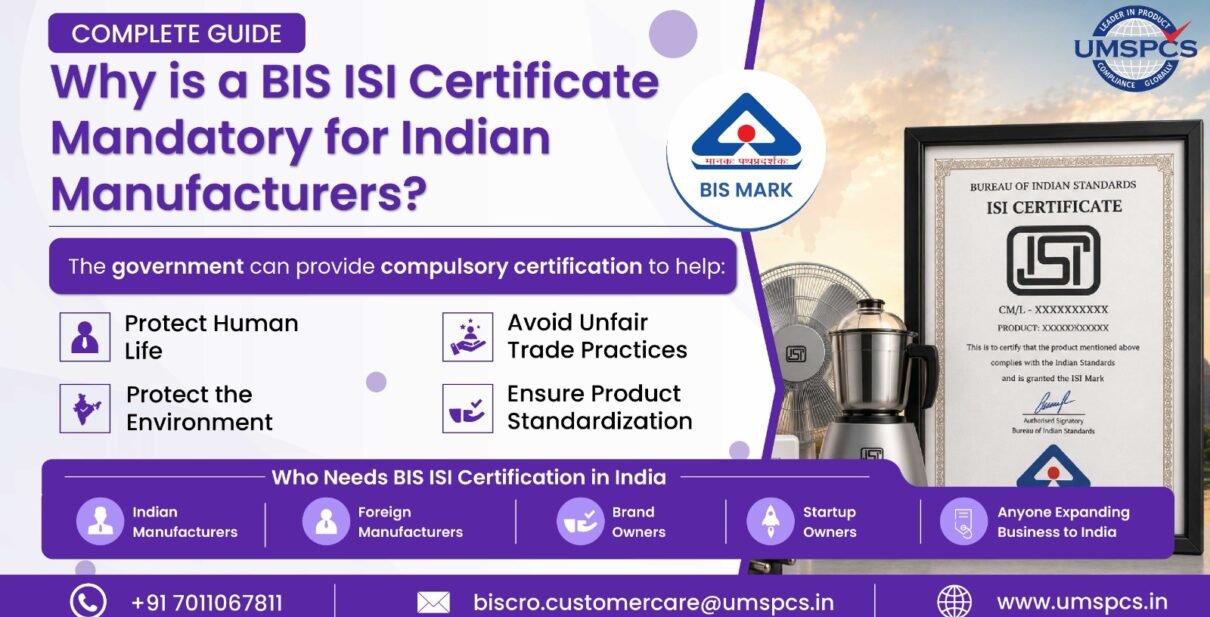
Mandatory BIS certification is made by the Government to:
- Protect consumers and maintain product quality
- Maintain human and environmental safety
- Avoid unfair trade practices
- Ensure product standardization
- Maintain national security and public interest
Although BIS certification is optional in most cases, it becomes mandatory for certain products notified by the Central Government through the relevant QCOs.
Legal Requirements for BIS ISI Certification in India
The legal rules governing BIS Certification for Indian Manufacturers are mainly governed by the Bureau of Indian Standards Act, 2016, along with other applicable regulations, conformity assessment regulations, Quality Control Orders, and specific products’ guidelines.
BIS Act lays down the legal regime for standardisation, conformity assessment and use of standard marks in India. The conformity assessment regulations of BIS lay down the procedures and requirements for certification schemes, licensing, inspection, surveillance, renewal, and compliance.
In case of regulated products, the applicable QCO usually sets out the appropriate Indian standard along with the requirement that the product should carry the Standard Mark under the valid BIS certificate.
Who Needs BIS ISI Certification in India?
The ISI license would be necessary for a manufacturer if:
- The item falls within the mandatory QCO or Compulsory Certification requirement
- The certification system involved requires a BIS License
- The item needs to conform to a particular Indian Standard prior to its sales
- The manufacturer wants to put the BIS Standard Mark voluntarily based on eligibility criteria
- The item is being sold to consumers, governmental agencies, or projects which require BIS compliance
Items falling under compulsory certification could include but not limited to cement, steel, electrical products, household items, building material, auto parts, chemicals, safety equipment and other regulated items.
Manufacturers would need to ascertain whether their product is covered under Compulsory Certification or will soon be covered under QCO.
Key Benefits of Obtaining BIS ISI Certification in India
Prior to applying for a BIS ISI Certificate for Indian Manufacturers, the manufacturer is expected to be ready to show that he complies with the appropriate Indian standard.
The important things would include:
- Identification of the Appropriate Indian Standard
- Proper Manufacturing Facility
- Testing and Quality Control Facility
- Product Testing
- Quality Control System
- BIS Inspection and Verification
Step-by-Step BIS ISI Certification Process for Indian Manufacturers
The certification process may differ depending on the product and certification schemes but the process generally involves the following steps:
Step 1: Identification of the Applicable Indian Standard (IS code)
This step involves identification of the right Indian standard (IS code) applicable to the product.
This step will involve:
- Identifying the right IS code applicable to the product.
- Making sure that the product is made according to the requirements of the Bureau of Indian Standards (BIS).
- Adapting manufacturing processes if need be to adhere to the standard.
Step 2: Product Testing and Documentation
This step involves testing of the product in the laboratory recognised by BIS and accredited by NABL.
This step involves:
- Testing of the product according to the IS standard applicable
- Preparation of technical and product documents
- Manufacturing details
- Filling the right application form
Step 3: Submission of the Application
Once the above process has been completed, the BIS application can then be submitted using the online portal.
The application generally includes the following:
- BIS application and cover letter
- Product test reports
- Factory and manufacturing details
- Government fees
Once submitted, the application is reviewed by BIS officials.
Step 4: BIS Factory Inspection
Inspection of the manufacturing plant by BIS officers to validate the following:
- Processes of manufacture
- Production facilities
- Quality systems
- Testing facilities within the plant
Samples of products may also be drawn during inspection for independent testing.
Step 5: Testing of Product Samples
Samples of products are tested in an approved laboratory. After testing, the Laboratory Test Report (LTR) is forwarded to BIS for technical verification.
Step 6: Closure of Non-Conformities
In the event that any nonconformities are discovered during the inspection or test process, then the manufacturer must:
- Implement necessary corrective actions
- Supply new documentation or further information when required
- Clear all observations prior to certification process
Step 7: Payment of Licence & Marking Fees
After the satisfaction of BIS about the compliance requirements, the manufacturer will have to make the following payments:
- Annual licence fees
- ISI marking fees
Step 8: Grant of BIS ISI Licence
After completion of all processes of testing, inspection, document verification and payment of fees, BIS issues the ISI Licence. The manufacturer can then use ISI Mark on the products under the terms of the licence.
Documents Required for BIS ISI Certification in India
The document requirement will differ from product to product and from one certification scheme to another. Documents which may generally be required are as follows:
- Basic data of the manufacturing unit and of the product sector
- Evidence of manufacturing unit location (certificate of ownership/lease, utility bill etc.)
- Registration certificate for trademark (in case the brand name is used and registered)
- Manufacturing licence/statutory approvals (in case applicable – pollution control approval and other industry specific approvals)
- Product Design Layout
- Capacity of the manufacturing unit
- Material list along with the specification
- Details of manufacturing machinery and equipment
- Layout plan of the factory including areas for production, testing and storage
- Flow diagram of the manufacturing process is provided
- Details of test equipment in house and calibration details
- Details of quality control team members
- Organisation chart of the factory
Incomplete or inconsistent documentation may result in additional queries and delays. Therefore, documents should be reviewed carefully before submission.
Key Benefits of Obtaining BIS ISI Certification in India
Besides complying with the regulatory obligations, obtaining the BIS ISI certification in India also offers other advantages.
- Market Entry Through Lawful Means
- Increased Consumer Trust
- Greater Product Uniformity
- Competitive Advantage in the Market
- Lower Risk of Compliance Issues
BIS ISI Certification Cost and Timeline in India
The fee for BIS ISI certification varies according to:
- Product category
- Testing requirements
- Factory size
- Documentation complexity
| Particulars | Estimated Cost (INR) |
| Application Fees (BIS) | ₹1,000 |
| Testing Charges (Lab Fees) | ₹15000 – ₹2,50,000 |
| Factory Inspection Charges | ₹7000 |
| Annual License Fees | ₹1,000 |
| Marking Fees (ISI Mark Usage) | As per BIS norms (based on production) |
| Consultancy Charges (UMSPCS) | ₹ 50000 |
This is based on many considerations, such as:
- Duration of time involved: 30 – 40 working days
- AIF Products: 180 days, in some cases
Manufacturers must initiate the process of certification long before the deadline of compliance or market entry.
Common Challenges During the BIS ISI Certification Process
Most manufacturing companies face delays as a result of the BIS process which involves product conformity and manufacturing system readiness.
Some of the common problems faced are:
- Wrong IS code identification
- Poor product definition or variation description
- Inadequacy of internal testing facilities
- Lack of calibration documentation
- Lack of quality control documentation
- Failures during product testing
- Misalignment between application information and factory information
- Unpreparedness for BIS inspection
- Lagging in response to technical questions
Even a small mistake in the classification of the product and preparation of testing could cause further testing, action, costs, or license approval delay.
Why Choose UMSPCS as Your BIS ISI Certification Consultant?
BIS certification is not just about filling the application form. The manufacturer needs to know the applicable Indian Standard, prepare the factory, arrange for testing, document, and meet the regulations.
UMSPCS, with 6+ years of experience and 600+ successful product compliances, helps the manufacturer in getting the BIS Certification through structured guidance and specific-product focus.
UMSPCS offers end-to-end guidance for BIS ISI Certification for Indian Manufacturers, which includes:
- Product Profiling and identification of applicable IS Code
- Regulation Applicability Study
- Review of Product & Factory Readiness
- Arrangement for Testing & Compliance
- Documentation Preparation
- Application for BIS
- Preparation for Factory Inspection
- Query Resolution & Corrective Actions
- Grant of Licence & Post Certification Guidance
- Renewal & Scope Extension
Read more about BIS Certificate for Foreign Manufacture
Conclusion
A BIS ISI Certificate for Indian Manufacturers is a necessity when the item is subject to mandatory BIS certification requirements. It assists in fulfilling legal requirements, ensuring conformity to Indian Standards, establishing credibility of the product, and gaining consumer trust.
The success of the certification process depends on proper IS code identification, correct product testing, readiness of the production facility, proper documentation, and efficient management of compliance.
UMSPCS can assist you in identifying the right requirements for your product and guide you through the entire process of obtaining the certification in case you wish to manufacture, introduce, or distribute a product in India.
Contact UMSPCS now for professional assistance in obtaining BIS ISI Certification in India.
Read more also: Get BIS ISI Certification Consultant in Jharkhand: Complete Guide
FAQs
- Is BIS ISI certificate compulsory for all Indian manufactures?
No, it is only compulsory for products subject to QCOs or other compulsory BIS rules.
- How can I find out whether my product requires BIS ISI Certification?
You can determine the applicability from the IS code and the mandatory BIS requirement of the product. UMSPCS can help you decide on this.
- What is the difference between BIS certification and ISI certificate?
The ISI Mark is granted under BIS Scheme-I to eligible products while BIS certification refers to many conformity assessment schemes.
- What is the time taken for BIS ISI Certification in India?
It may vary according to the testing period, documentation, factory inspection, and BIS approval.
- Is an in-house laboratory compulsory for BIS ISI Certification?
Depends upon the Indian standard and BIS rules applicable to the product.
- What would happen if the mandatory BIS certified product is sold without licence?
Regulatory action would be taken against the company for the offence and selling the product.
- What documentation is necessary for a BIS ISI Certificate?
Generally, a company’s document, factory data, product specification, test report, quality control data, etc. are some of the necessary documents.
❓ Ask a Question
Have any doubts? Fill the form below and our team will respond shortly.