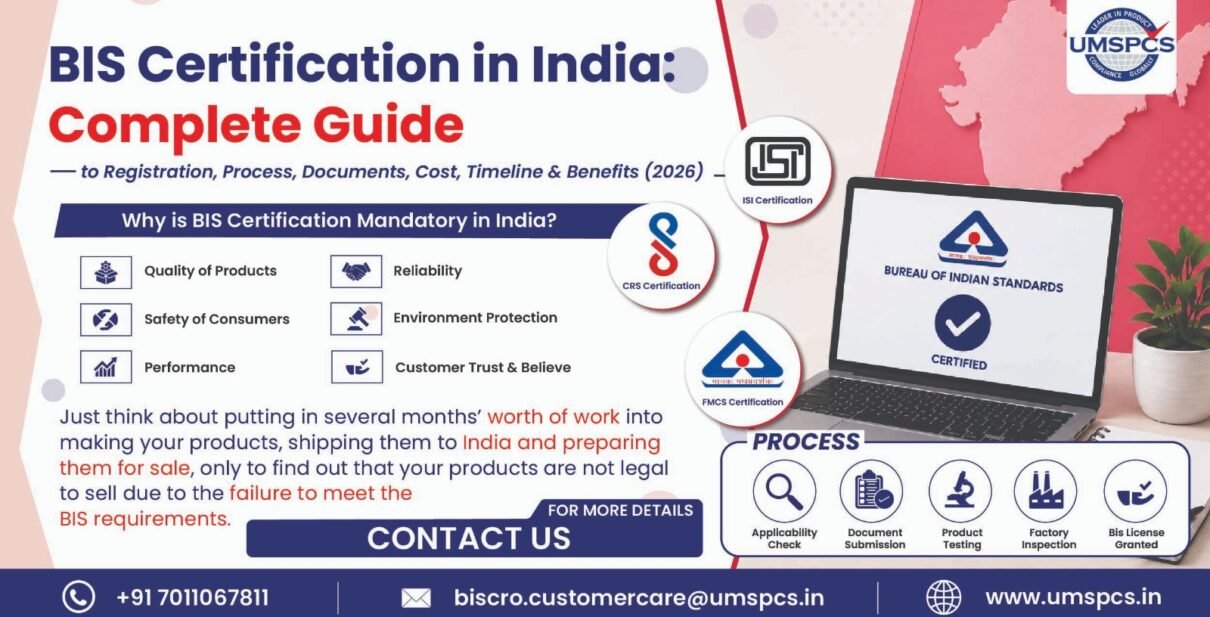
Just think about putting in several months’ worth of work into making your products, shipping them to India and preparing them for sale, only to find out that your products are not legal to sell due to the failure to meet the BIS requirements.
It is the kind of situation which many manufacturers, importers and brand owners have to face on an annual basis. Given that the Government of India continues to add to its mandatory quality requirements through different QCOs and CRS, BIS Certification in India has never been more important than today.
Regardless of whether you produce electronics, electrical appliances, steel products, cement, chemicals, toys, household appliances or industrial products, you should be aware of the BIS Certification Process to avoid any complications while selling in the Indian market.
In the blog post, UMSPCS will help you understand everything about BIS Certification in India, starting from eligibility to applicable products, testing, documentation, registration, costs and timelines, and many more.
What is BIS Certification in India?
BIS Certification in India is a conformity assessment system managed by the Bureau of Indian Standards (BIS), the National Standards Body of India operating under the Ministry of Consumer Affairs, Food & Public Distribution, Government of India.
The main aim of this certification system is to assure the compliance of products marketed in India with the established Indian Standards (IS) in regard to:
- Quality of products
- Safety of consumers
- Performance
- Reliability
- Environment protection
Depending on the type of product, the manufacturer should obtain any one of the BIS certification schemes before marketing their products in India.
In case of products falling within the purview of Quality Control Orders (QCOs), a BIS Certificate is a mandatory requirement rather than an option for a quality label.
Types of BIS Certification Schemes in India
The Bureau of Indian Standards (BIS) implements various certification programs to ensure that the products available in the Indian market meet Indian Standards (IS). Based on the product type, manufacturing country, and regulation required, different certification programs can be implemented for the product. Below are the three most popular BIS certification programs.
1. BIS CRS (Compulsory Registration Scheme)
This Compulsory Registration Scheme (CRS) was developed by the Government of India for ensuring the quality and safety of electronic and IT products. This requires all manufacturers to get their products tested from a certified BIS laboratory and then register for BIS registration before selling the products in India.
List of Applicable Products Includes:
- LED Lights
- Mobile Phones
- Laptops
- Power Banks
- Smart Watches
- TVs
- Clocks – Electronic
- UPS/Inverters
- Wireless Keyboards & Mice
- Other electronic and IT products notified by the Government
- Plus 70+ more
2. BIS ISI Certification Scheme
ISI Certification Scheme is one of the oldest and well-known product certification schemes in India. This scheme is mainly applicable to those products which fall under the category of Quality Control Orders (QCOs), and it is mandatory to have an ISI license prior to the production of such products in India.
Under this scheme, BIS will evaluate the manufacturing process, quality control system, product testing and factory setup before issuing a license.
Products Applicable Under ISI Certification Scheme:
- Cement
- Steel Products
- Electrical Appliances
- Pressure Cookers
- Packaged Drinking Water
- LPG Cylinders
- Household Electrical Goods
- Automotive Components
- Chemicals & Industrial Products
- And 700+
3. BIS FMCS (Foreign Manufacturers Certification Scheme)
This Foreign Manufacturers Certification Scheme (FMCS) helps the manufacturers outside India in getting a BIS license for their products falling under the mandatory BIS certification scheme. This scheme facilitates foreign manufactures in exporting their products to India as per Indian quality standards.
Under the FMCS scheme, BIS will generally conduct an overseas factory inspection prior to issuing a license. The manufacturers outside India are expected to appoint an Authorised Indian Representative (AIR) for liaison with BIS.
Products Applicable Under FMCS Scheme:
- Cement
- Steel Products
- Chemicals
- Electrical Products
- Household Appliances
- Industrial Products
Products covered under mandatory ISI certification and manufactured outside India
Why BIS Certification is More Important Than Ever in 2026
India maintains its strict policies concerning quality of goods through various industries every year, and each year more products become subject to BIS regulation to ensure that consumer safety and sale of faulty goods are prevented.
The process of BIS certification in India is important for organisations because it allows:
- Legal sales in the Indian market
- Creation of consumer confidence
- Regulatory requirements of the government
- Clearance of customs issues
- Prevention of product recalls and fines
- Opening of business prospects in India
For producers and importers, the BIS certification is not just compliance anymore; it is an essential process to gain credibility in one of the rapidly developing countries.
Who Needs BIS Certification?
Subject to applicable laws, BIS certification could be necessary for:
- Manufacturers from India
- Foreign Manufacturers
- Importers
- Brand Owners
- Original Equipment Manufacturers (OEM)
- Contract Manufacturers
It is essential to understand that in the majority of cases, the BIS license is issued to the manufacturer rather than the importer or trader.
Eligibility Requirements for BIS Certification in India
In order to get registration under BIS in India, one needs to have the following qualifications:
The item must come under the relevant Indian Standard (IS).
- Production facilities must have appropriate infrastructure for manufacturing and quality control.
- The item must clear the test conducted in a laboratory accredited by BIS.
- There must be technical data and information about the manufacturing process.
- Appointing an Authorized Indian Representative (AIR) is necessary for foreign manufacturers if it is a requirement for that certification scheme.
- The applicant must follow all the relevant BIS standards and scheme-specific criteria.
Eligibility criteria play an important role in getting the certification. Also need to know more about BIS ISI Certification Consultant in Kolkata.
Applicable Product Testing for BIS Certification
Product Testing is one of the most critical steps in the BIS Certification process. Testing is done to confirm that the product conforms to the appropriate Indian Standard (IS) before certification.
Testing involves the following:
- Safety Tests
- Performance Tests
- Electrical Tests (if required)
- Mechanical Tests
- Tests for chemical composition (as required by the product)
- Dimensions and Construction
Testing usually needs to be carried out in labs accredited by BIS, and the exact parameters for testing would be according to the Indian Standard for the product.
Documents Required for BIS Certification in India
The documentation needed for BIS Certification in India is dependent upon the particular certification scheme, category of the product, and whether the applicant company is either Indian or foreign.
The preparation of proper and complete documentation is essential, as failure in providing complete documentation leads to rejections or delays in processing of the applications.
The common types of documentations that are usually asked for are as follows:
- Basic data regarding manufacturing facility and product line
- Address proof of manufacturing unit (either ownership or lease deed, utility bill, etc.)
- Trademark registration (if brand name is used and registered)
- Manufacturing license/statutory approvals (wherever needed – for example, pollution
- control approval, industrial specific approval, etc.)
- Product design/drawing
- Installed manufacturing capacity
- Material specification list with specifications
- Manufacturing machine/equipment list
- Layout plan of the factory with production area, testing area, storage area
- Flow of manufacturing process is provided in detail
- Details of testing facilities along with calibration details
- Quality control personnel details
- Organisational chart of the factory
In case of some products, additional technical documents may be asked for by BIS.
Step-by-Step BIS Certification Process in India
Steps to Get BIS Certification in India include many steps, from determining which standard applies through to obtaining a license. The right procedure will help you reduce the chances of facing delays.
Step 1: Identify the Indian Standard (IS Code)
Determine which Indian Standard (IS Code) is applicable to your product. The manufacturer should ensure that the product is manufactured in accordance with BIS standards.
Step 2: Product Testing and Preparation of Technical Documents
The product is tested in a laboratory certified by NABL. During the same time, the technical documents, factory details, and application form are prepared.
Step 3: Filing of the Application
Filing of the application is done through the BIS online portal together with the required documentation and government fees.
Step 4: BIS Factory Inspection
If required under the scheme, the manufacturing factory is inspected by the BIS inspectors to validate the manufacturing process.
Step 5: Testing of Product Samples in Laboratory
The product samples collected, if any, are tested in an approved laboratory and the report of the lab tests are directly submitted to BIS.
Step 6: Closure of Non-Conformities
Any problem noticed during the inspection/testing will be rectified and proper documents submitted to ensure compliance.
Step 7: Payment of Licence & Marking Fees
Upon completion of evaluation, the manufacturer pays the respective licence and marking fees according to the particular BIS certification program.
Step 8: Issue of BIS Licence
After fulfilling all the requirements, the BIS grants the licence, which gives authority to the manufacturer to apply the appropriate BIS Standard Mark.
BIS Certification Cost in India
One of the most frequent queries related to companies is the BIS Certification Cost. The cost is not static since it depends on several parameters.
The total cost depends on:
- Type of product
- Applicable BIS certification scheme
- No. of product variants
- No. of manufacturing plants
Before calculating the overall cost of certification, companies should consider all aspects of compliance.
The duration for getting the BIS certification in India varies according to the type of product, schedule of lab test, availability of documentation, and applicable BIS certification scheme.
On an average, the overall duration of certification usually takes 30 – 40 working days.
Read more also CRS Certification Consultant in Kolkata.
Common Challenges in Obtaining BIS Certification
Even though there is a defined process involved, there are many practical problems that arise in the way of certification of the products.
The major ones include:
- Inappropriate selection of Indian Standard (IS)
- Mistaken categorization of the products
- Delay in laboratory tests
- Incomplete or inaccurate documentation
- Failure of compliance during the test of products
- Problems at the factory when it comes to inspections
- Late responses to queries from BIS
- Ignorance regarding the changing QCOs
Consultation from a compliance expert can greatly help.
Why Choose UMSPCS for BIS Certification in India?
Gaining BIS Certification in India requires following the technical guidelines, documentations, tests and regular coordination with labs and regulatory bodies. Any small mistake made at each step may lead to unnecessary delays, higher costs of testing or rejection of application.
At UMSPCS, we make the entire process of BIS certification simple and easy for you with our comprehensive assistance throughout the process.
Why Do Businesses Choose UMSPCS?
- Experience of more than 6 years in product regulatory compliance
- Successfully managed 600+ product compliance projects
- Expert team of BIS compliance professionals
- Clear process and up-to-date status of project
- End-to-end assistance to Indian and foreign companies
- Committed to assist businesses in compliance
Whether you are launching a new product or entering into the Indian market or just renewing your BIS license, UMSPCS is always there for you.
Conclusion
As India becomes more stringent in its approach towards the quality and safety of products in the market, BIS Certification in India has become a must-have for all manufacturers and importers in several industries.
Knowing the applicable standards, test requirements, documents, and certification process is the first step in ensuring that your product meets all the necessary requirements for launching into the market.
Get in touch with our expert on compliance to make sure that your BIS certification in India process goes as smoothly as possible.
Do you need help with BIS Certification in India?
Our experts will guide you through the entire process to obtain BIS Certification in India!
Read more also: Legal Metrology Services in Delhi NCR: Guide to Certification
FAQs
- What is BIS Certification in India?
BIS Certification is a conformity certificate issued by the Bureau of Indian Standards which indicates compliance of products with relevant Indian Standards with respect to quality, safety and performance.
- Is BIS Certification compulsory for all products?
No, it is compulsory only for those products which have been notified under relevant QCOs or CRS schemes.
- Who can apply for BIS Certification in India?
BIS Certification applications can be made by Indian manufacturers, foreign manufacturers, brand owners (wherever applicable), and authorized representatives.
- What is the time frame for obtaining BIS Certification?
Generally, 30 – 40 days are required for obtaining BIS Certification depending upon the testing, documentation and relevant certification scheme.
- Can foreign manufacturers apply for BIS Certification?
Yes, they can obtain BIS Certification under Foreign Manufacturers Certification Scheme (FMCS) and will have to nominate their Authorised Indian Representatives (AIS).
❓ Ask a Question
Have any doubts? Fill the form below and our team will respond shortly.