India is fast becoming one of the most sought-after markets around the world for global manufacturing companies, as it holds numerous opportunities in industries ranging from steel, electricals, chemicals, building materials, consumer goods to industrial items. For Thai manufacturing firms interested in exporting their products to India, there is only one prerequisite that is compulsory for success – meeting BIS standards.
Despite spending many hours on the development of the product and international trade, many manufacturers have run into trouble at the last minute due to non-compliance with BIS standards, which makes it very difficult for them to export their products to India. Non-compliance may arise due to missing documentation, wrong product classification, delays in testing or a lack of information about the FMCS scheme.
In this blog, we will discuss the BIS Certification Consultant in Thailand, our experts provide all the information needed on BIS certification in India, including eligibility requirements, products covered, process of certification, testing required, documentation required, cost and timeline, compliance hurdles and how UMSPCS streamlines the process for Thai manufacturers.
Why Thai Manufacturers Need BIS Certification
India and Thailand are major trading partners, with Thailand supplying a variety of industrial and consumer goods. If these goods belong to an obligatory QCO list, however, BIS certification will be required for their admission into the Indian market.
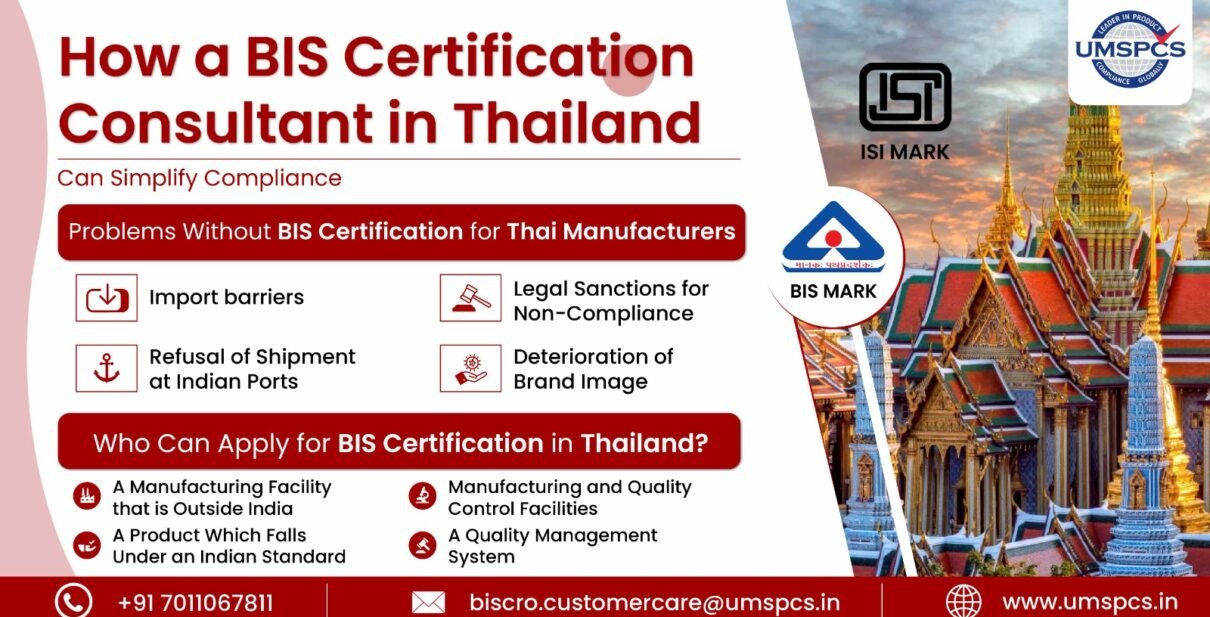
If your product does not have valid BIS certification, you might run into the following problems:
- Import barriers
- Refusal of shipment at Indian ports
- Legal sanctions for non-compliance
- Higher logistics expenses
- Loss of commercial prospects with Indian buyers
- Deterioration of brand image
Working with a BIS Certification Consultant in Thailand will help manufacturers make sure that all regulatory requirements are complied with prior to shipment.
Who Can Apply for BIS Certification in Thailand?
BIS Certification for Foreign Manufacturers is granted solely to the manufacturer, and no other parties can apply for it if they do not own the manufacturing facility themselves.
For a manufacturer to be eligible to get this license, they will need to have:
- A manufacturing facility that is outside India
- A product which falls under an Indian Standard
- Manufacturing and quality control facilities
- Ability to test their product or have some kind of an agreement regarding testing
- A quality management system
- Authorized Indian representative (AIR) to help the foreign manufacturer interact with BIS if applicable.
UMSPCS helps the companies assess their eligibility and prepare all the paperwork before the submission of the application.
Why Hiring a BIS Certification Consultant in Thailand Makes a Difference
However, getting a BIS Certification is more than applying for it. It is a process of determining the right standards, preparing technical documents, conducting product tests, carrying out factory inspections, responding to BIS queries, and ensuring compliance with continuous regulatory needs.
At UMSPCS, we assist you in all of the above processes of obtaining BIS certification by:
- Assessment of product suitability for BIS regulations
- Determination of the right Indian standard and QCO
- Preparation and review of technical documents
- Conducting product testing at the certified laboratories
- Facilitating factory inspection preparation
- Facilitating communications with BIS
- Appointment and management of Authorized Indian Representative (AIR)
- Solution of technical observations made during the application process
- Getting help in license granting, renewing and surveillance
Our systematic approach will help reduce risks of non-compliance, shorten the process of obtaining certification, and allow companies to enter the Indian market.
Step-by-Step Process for Obtaining BIS Certification in Thailand
Certification of foreign companies for BIS certification requires passing through several technical and regulatory stages. At UMSPCS, we have a systematic way to assist manufacturers in completing each stage successfully.
Step 1: Application Filing
The first step consists of filing an application, along with necessary documentation and fees.
Involves:
- Application filing
- Documentation
- Fees
- Scrubbing of BIS application
Step 2: Resolving BIS Queries
BIS examines the application and might put forward queries regarding documents or technical requirements that need to be answered quickly.
Involves:
- Scrubbing of BIS observations
- Response filing
- Additional documentation (if any)
Step 3: Factory Visit
BIS visits the manufacturing unit in the overseas country to ensure that it follows the appropriate process and has the right quality control mechanism.
Includes:
- Overseas manufacturing unit visit
- Process examination
- Quality control examination
- Test facilities examination
Step 4: Testing of Products
During the factory visit, the BIS officials draw samples from products for testing at the BIS-recognized laboratory.
Includes:
- Sampling
- Testing at BIS laboratory
- Filing test report
Step 5: Issue of BIS License
Following the evaluation process, BIS issues the license, thus enabling the manufacturer to avail himself of the ISI mark.
Consists of:
- Approval of application
- Payment of license fee and marking fee
- Issue of BIS license
Step 6: Indemnity Bond and PBG
A foreign manufacturer needs to go through some legal and financial formalities before issuing the license.
Consists of:
- Indemnity bond by Authorized Indian Representative (AIR)
- Deposit of USD 10,000 Performance Bank Guarantee (PBG)
- Final compliance verification
Documents Required for BIS Certification in Thailand
Documentation requirements can vary according to the product and Indian Standard. However, some of the common documents that may be required for certification are:
- Basic details of the manufacturing facility and category of the product
- Test report from an authorized laboratory based on the Indian Standard of BIS/NABL
- Proof of ownership of the manufacturing facility (Ownership document, Utility Bills, etc.)
- Trademark Certificate
- Licenses / Approval from statutory bodies
- Drawings of the Product Design/Schematic
- Capacity of the manufacturing facility
- Details of raw material being used
- Details of manufacturing machines
- Manufacturing Process Flow Diagram
- Details of packaging method/ type and Packaging Process
- List of test equipment with their calibration present at the manufacturing facility
- Details of Quality Control staff
- Substandard Product Disposal procedure
- Manufacturing facility layout
- Organizational Structure of the Manufacturing facility
Documents for Foreign manufacturers
- Letter of Appointment of Authorized Indian Representative (AIR)
- Documents of overseas manufacturing facility (layout, Machines and Quality Control set-up)
- Undertaking and Affidavit in line with the BIS format
At UMSPCS, we ensure thorough document scrutiny prior to submission so that there is less possibility of queries/rejection of the application.
Applicable Testing Requirements for BIS Certification in Thailand
Testing is an essential part of the BIS certification process. This is because the product needs to meet the relevant Indian Standard in order to prove its quality and performance.
Depending on the type of product, some tests conducted by BIS include:
- Testing of mechanical strength
- Analysis of chemical composition
- Testing for electrical safety
- Insulation resistance testing
- Testing of performance
- Testing of dimensions
- Endurance testing
- Fire resistance testing
- Pressure testing
- Material testing
Because different products need different types of tests to be carried out, the help of UMSPCS will ensure that you conduct the right tests through relevant laboratories.
Role of the Authorized Indian Representative (AIR)
The Authorized Indian Representative (AIR) assumes a very important position in the FMCS program. This is the person who is appointed to act as a representative on behalf of the foreign manufacturer to BIS.
Functions of the AIR
- Interaction with BIS officials
- Receipt of communications from BIS
- Inspection and certification activities support
- Compliance assistance
- Acting as a representative for the manufacturer in India when necessary
Where the manufacturer lacks an eligible AIR, then UMSPCS can assist in appointing an AIR according to BIS regulations.
Costing & Timeline for BIS Certification in Thailand
There is no set cost for BIS certification since every product has its own criteria of compliance. The total cost involved depends upon many aspects such as:
- Product type
- Number of factories
- Laboratory testing costs
- Factory inspection costs
- Government fees for application and licensing
- AIR-related costs
| Particulars | Estimated Cost (Dollar) |
| Application Fees (BIS) | $12.00 |
| Per Diem Expenses for Bis Officers- 3 Days | $900.00 |
| Charges for the Visit | $466.66 |
| Contingency Funds | $111.11 |
| Bis Charges- Travel/Visa etc. -Estimate | $2173.00 |
| Marking Fee (Min.) | $2744.00 |
| Sample Testing | $400 to $3000 |
| Total Bis Cost | $6850.77 to $10000.77 |
At UMSPCS, we offer you a clear product-wise cost estimate for BIS certification. This will give you clarity about the cost involved before embarking on the process of certification.
The time frame for BIS certification varies according to the complexities of the product, testing, inspection, and BIS approval. Our experts keep a close watch on the entire process, and it usually takes around 5-6 months to be completed.
Common Challenges Faced by Foreign Manufacturers
Many foreign manufacturing companies face several issues while going through the BIS certification process, which include the following:
- Determining the proper Indian Standard
- Interpretation of relevant Quality Control Orders
- Production of technically correct documents
- Arrangement for product testing
- Communication problems
- Factory inspection preparation
- Submission delays due to incomplete submission
- Handling technical observations of BIS
- Handling regulatory changes
All these issues may be handled smoothly with professional help from UMSPCS.
Why Choose UMSPCS as Your BIS Certification Consultant in Thailand?
We at UMSPCS believe that effective certification entails not only documentation but technical expertise and regulatory knowledge, along with continuous support. The experts at UMSPCS have been assisting manufacturers to get BIS certification for more than 6 years now and have handled products in over 600 product categories.
By partnering with UMSPCS, you get:
- Assessment of BIS applicability of products
- Guidance on Indian Standards & QCOs
- Documentation
- Product testing coordination
- Inspection of factory
- AIRC appointment assistance
- Immediate rectification of BIS observations
- Project management
- Grant of BIS License and other support
Regardless of whether you are looking for BIS Certification of Foreign Manufacturers, BIS ISI Certification of Indian Manufacturers or any BIS Certification in Thailand, UMSPCS Compliance Professionals will make your journey smooth and trouble-free.
Conclusion
Entry into the Indian market holds tremendous potential for growth, but adherence to BIS regulations can get very tricky without professional help. Whether it is determining the right Indian standard, handling testing and documentation, undergoing inspection at the factory, and coordinating with the BIS, everything needs to be done with utmost accuracy.
At UMSPCS, we believe in making this process as simple as possible for companies around the globe. With the help of our skilled consultants, we facilitate easy acquisition of BIS certification for businesses.
Planning to export your goods from Thailand to India?
Get in touch with UMSPCS today for professional services from a BIS Certification Consultant in Thailand.
Read more about BIS Certification Consultant in Ireland.
FAQs
- Why do I need to hire a BIS Certification Consultant in Thailand?
A consultant would help the manufacturer understand BIS norms, prepare documentation, conduct tests, conduct inspections and certify the product.
- Do I need BIS certification for all my exported products from Thailand?
No, you need BIS certification only for those products which come under respective Quality Control Orders (QCOs) issued by the Government of India.
- Can I certify my products in Thailand as a foreign manufacturer?
Yes, a foreign producer can get its products certified under the Foreign Manufacturer’s Certification Scheme (FMCS).
- What is the role of Authorised Indian Representative (AIR) for a Thai manufacturer?
The AIR is a representative of a foreign producer in India, who deals with BIS in respect of BIS certifications.
- How much time does it take to obtain a BIS certificate in Thailand?
Time taken depends upon the product group, testing method, documentation, and schedule of BIS inspection.
- What are the main expenses for getting BIS certification in Thailand?
The total expenses vary from case to case and include government charges, testing costs, inspection expenses, consultant fees, costs related to AIR, etc.
❓ Ask a Question
Have any doubts? Fill the form below and our team will respond shortly.